
GMKtec EVO-X3 AMD Ryzen™ AI Max+ 395


$3,949.99
 Amazon.com
| Processor | 9.7 |
|---|---|
| RAM | 9.8 |
| Hard Disk | 9 |
| Connectivity | 8 |
GMKtec EVO-X3 — AI workstation mini PC with AMD Ryzen™ AI Max+ 395 (Strix Halo, Zen 5). 16 cores / 32 threads up to 5.1 GHz. AMD Radeon™ 8060S — 40 RDNA 3.5 Compute Units — up to 96 GB shared VRAM. XDNA 2 NPU 50 TOPS — up to 126 TOPS total — Copilot+ PC capable. 128 GB LPDDR5X 8000 MT/s — SOLDERED — non-upgradeable. 2 TB / 4 TB PCIe 4.0 SSD — 2× M.2 2280 PCIe 4.0 ×4 — up to 16 TB. OCuLink PCIe Gen4 ×4 for external GPUs (no hot-plug). HDMI 2.1 + USB4 — dual display up to 8K. Wi-Fi 7 + Bluetooth 5.4. 2.5 GbE Ethernet. Three power modes: 54 W / 85 W / 140 W peak. 3 heat pipes + large dual fans. Full-metal vertical chassis 353 × 186 × 41 mm — approx. 2.3 kg. Windows 11 Pro.

$3,949.99
GMKtec EVO-X3 AMD Ryzen™ AI Max+ 395 Prices

Price History
Description
GMKtec EVO-X3
AI Workstation Mini PC — AMD Ryzen™ AI Max+ 395 (Strix Halo) with 128 GB and OCuLink
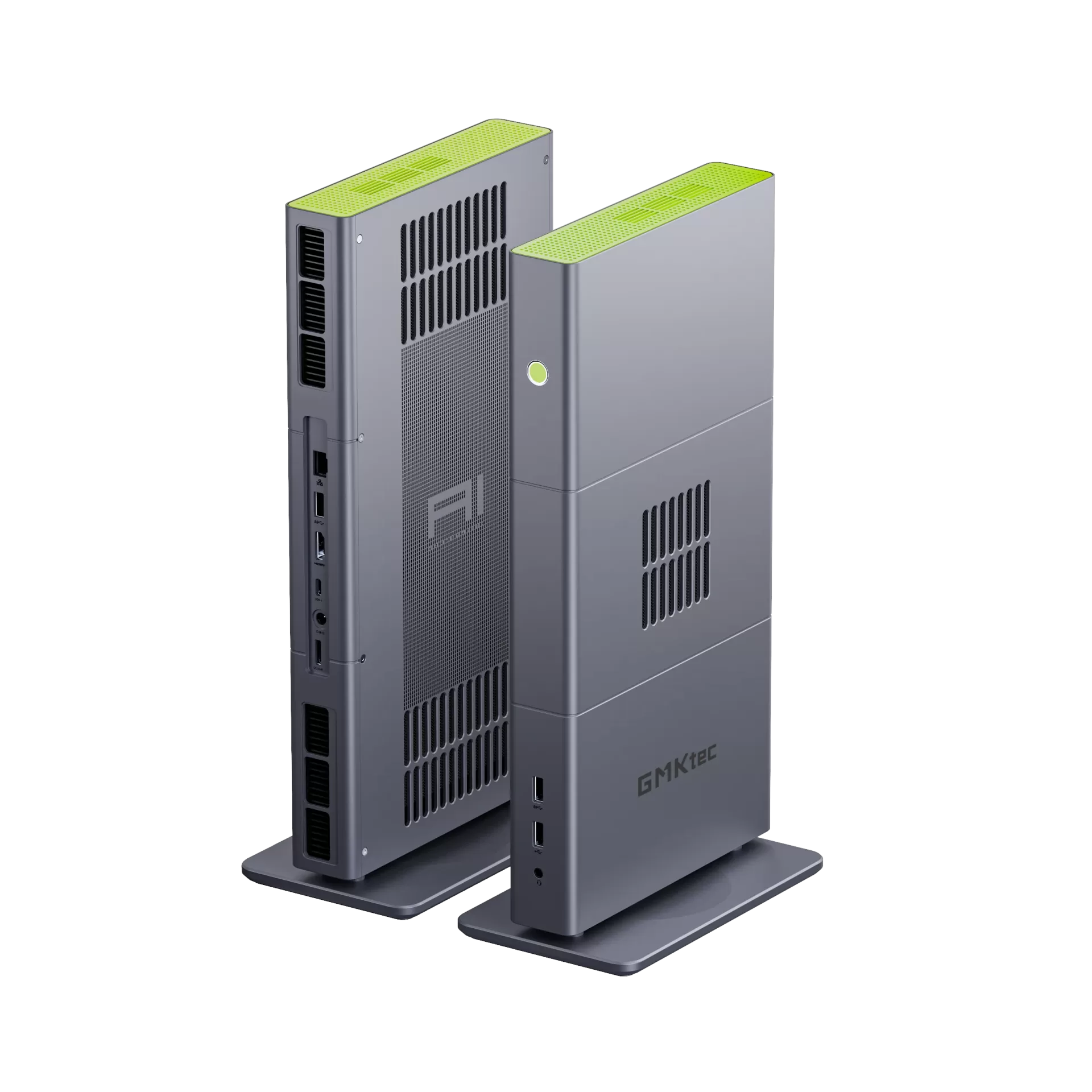
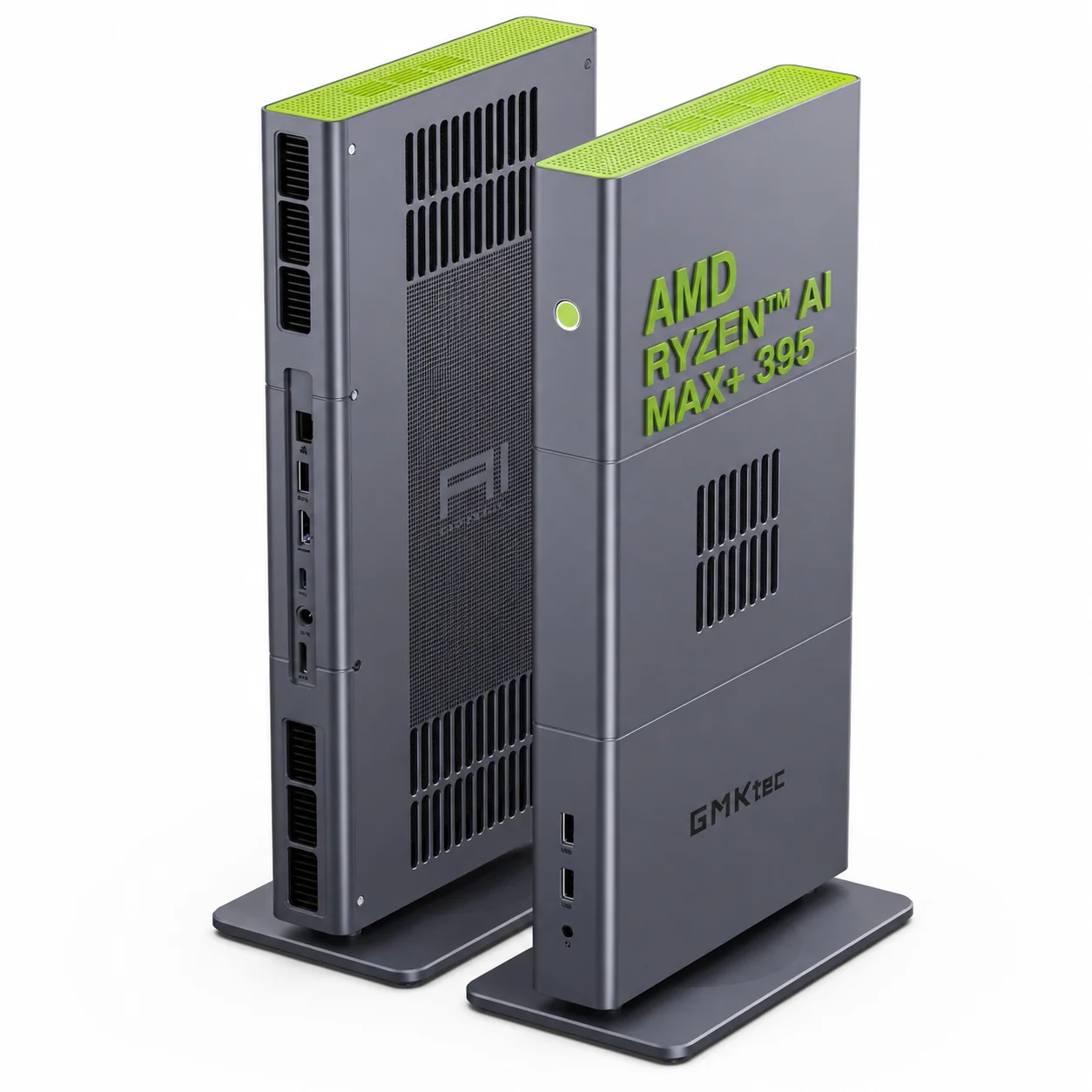
The GMKtec EVO-X3 was released globally on June 29, 2026, as the successor to the EVO-X2 and as the new flagship of the GMKtec catalogue. It keeps the same processor family — the AMD Ryzen™ AI Max+ 395, the fully enabled top model of the Strix Halo generation — but places it inside a completely different chassis: a tall, slim, full-metal tower that stands vertically on its own base, measures 353 × 186 × 41 mm and weighs approximately 2.3 kg. The new enclosure exists for one reason: to give the 16-core processor and its 40-Compute-Unit integrated GPU a cooling system large enough to sustain 115 W continuously, with peaks of 140 W, while remaining quiet.
Three elements define the EVO-X3 against the previous model and against most other Strix Halo mini PCs. The first is memory: every configuration ships with 128 GB of LPDDR5X at 8000 MT/s, of which up to 96 GB can be assigned to the graphics processor, which is the configuration required to load large language models locally. The second is a native OCuLink port (PCIe Gen4 ×4) on the rear panel for external desktop graphics cards, a connector that is rare in machines built on this processor. The third is a set of three selectable power modes — 54 W, 85 W and 140 W peak — that the EVO-X2 did not offer. This page documents every hardware area of the machine in detail.
| GMKtec EVO-X3 — AMD Ryzen™ AI Max+ 395 | |
|---|---|
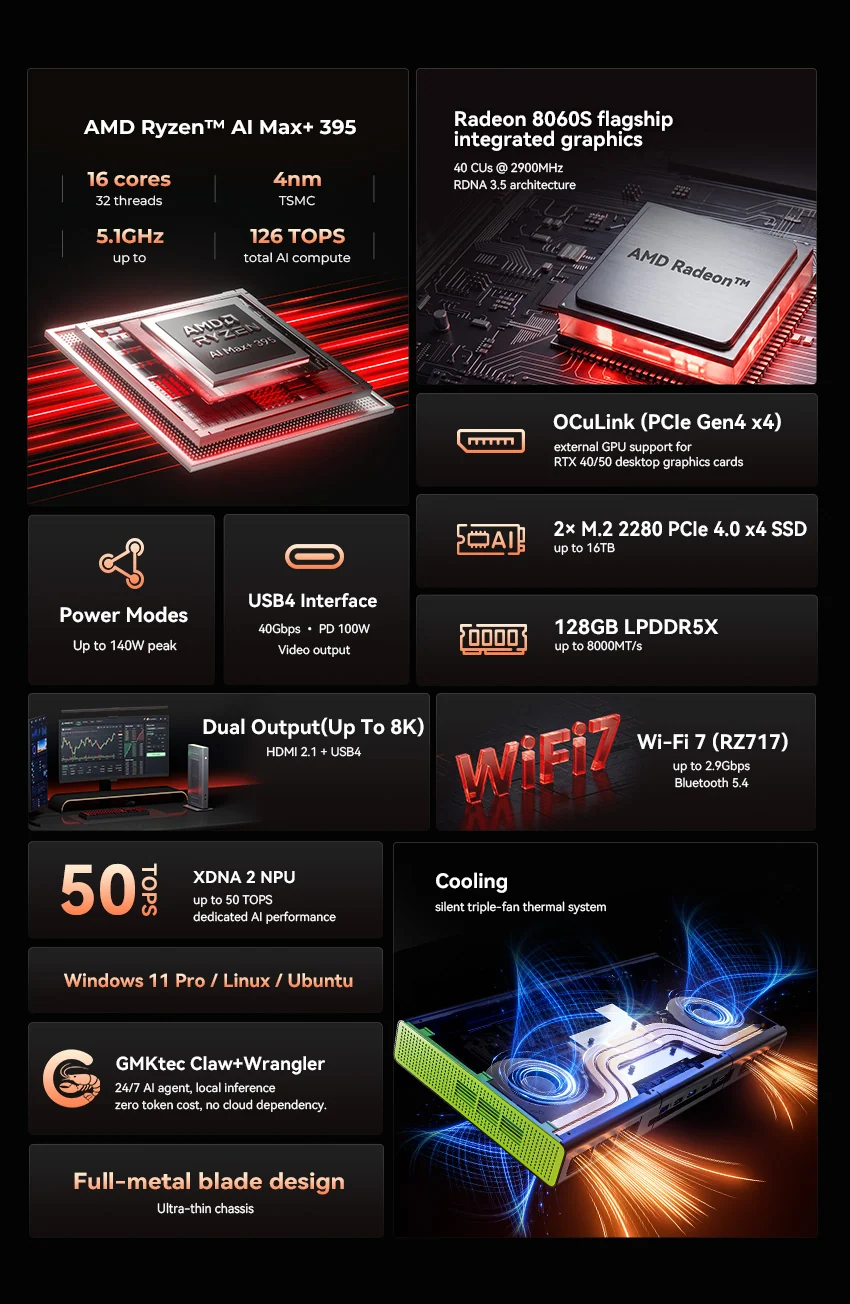
| CPU | AMD Ryzen™ AI Max+ 395 (Strix Halo — Zen 5) — 3.0 GHz base, up to 5.1 GHz boost — 16 Cores / 32 Threads — 80 MB cache (L2: 16 MB + L3: 64 MB) — TSMC 4 nm — NPU: Yes (XDNA 2) |
| GPU | AMD Radeon™ 8060S (integrated) — RDNA 3.5 — 40 Compute Units — up to 2900 MHz — up to 96 GB of the unified memory assignable as VRAM — AVC / HEVC / VP9 / AV1 hardware codecs |
| AI Engine | AMD XDNA 2 NPU — 50 TOPS — up to 126 TOPS total platform AI performance (CPU + GPU + NPU) — Copilot+ PC capable |
| Memory | 128 GB LPDDR5X 8000 MT/s (8× 16 GB, onboard) — SOLDERED — non-upgradeable — 128 GB maximum |
| Storage | 2 TB or 4 TB M.2 2280 PCIe 4.0 ×4 NVMe SSD (depending on configuration) |
| Storage Expansion | 2× M.2 2280 PCIe 4.0 ×4 NVMe slots in total (1 free) — up to 16 TB (2× 8 TB) |
| Wireless Connectivity | Wi-Fi 7 (802.11be, MediaTek MT7925 / RZ717 — up to 2.9 Gbps theoretical, 160 MHz channels) + Bluetooth 5.4 |
| Ethernet | 1× RJ45 2.5 Gigabit Ethernet (Realtek RTL8125BG) |
| Video Output | 1× HDMI 2.1 (8K@60Hz) + 1× USB4 Type-C (DisplayPort Alt Mode) — dual display, up to 8K |
| Audio Output | 1× 3.5 mm combo audio jack (front) — digital audio over HDMI / USB4 |
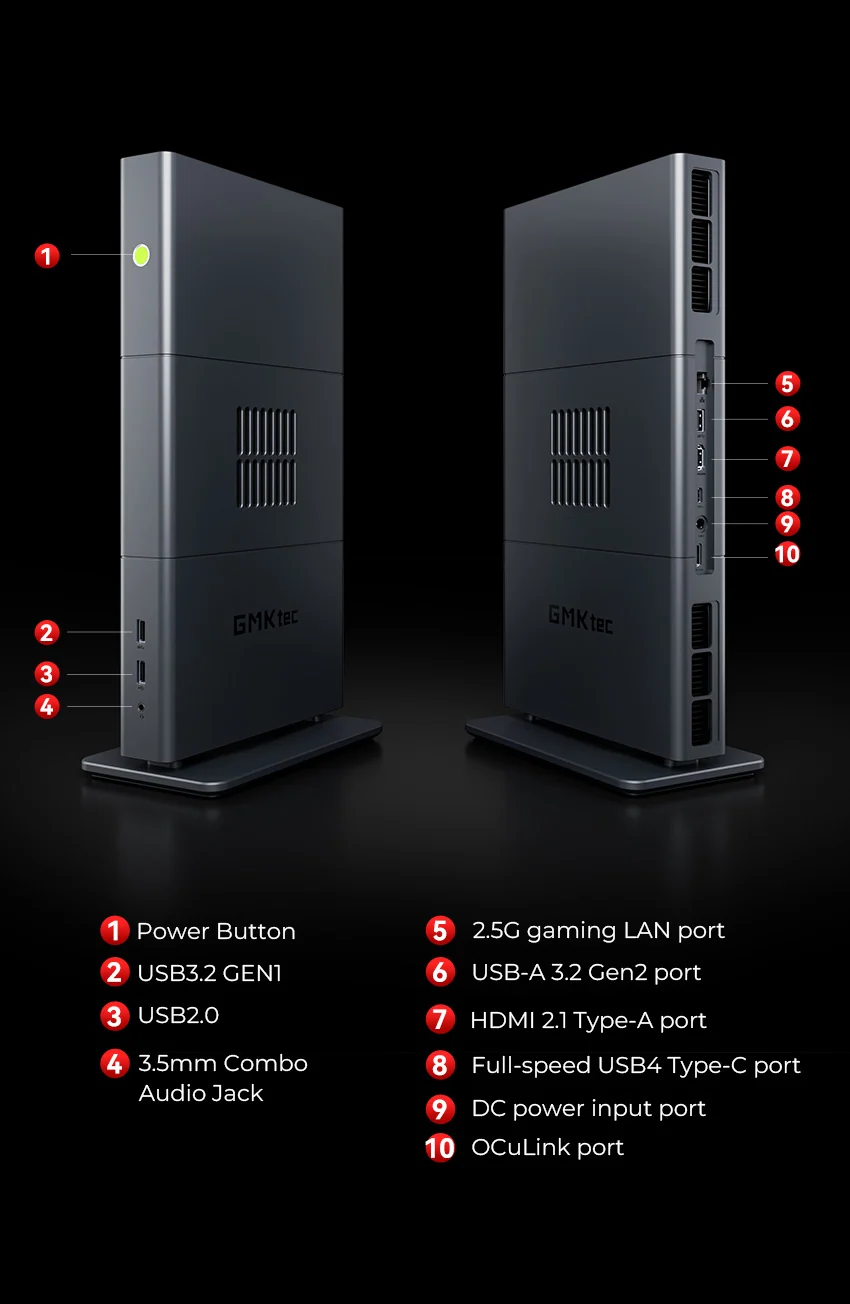
| Ports & Buttons | Front: 1× USB-A 3.2 Gen1 (5 Gbps), 1× USB-A 2.0 (480 Mbps), 1× 3.5 mm combo jack, power button with LED · Rear: 1× USB4 Type-C (40 Gbps / display / PD), 1× USB-A 3.2 Gen2 (10 Gbps), 1× HDMI 2.1, 1× OCuLink (PCIe Gen4 ×4 — no hot-plug), 1× 2.5G RJ45, 1× DC-in (5.5 × 2.5 mm) |
| Performance Modes | Silent 54 W · Balanced 85 W (default) · Performance 115 W sustained, up to 140 W peak |
| System | Windows 11 Pro (pre-installed) — Linux / Ubuntu supported |
| Product Dimension | 353 × 186 × 41 mm (without stand) — approx. 2.3 kg |
| Power | External power adapter DC 19.5 V / 11.8 A (230 W) — 5.5 × 2.5 mm barrel connector |
Processor — AMD Ryzen™ AI Max+ 395: 16 Zen 5 Cores, Up to 5.1 GHz
The AMD Ryzen™ AI Max+ 395 is the highest model of the Ryzen AI Max 300 series. It integrates 16 full Zen 5 cores with 32 threads, a 3.0 GHz base frequency, a maximum boost frequency of 5.1 GHz, 16 MB of L2 cache and 64 MB of L3 cache, and it is manufactured on TSMC’s 4 nm FinFET process. Unlike the Ryzen AI 9 HX 370 / HX 470 family, which mixes full-size and compact cores, all 16 cores here are full Zen 5 cores, and the chip is paired with a much larger graphics block and a 256-bit memory interface.
Key processor data:
- 16 Cores / 32 Threads — Zen 5 architecture (Strix Halo)
- 3.0 GHz base frequency — up to 5.1 GHz maximum boost
- 16 MB L2 + 64 MB L3 cache
- TSMC 4 nm FinFET process
- Integrated XDNA 2 NPU — 50 TOPS
- Processor launched in January 2025; EVO-X3 launched in June 2026
In the Performance mode, reference measurements for this machine are around 1,890 points in Cinebench R24 multi-core and 114 points single-core, about 7,800 points in Cinebench 2026 multi-core, and approximately 3,080 / 22,300 points in Geekbench 6 single-core / multi-core (approximate values; results vary with the selected power mode, firmware and ambient temperature). The machine leaves the factory in Balanced mode (85 W), in which multi-core results are slightly lower than those of the EVO-X2, which always ran at its maximum power level.

Performance Modes — 54 W, 85 W and 140 W Peak
The EVO-X3 exposes three power profiles in its firmware. Silent mode holds the processor at a stable 54 W. Balanced mode, the factory default, sets 85 W. Performance mode sustains 115 W and allows peaks of up to 140 W. The profile determines the heat generated and therefore the fan speed, so it is the main control over the noise level of the machine. The firmware also includes a manual fan curve and the setting that defines how much of the unified memory is reserved for graphics (up to 96 GB).

Graphics — AMD Radeon™ 8060S: 40 Compute Units, RDNA 3.5
The integrated AMD Radeon™ 8060S is the largest integrated GPU currently available in an x86 processor: 40 Compute Units on the RDNA 3.5 architecture, with a maximum frequency of 2900 MHz. It does not have dedicated video memory; it uses the unified LPDDR5X pool, of which up to 96 GB can be assigned as VRAM. It supports hardware decoding and encoding of AVC, HEVC, VP9 and AV1.
In 3DMark Time Spy the reference result for this machine is approximately 11,390 points. At 2560 × 1440, reference figures are around 74 fps in Cyberpunk 2077 with FSR in Quality mode and around 83 fps in Black Myth: Wukong (approximate values, dependent on settings and driver version). GMKtec’s own figures at 1080p High are 134 fps in Delta Force, 73 fps in Black Myth: Wukong, 155 fps in Cyberpunk 2077 and 247 fps in League of Legends (manufacturer data; upscaling settings not specified).


AI Engine — XDNA 2 NPU, 126 TOPS and Local LLMs
The processor includes the AMD XDNA 2 neural processing unit, rated at 50 TOPS, which exceeds the 40 TOPS required for Copilot+ PC features in Windows 11. The total AI performance of the platform, adding CPU, GPU and NPU, is stated at up to 126 TOPS. The NPU handles tasks such as background noise suppression, camera effects and live captions without loading the CPU or GPU.
For large language models, the determining factor is memory. With 128 GB of unified memory and up to 96 GB assignable to the GPU, the EVO-X3 can load models of 70 billion parameters and larger, which do not fit in the 16–24 GB of a consumer graphics card. In a reference test with the 14-billion-parameter Phi-4 reasoning model the machine generated about 24.7 tokens per second with a time to first token of about 1.46 seconds. GMKtec publishes its own figures for larger models, for example approximately 45 tokens per second with gpt-oss-120b (Q4_K_M) and approximately 11 tokens per second with Qwen3-235B (manufacturer data, approximate). During LLM inference the power drawn from the wall is normally 100 W or less.


GMKtec Claw + Wrangler — Local AI Software
The EVO-X3 is supplied with GMKtec’s own local AI environment, composed of Claw and Wrangler. Claw works as a local AI model manager and assistant that runs on the machine without sending data to external servers, with functions for productivity tasks, data analysis and remote control through messaging channels. The suite is optional: the machine is a standard Windows 11 Pro PC and is also compatible with LM Studio, Ollama, llama.cpp and other common tools, as well as with Linux distributions.

Memory and Storage — 128 GB LPDDR5X-8000, Two M.2 Slots up to 16 TB
Memory is 128 GB of LPDDR5X at 8000 MT/s, built from eight 16 GB modules mounted directly on the motherboard. It is SOLDERED — non-upgradeable, and 128 GB is both the installed and the maximum capacity. The memory is shared between the processor, the graphics and the NPU.
Storage uses two M.2 2280 slots, both PCIe 4.0 ×4 NVMe. One holds the factory SSD (2 TB or 4 TB depending on the configuration purchased) and the second is free. The maximum supported capacity is 16 TB (2× 8 TB). There is no SATA bay and no card reader.

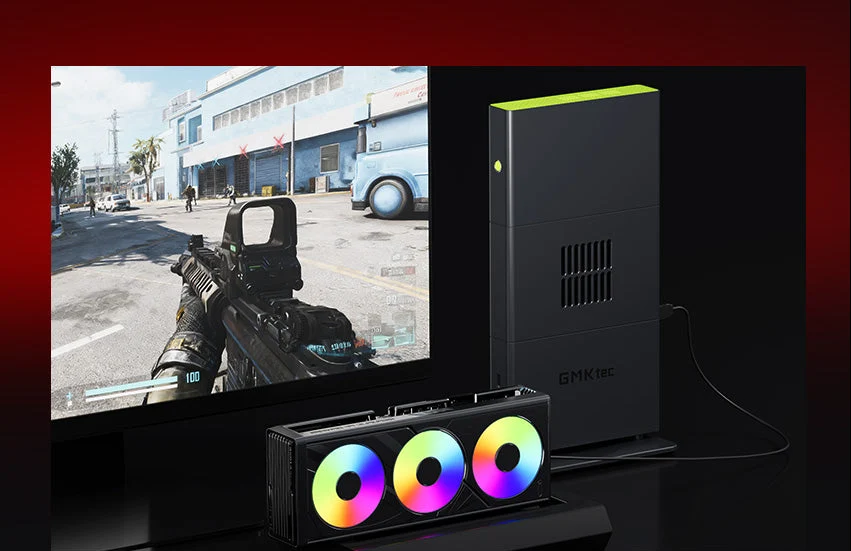
OCuLink — External Graphics over PCIe Gen4 ×4
The rear panel includes one OCuLink port wired to four PCIe Gen4 lanes of the processor. It is intended for external GPU docks with desktop graphics cards (dock and card not included) and offers a direct PCIe link, without the protocol overhead of USB4 enclosures. OCuLink on this machine does not support hot-plug: the computer must be switched off before connecting or disconnecting the cable, as doing so while powered can damage the motherboard.
Connectivity — Wi-Fi 7, 2.5 GbE, USB4 and HDMI 2.1
Wireless connectivity is provided by a MediaTek MT7925 (RZ717) module with Wi-Fi 7 (802.11be) and Bluetooth 5.4, with a theoretical maximum of 2.9 Gbps and 160 MHz channels. Wired networking consists of one 2.5 Gigabit Ethernet port with a Realtek RTL8125BG controller.
Video output is limited to two connectors: one HDMI 2.1 (8K@60Hz) and one USB4 Type-C with DisplayPort Alt Mode, for a maximum of two displays. The front panel has one USB-A 3.2 Gen1 (5 Gbps), one USB-A 2.0, the 3.5 mm combo audio jack and the power button with LED. The rear panel has the USB4 Type-C port (40 Gbps, display and Power Delivery), one USB-A 3.2 Gen2 (10 Gbps), HDMI 2.1, OCuLink, the 2.5G RJ45 and the DC input. In total there are three USB-A ports and one USB-C. There is no DisplayPort connector, no SD card reader and no second Ethernet port.

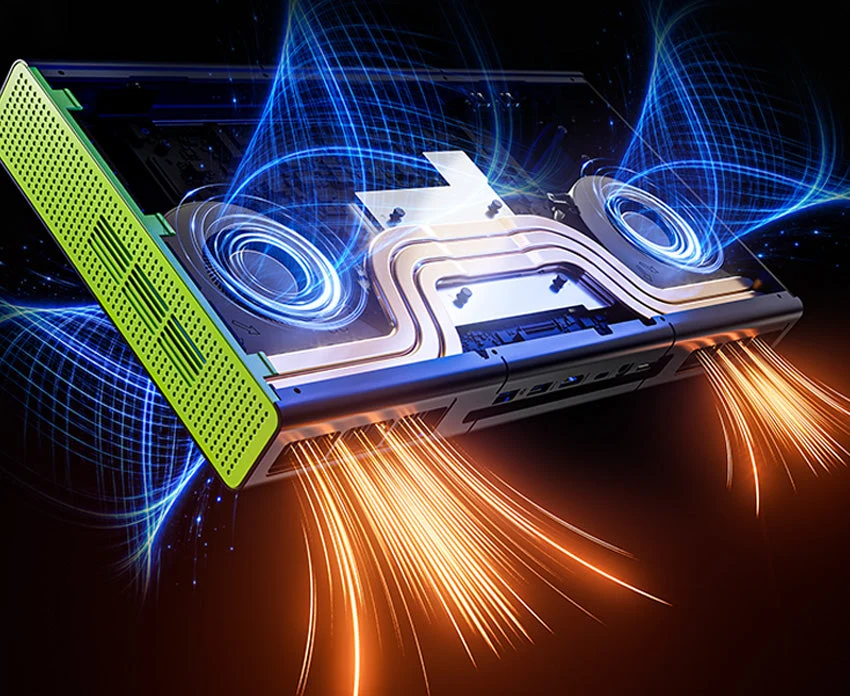
Cooling — Three Heat Pipes and Large Dual Fans in a Vertical Chassis
The vertical chassis is built around the cooling system. GMKtec specifies three heat pipes and two oversized fans covering the full processor area; part of the launch material mentions three fans, so the exact fan count is not fully confirmed. Both large side panels are ventilated and include a dust filter mesh, and the heatsinks are visible through the rear grille. The stand keeps the machine upright so that both sides can take in air.
Reference temperature measurements are approximately 66 °C on the processor during 1440p gaming and a maximum of about 83 °C in CPU stress tests (approximate values). Power consumption at the wall is about 11 W at idle, about 18 W during 4K video playback, about 147 W during AAA gaming in Performance mode, and between 160 and 180 W at absolute peak with CPU and GPU fully loaded (approximate values). In Silent and Balanced modes the fans are barely audible; airflow becomes audible above roughly 100 W.
Design and Build
The enclosure is machined metal in grey with green accents, in a format GMKtec calls a full-metal blade design. It is 41 mm thick and is used vertically on the included stand (supplied with screws and rubber feet). The machine is powered by an external 230 W adapter (19.5 V / 11.8 A). Information on VESA mounting is contradictory between sources and is therefore not confirmed.
Operating System
Windows 11 Pro is pre-installed. GMKtec also lists Linux / Ubuntu as supported, and the AMD platform is compatible with current Linux kernels and with SteamOS-type distributions.
Who Is the EVO-X3 For?
The EVO-X3 is designed for users who run large AI models locally and need the maximum unified memory, for developers and creators who work with heavy multi-threaded loads, and for users who want the option of adding a desktop graphics card through OCuLink at a later date. It is not the appropriate machine for users who need many USB ports, more than two displays without adapters, 10 Gigabit Ethernet, a card reader or upgradeable memory, nor for those looking for the lowest price for this processor: the EVO-X3 is priced from approximately $3,799.99 / €3,599.99 with 2 TB (prices approximate and subject to change).
Disclaimer: The specifications, features, prices and availability shown on this page are provided for information purposes only. They may contain errors or change without notice. Please always check them on the manufacturer's official product page before buying.
Additional information
Specification: GMKtec EVO-X3 AMD Ryzen™ AI Max+ 395
| Configuration Options | ||||||||||||||||||||
|---|---|---|---|---|---|---|---|---|---|---|---|---|---|---|---|---|---|---|---|---|
|
||||||||||||||||||||
| AI Capabilities | ||||||||||||||||||||
|
||||||||||||||||||||
| Processor | ||||||||||||||||||||
|
||||||||||||||||||||
| Ports | ||||||||||||||||||||
|
||||||||||||||||||||
| Network | ||||||||||||||||||||
|
||||||||||||||||||||
| GPU | ||||||||||||||||||||
|
||||||||||||||||||||
| Internal Ports | ||||||||||||||||||||
|
||||||||||||||||||||
| Storage & RAM | ||||||||||||||||||||
|
||||||||||||||||||||
| Power | ||||||||||||||||||||
|
||||||||||||||||||||
| Others Specifications | ||||||||||||||||||||
|
||||||||||||||||||||
| Specification | ||||||||||||||||||||
|
||||||||||||||||||||


There are no reviews yet.