
Bosgame M5 AI Mini Desktop AMD Ryzen™ AI 9 Max+ 395


 Amazon.com
| Processor | 9.8 |
|---|---|
| RAM | 9.5 |
| Hard Disk | 9 |
| Connectivity | 9.2 |
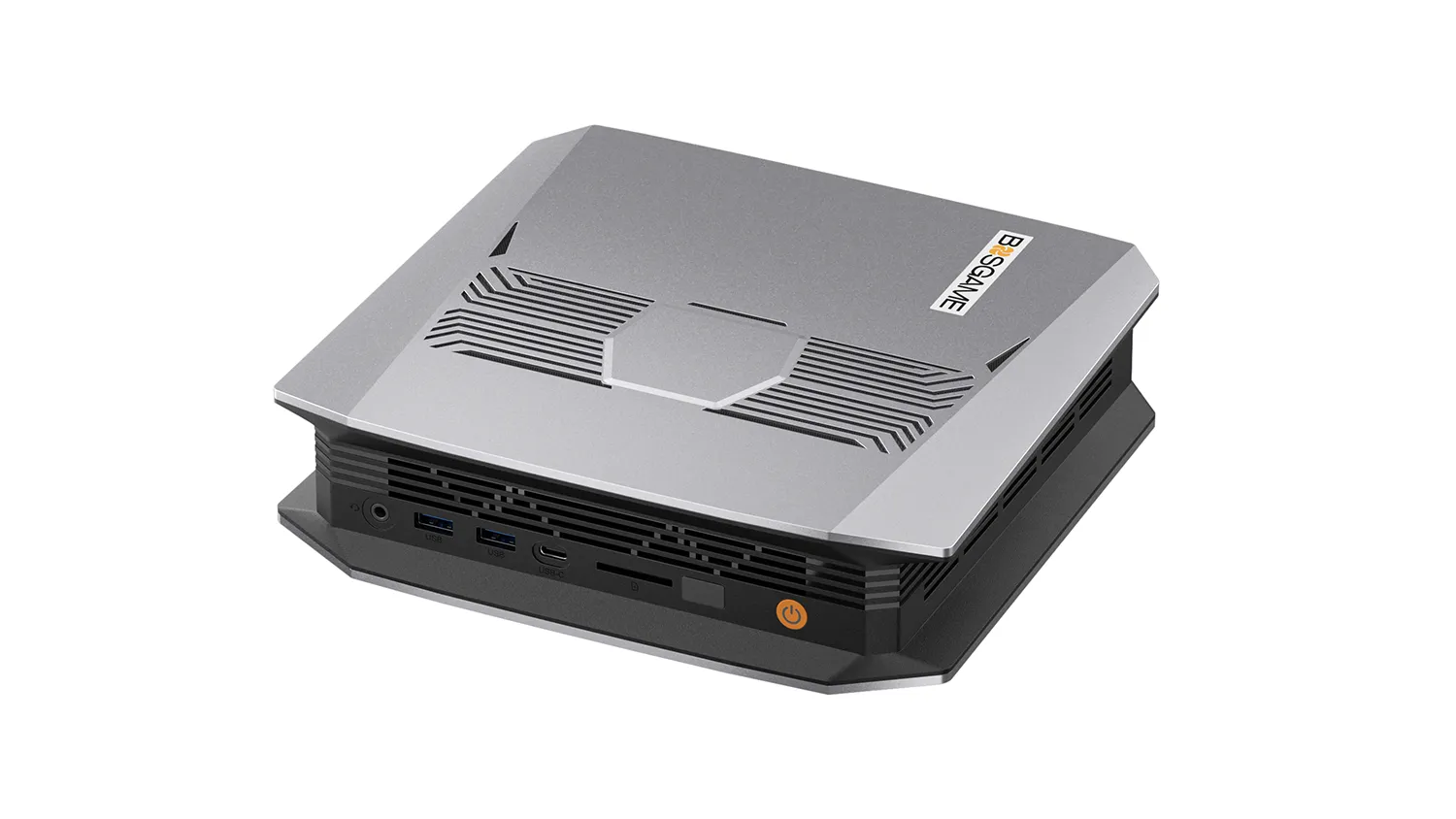
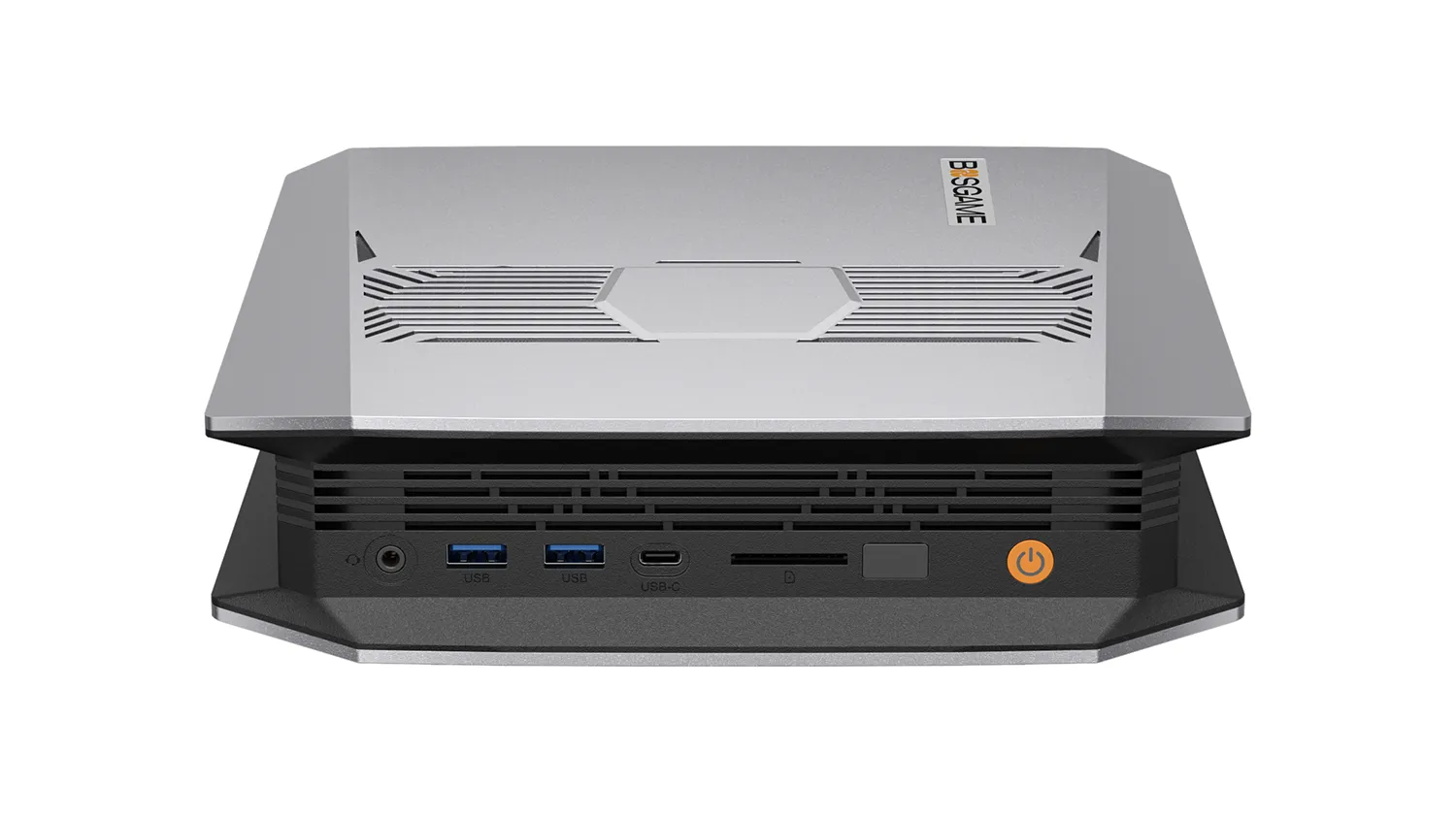
AMD Ryzen™ AI Max+ 395 (Strix Halo) AI Mini PC. 16 Zen 5 cores / 32 threads up to 5.1 GHz. AMD Radeon™ 8060S — 40 RDNA 3.5 CUs, up to 96 GB shared VRAM. XDNA 2 NPU — 50 TOPS. 126 TOPS total AI performance. Up to 128 GB LPDDR5X-8000 (soldered — non-upgradeable). Dual M.2 PCIe 4.0. Quad display (HDMI 2.1 + 3× DP + 2× USB4). 2× Thunderbolt + 1× Docking Station Port. 1× 2.5 GbE. Wi-Fi 7 + BT 5.4. Three performance modes. RGB ambient lighting. Vertical aluminium stand included. 220.8 × 199.5 × 57.1 mm. ~1.3 kg.

Bosgame M5 AI Mini Desktop AMD Ryzen™ AI 9 Max+ 395 Prices

Price History
| Price history for BOSGAME AI MAX+ 395 Desktop Gaming PC, 128GB LPDDR5x 8000MHz, 2TB PCIe 4.0 2280 SSD, Triple 8K Display, Wi-FI 7, BT 5.4, Radeon 8060S 2900Mhz iGPU | |
|---|---|
|
Latest updates:
|
|
Description
Bosgame M5
AI Mini Desktop — AMD Ryzen™ AI 9 Max+ 395 (Strix Halo)
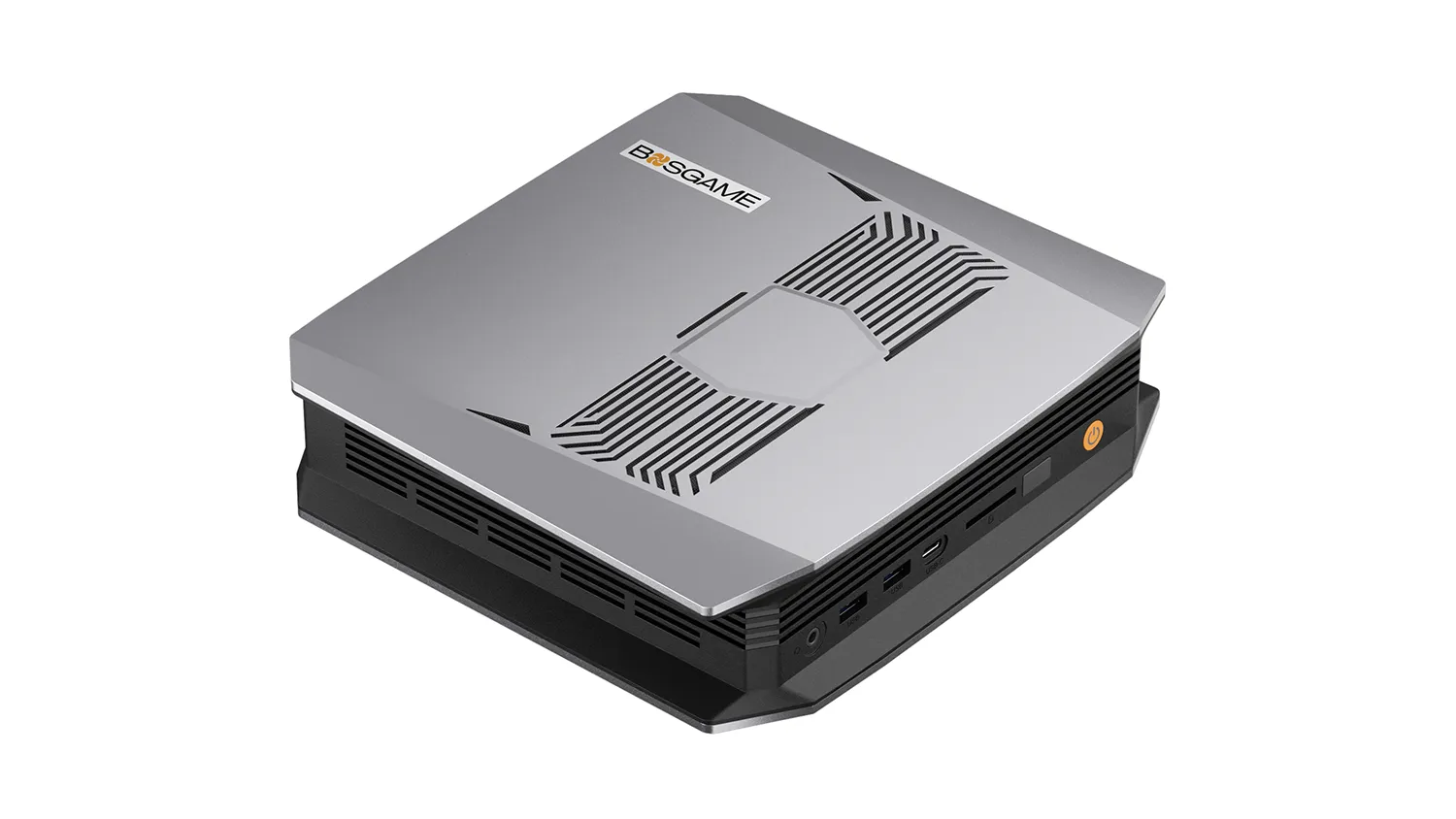
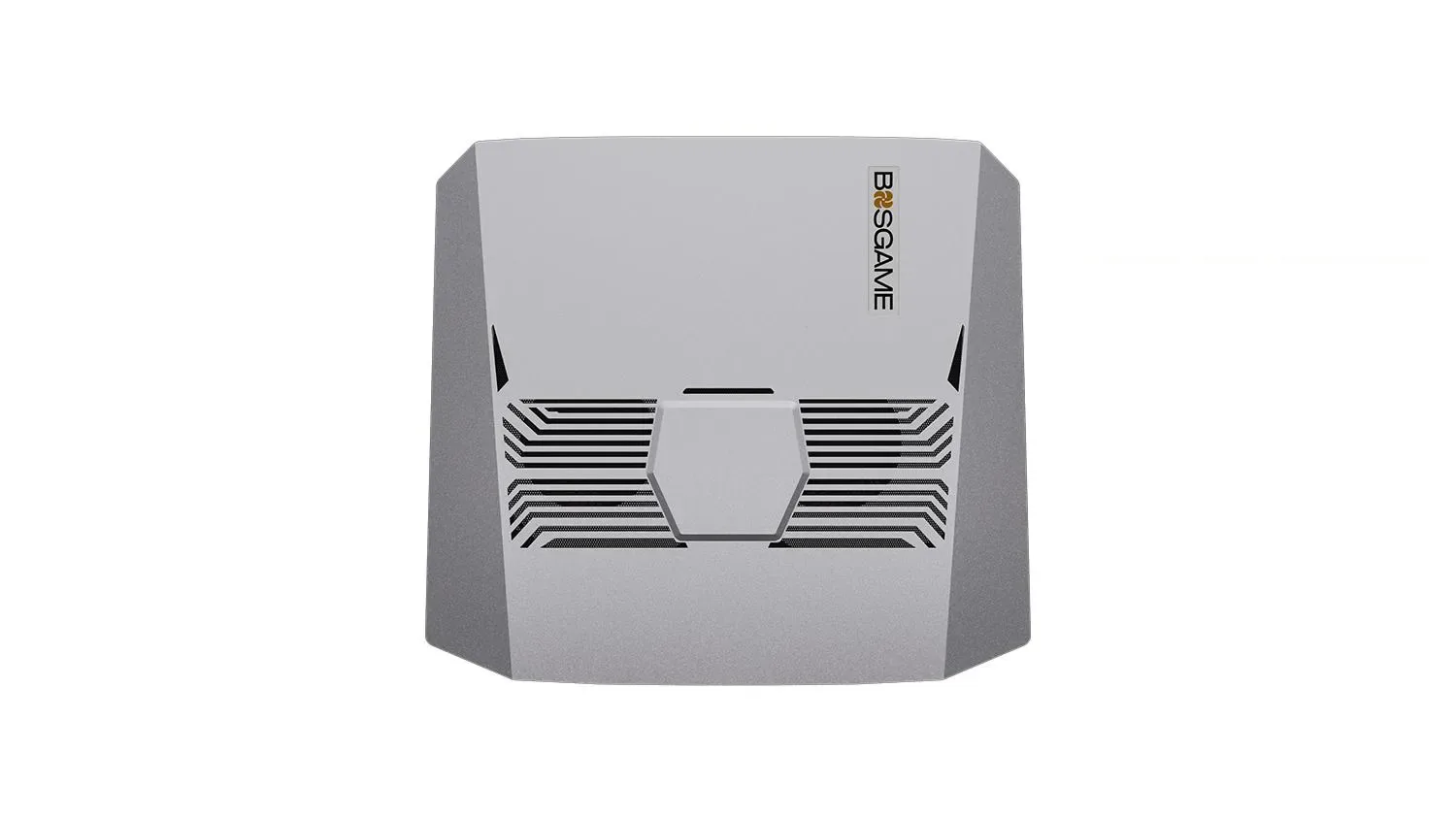
The Bosgame M5 is a flagship AI mini desktop built around AMD’s Ryzen AI Max+ 395, the most powerful consumer APU ever produced. Launched in June 2025 and reviewed by NotebookCheck, TechRadar, Guru3D, and Liliputing — all of whom awarded it top marks in its category — the M5 combines 16 Zen 5 CPU cores, the 40-CU Radeon 8060S iGPU, and an XDNA 2 NPU into a chassis that measures just 220.8 × 199.5 × 57.1 mm. With up to 128 GB of LPDDR5X-8000 unified memory shared across the CPU, GPU, and NPU, the M5 can assign up to 96 GB as dedicated GPU VRAM — a figure that dwarfs any fixed-VRAM discrete card under $1,500, and that makes local AI model inference of even very large language models practical without cloud dependency. TechRadar’s reviewer described it as “the most powerful mini PC I’ve ever tested,” while independent benchmark comparisons placed the M5 ahead of the Lenovo ThinkStation P3 Tower workstation in both GPU and AI compute tasks. Its design, inspired by the aerodynamic geometry of eagle wings and layered mech armour, also won the 2025 MUSE Award for product design.
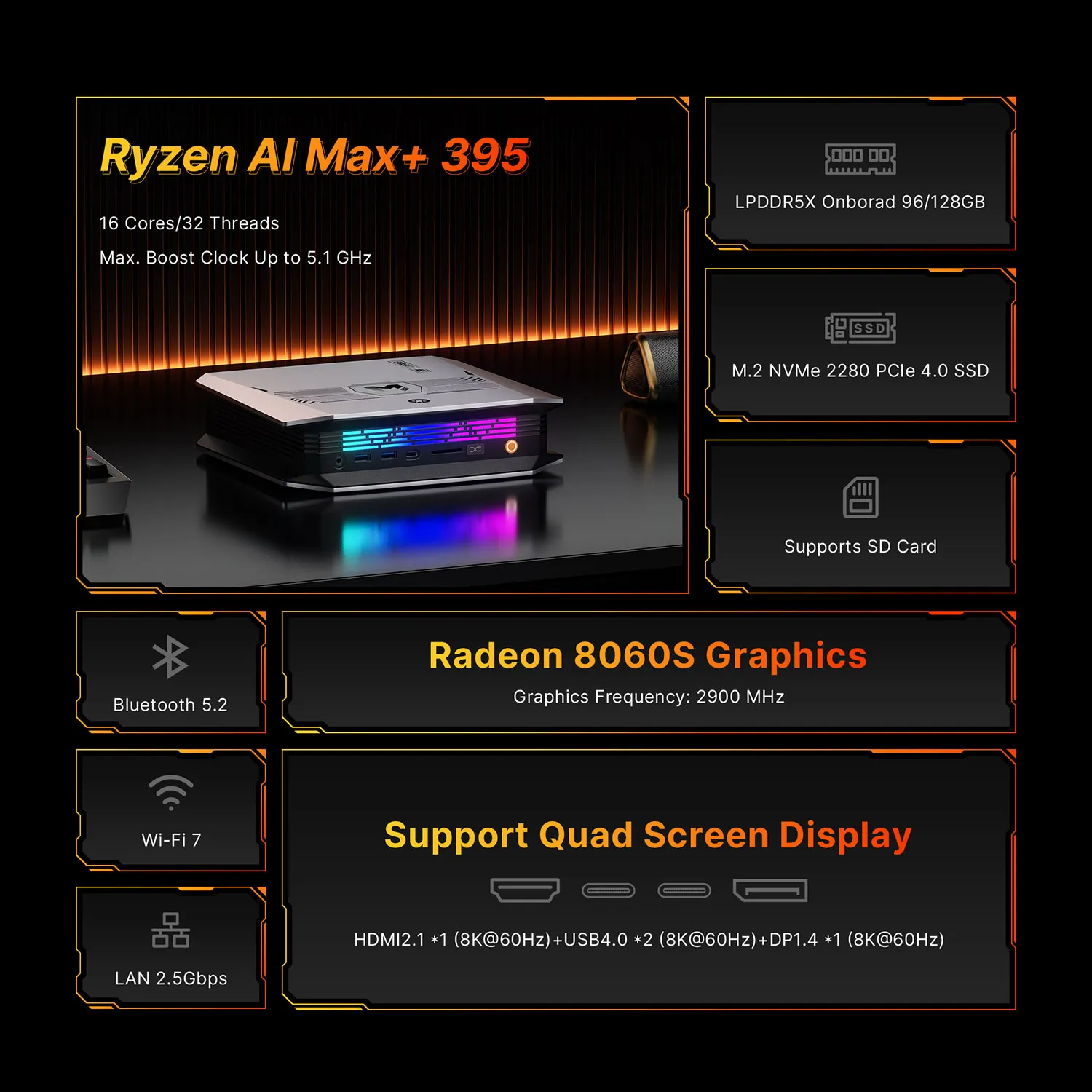
AMD Ryzen™ AI Max+ 395 — The Absolute Peak of the Strix Halo Platform
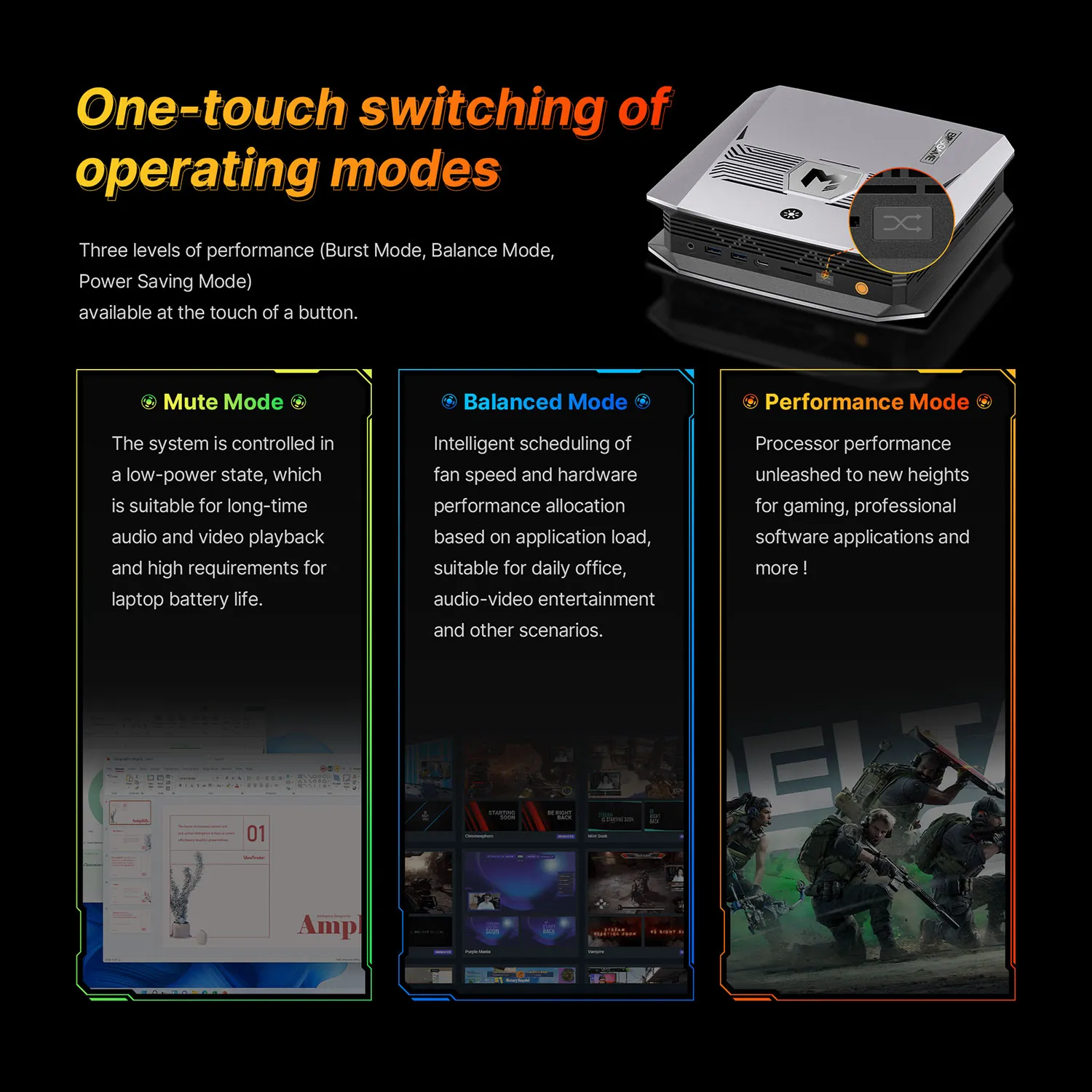
The Ryzen AI Max+ 395 sits at the very top of AMD’s Strix Halo lineup, occupying a tier above the standard Ryzen AI Max 395 through its expanded memory bandwidth configuration and higher sustained power envelope. Manufactured on TSMC’s 4 nm process node, it integrates 16 Zen 5 cores with 32 threads across a single monolithic die that also houses the GPU and NPU — an architecture AMD calls “Strix Halo” that shares memory bandwidth across all three compute engines via a unified 256 GB/s memory bus. The CPU boosts to 5.1 GHz and sustains operation at 120W (PL1) with burst headroom to 140W (PL2). In benchmarks across multiple independent reviews, the AI Max+ 395 delivers multi-core Cinebench R23 scores in the 14,000–15,500 range and single-core scores around 1,900 — figures that outperform many conventional desktop Ryzen 7000 chips and rival the performance of Apple’s M3 Max in CPU-bound workloads. Three onboard performance modes — Silent (~86W), Balanced (~127W), and Performance (~175W) — are switchable via a hardware button on the front panel, each confirmed by a colour icon on the connected display.
- 16 Zen 5 cores / 32 threads — unified monolithic die (Strix Halo)
- Base 2.0 GHz — Boost up to 5.1 GHz
- L2 Cache: 16 MB | L3 Cache: 64 MB
- 4 nm TSMC process node
- TDP: 120W sustained (PL1) / 140W peak (PL2)
- Three performance modes: Silent ~86W / Balanced ~127W / Performance ~175W
- Launched: June 2025 — dual CCD architecture with dedicated IOD chip
AMD Radeon™ 8060S — 40 RDNA 3.5 CUs, Up to 96 GB Shared VRAM
The Radeon 8060S integrated GPU incorporates 40 RDNA 3.5 compute units drawing directly from the system’s LPDDR5X-8000 unified memory pool. Because the memory is shared rather than partitioned, the GPU can access up to 96 GB of VRAM when configured through AMD’s software tools — a configuration that allows the M5 to load and run AI models and 3D scenes far larger than any conventional discrete GPU card at any price point. In gaming benchmarks at 1080p and 1440p, the Radeon 8060S delivers performance in the range of a GeForce RTX 4070, running Cyberpunk 2077, Baldur’s Gate 3, and Street Fighter at high to ultra settings with smooth frame rates. In 3DMark Steel Nomad Lite, the M5 scored 11,201 — higher than the review site’s Lenovo ThinkStation P3 Tower with RTX A2000 12 GB graphics. CPU temperatures under sustained gaming remained below 73.5°C with no thermal throttling in performance mode, confirming that the cooling system keeps pace with the GPU’s full output. The 8060S also supports hardware video encode and decode for H.264, H.265, AV1, and VP9, accelerating workflows in DaVinci Resolve, Premiere Pro, and Handbrake significantly compared to CPU-only processing.
XDNA 2 NPU — 50 TOPS, 126 TOPS Total — 2.2× Faster Than RTX 4090 in LM Studio
The Ryzen AI Max+ 395 incorporates AMD’s XDNA 2 neural processing unit delivering 50 peak TOPS of dedicated AI inference, completely independent of the CPU and GPU power domains. Combined with the contributions from the GPU and CPU instruction sets, total system AI throughput reaches 126 TOPS — a figure that Bosgame validates through LM Studio benchmarks showing the M5 running Llama 3 at 2.2× the token generation rate of an RTX 4090. This result is made possible not only by the NPU speed but by the massive unified memory pool: unlike the RTX 4090’s 24 GB VRAM ceiling, the M5’s 128 GB shared memory allows the full Llama 3 70B parameter model to be loaded into memory without quantisation or layer offloading, preserving model quality while eliminating the swap overhead that limits GPU-only inference on cards with smaller VRAM. For developers running TensorFlow or PyTorch workloads, the XDNA 2 NPU integrates fully with AMD’s ROCm stack, and Bosgame’s proprietary control panel provides real-time visualisation of CPU, GPU, and NPU utilisation alongside fan speed and thermal status.
128 GB LPDDR5X-8000 — Soldered, Non-Upgradeable, Extraordinary Bandwidth
The M5 ships in two configurations: 96 GB and 128 GB of LPDDR5X memory running at 8,000 MT/s (8533 MT/s in some early hardware revisions) with a total memory bandwidth of 256 GB/s. This bandwidth figure is the key enabler of the Radeon 8060S’s gaming and AI performance — it feeds the GPU’s 40 compute units at a rate comparable to dedicated GDDR6X on high-end discrete cards, without the latency penalties of a PCIe bus between the CPU and GPU. The memory is soldered permanently to the motherboard using the same approach as the GMKtec EVO-X2. There is no upgrade path, and users who anticipate needing more than 128 GB of RAM for future workloads must consider this a fixed constraint. In exchange for this limitation, the LPDDR5X soldered configuration delivers memory bandwidth and capacity that no SO-DIMM or LPDDR5 module-based system can match at equivalent speed.
- 96 GB or 128 GB LPDDR5X-8000 MT/s — 256 GB/s total bandwidth
- Soldered — non-upgradeable under any circumstances
- Up to 96 GB allocatable as dedicated GPU VRAM
- Unified memory architecture — CPU, GPU, and NPU share the same pool

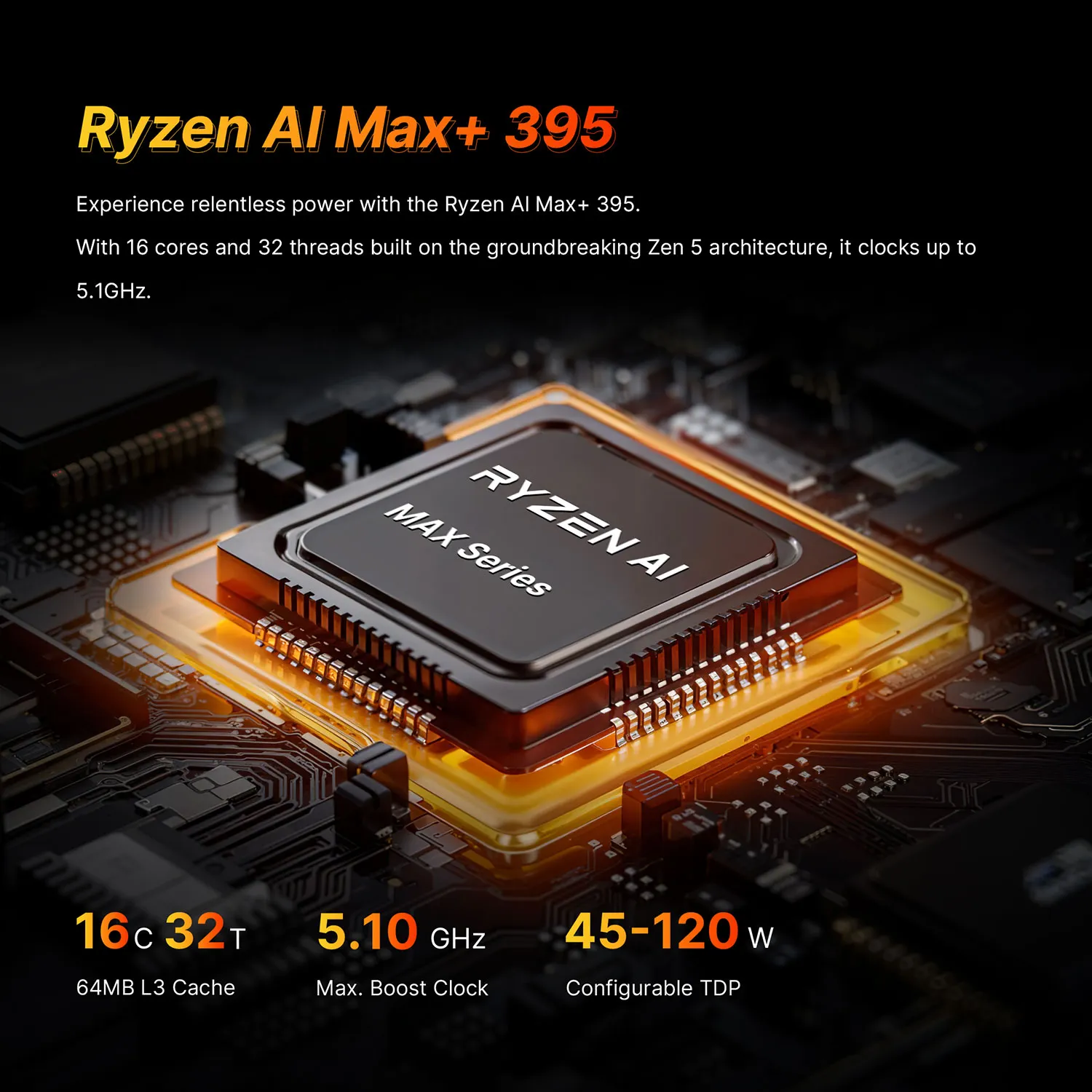
Dual M.2 PCIe 4.0 — Fast Expandable NVMe Storage
The M5 is equipped with two M.2 2280 slots both running at PCIe 4.0 ×4 bandwidth, delivering sequential read speeds exceeding 7,000 MB/s with compatible drives. The standard configuration ships with a Kingston 2 TB NVMe SSD pre-installed in the primary slot, leaving the secondary slot open for expansion without requiring a swap. Both slots are accessible from the underside of the chassis, though Bosgame’s reviewers noted that the M5’s internal layout makes full disassembly more involved than competing products — a minor inconvenience that reflects the densely engineered cooling and motherboard stack required to house the Strix Halo APU’s thermal requirements within a sub-60mm chassis height.
Quad Display Output — HDMI 2.1 + 3× DisplayPort + 2× USB4
The M5 supports up to four simultaneous external displays through a combination of HDMI 2.1 FRL (8K@60Hz), three DisplayPort outputs (via USB-C with DP Alt Mode and the docking station port), and two USB4 ports with DisplayPort Alt Mode capability — each capable of driving an 8K@60Hz monitor independently. This output configuration provides more display flexibility than the GMKtec EVO-X2, which offers 2× HDMI and 2× USB4. The additional DisplayPort outputs are particularly valuable for professional multi-monitor deployments such as video editing suites, trading workstations, and software development environments that benefit from four dedicated high-resolution screens. The inclusion of a proprietary docking station port (accessible via compatible Bosgame docking accessories) extends the connectivity footprint further for desktop users who want a single-cable docking experience.

Thunderbolt Support — High-Speed Peripheral Connectivity
In addition to its two USB4 40 Gbps ports, the M5 includes two Thunderbolt connections that provide compatibility with the extensive Thunderbolt peripheral ecosystem — including Thunderbolt docks, external storage arrays, and professional audio interfaces that require certified Thunderbolt connectivity rather than generic USB4. This dual Thunderbolt implementation sets the M5 apart from the GMKtec EVO-X2 and most other Strix Halo-based mini PCs, which offer USB4 without Thunderbolt certification. For professionals who have already invested in a Thunderbolt workflow — docks, RAID enclosures, or audio gear — the M5’s Thunderbolt support provides direct compatibility without adapters or protocol bridges.
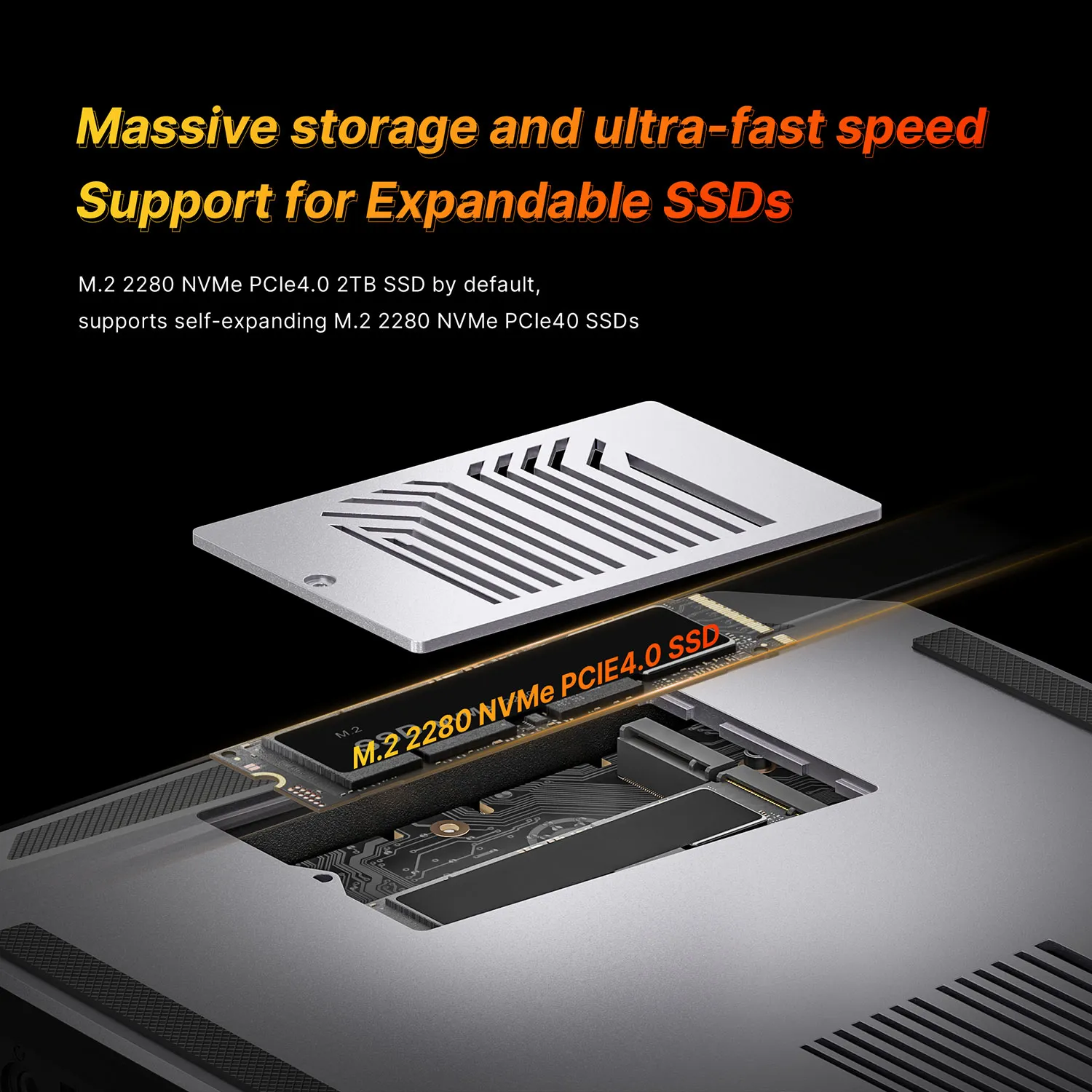
Wi-Fi 7 + Bluetooth 5.4 + 2.5 GbE — Capable Networking
Wireless connectivity is managed by a MediaTek MT7925 Wi-Fi 7 (802.11be) module with Bluetooth 5.4, delivering multi-link operation across 2.4 GHz, 5 GHz, and 6 GHz bands simultaneously and providing future-proof wireless performance for next-generation routers and access points. Wired networking is provided by a single Realtek RTL8125 2.5 Gigabit Ethernet port — fast and reliable for everyday use, but worth noting for users who need dual-port wired connectivity, as the competing GEEKOM A9 Max and Minisforum AI X1 Pro-470 both offer two 2.5 GbE ports. Wake-on-LAN is supported for remote power management scenarios.
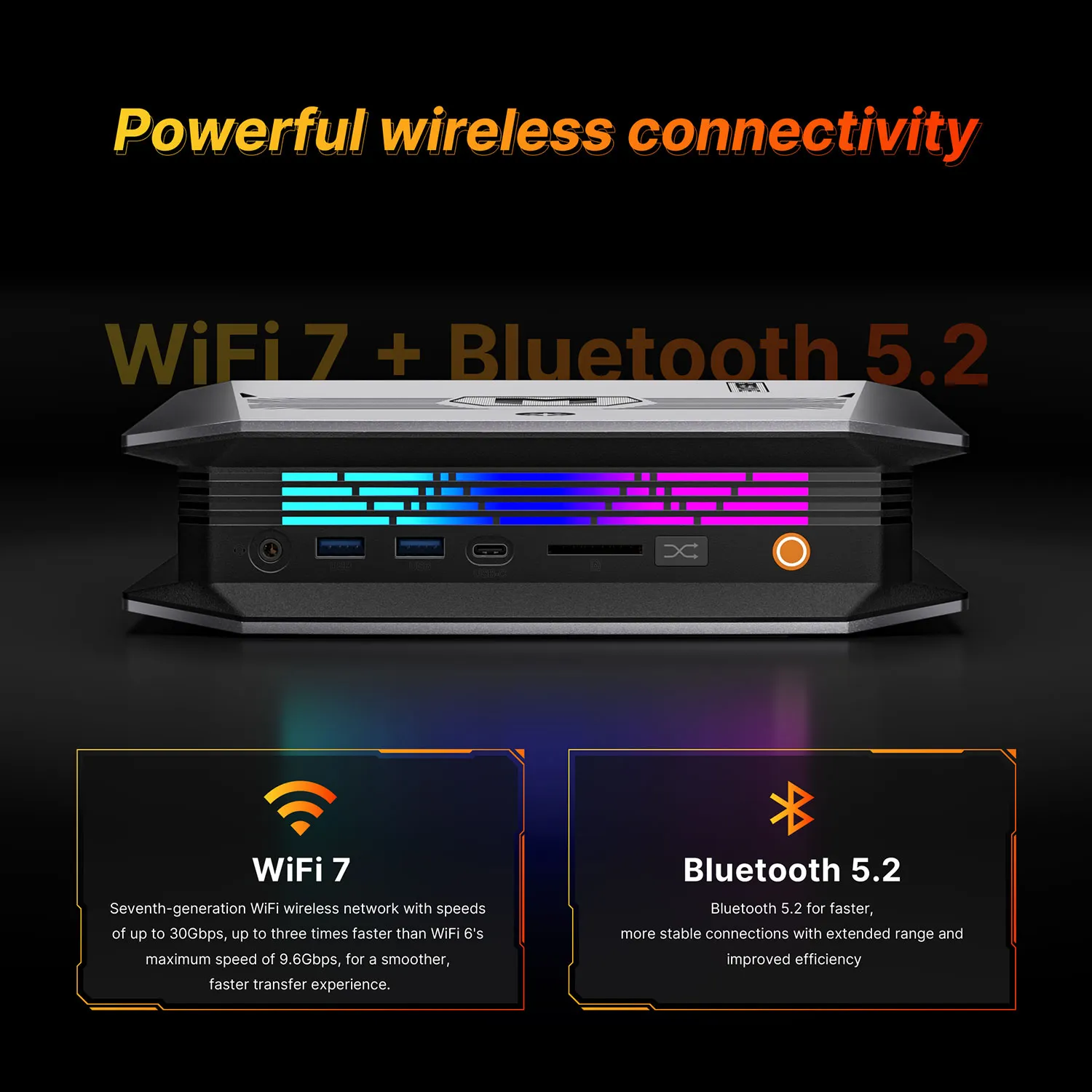
RGB Ambient Lighting + Aluminium Vertical Stand
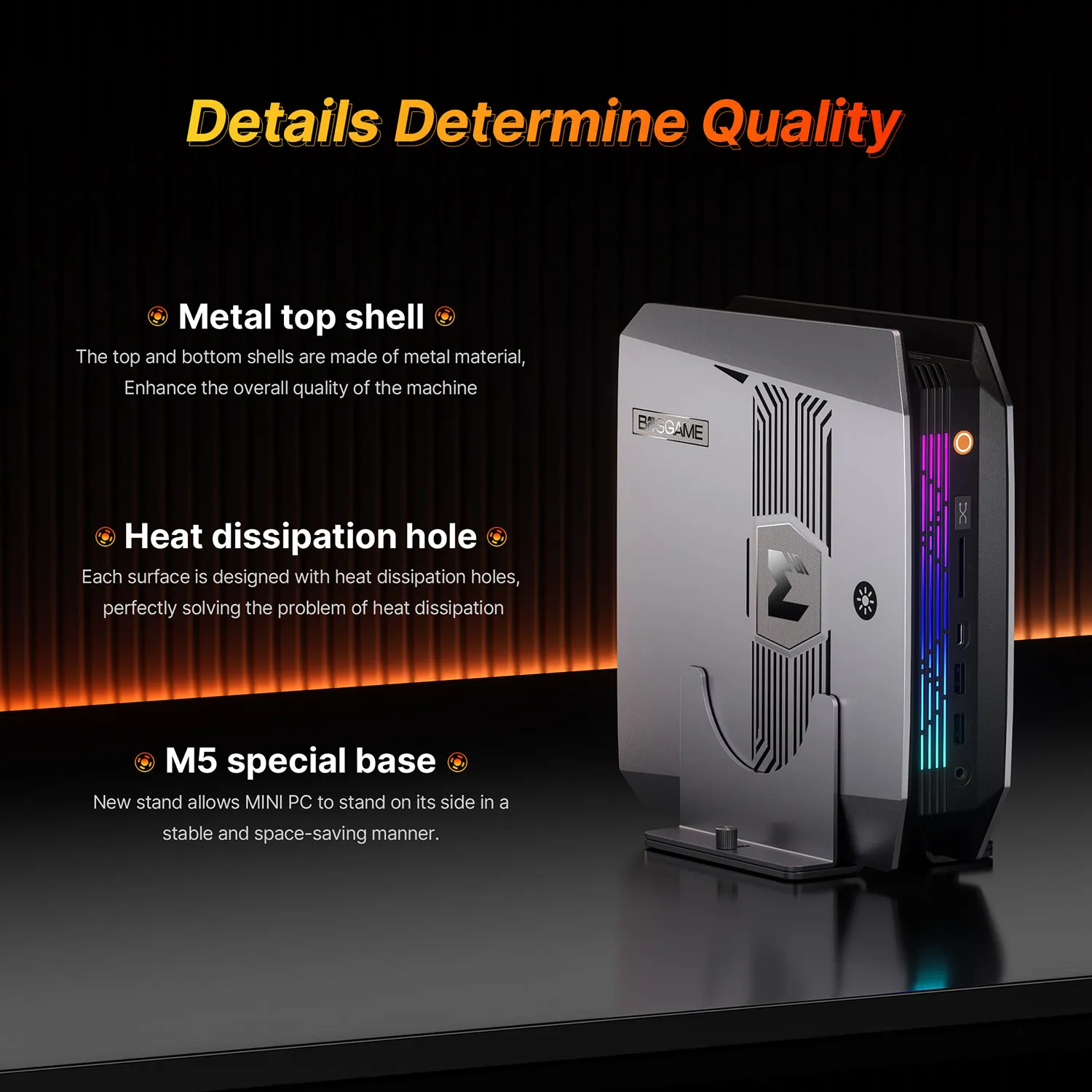
The M5’s chassis design draws inspiration from eagle wing geometry and layered mech armour aesthetics, using an anodised metal construction with a nickel-etched logo and UV-treated polymer accents. Ambient RGB lighting runs along the underside perimeter of the chassis, creating a subtle glow effect on the desk surface that can be configured through the Bosgame control panel across multiple colours and animation modes — without any additional software installation required. An aluminium vertical stand is included in the box, allowing the M5 to be oriented upright in a console-style configuration that saves horizontal desk footprint and improves airflow through the side ventilation slots. In horizontal orientation, rubber feet on the underside provide stable placement on any surface. There is no VESA mount support.
Cooling System — Dual Fan with Three Performance Modes
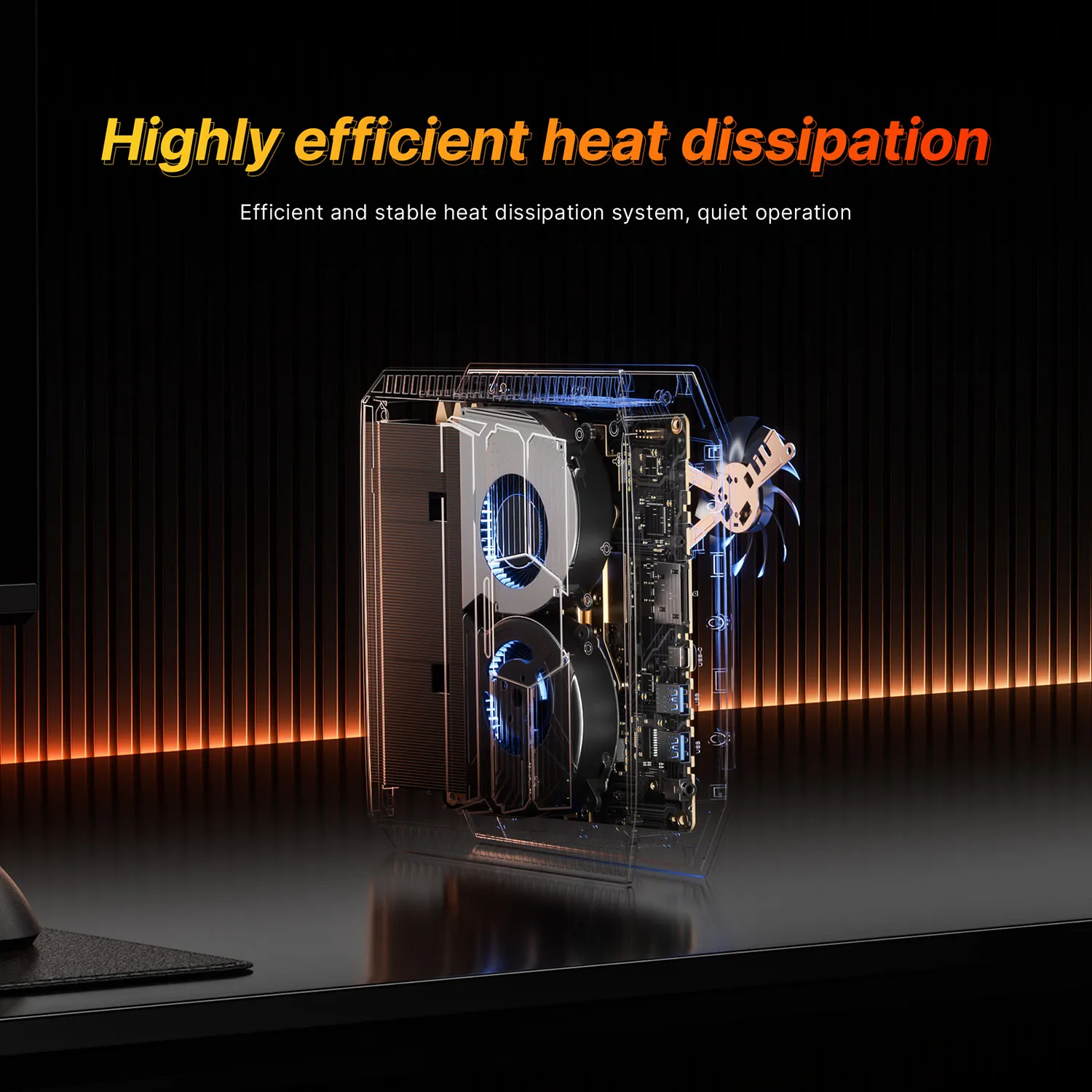
Cooling the Strix Halo APU’s 120–175W power envelope in a 220.8 × 199.5 × 57.1 mm chassis requires a dedicated thermal solution. The M5 uses a dual-fan blower configuration with multiple heat pipes and strategically placed ventilation slots on the top, sides, and rear panels. In Silent Mode the fans operate at low speed with peak consumption around 86W, maintaining near-inaudible noise levels suitable for office environments. Performance Mode pushes consumption to approximately 175W with fan noise measured at around 50.4 dB under extended full load — clearly audible but acceptable for a machine at this performance level. Independent testing across multiple reviews confirmed that CPU temperatures peak at approximately 73.5°C under maximum sustained load with no thermal throttling in Balanced or Performance mode. One consistent piece of user feedback across reviews is the desire for a user-configurable fan curve, as the three fixed modes do not allow fine-grained control between the Silent and Performance extremes.
Complete Port Layout
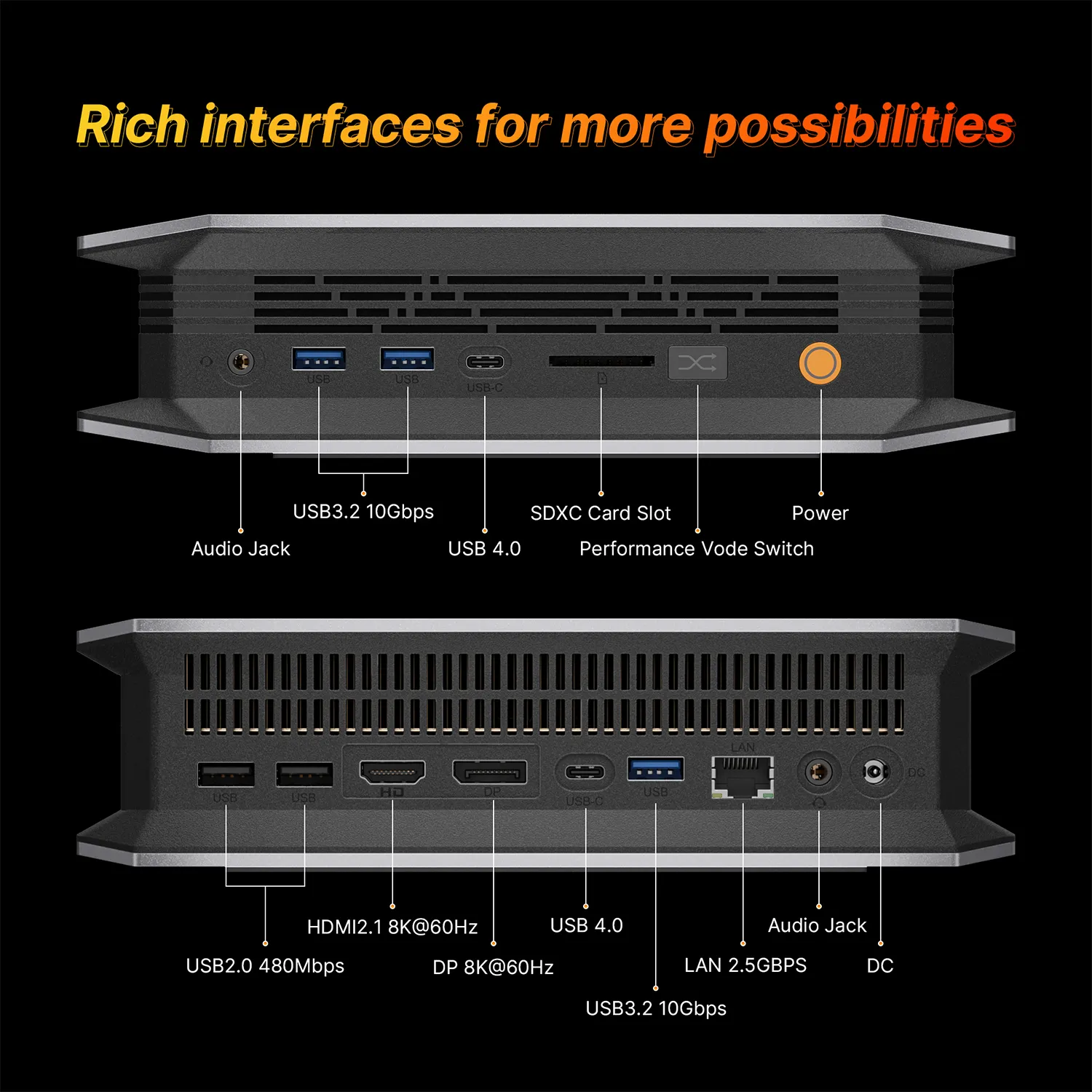
Front: 2× USB-A 3.2 Gen2 (10 Gbps) · 1× USB4 (40 Gbps, DP Alt Mode / Data) · 1× SD 4.0 / SDXC UHS-II card reader · 1× 3.5mm combo audio jack · Power button · P-MODE performance button
Rear: 1× HDMI 2.1 FRL (8K@60Hz) · 2× USB4 / Thunderbolt (40 Gbps, DP Alt Mode) · 3× DisplayPort (via USB-C + Docking Station port) · 2× USB-A 3.2 Gen2 (10 Gbps) · 2× USB-A 2.0 · 1× RJ45 2.5 Gigabit Ethernet · 1× Docking Station Port (proprietary, for Bosgame dock accessories) · 1× 3.5mm combo audio jack · 1× DC power input
Windows 11 Pro — Full AI Feature Set from Day One
The M5 ships with Windows 11 Pro pre-installed and activated, with all AI and productivity features enabled from first boot. AMD’s Adrenalin GPU driver suite provides full access to Radeon RX 8060S features including FidelityFX Super Resolution (FSR), Radeon Anti-Lag, and the media encode/decode engine. Bosgame’s control panel software handles fan profile switching, real-time hardware monitoring, and RGB lighting configuration from a single application. Firmware updates are delivered through an online utility ensuring the system always carries the latest AGESA optimisations. Linux distributions including Ubuntu are fully supported, with complete driver coverage for the Strix Halo platform available through the standard AMD ROCm and Mesa driver stacks.
Video:
Additional information
Specification: Bosgame M5 AI Mini Desktop AMD Ryzen™ AI 9 Max+ 395
| Configuration Options | ||||||||||||||||||||||
|---|---|---|---|---|---|---|---|---|---|---|---|---|---|---|---|---|---|---|---|---|---|---|
|
||||||||||||||||||||||
| AI Capabilities | ||||||||||||||||||||||
|
||||||||||||||||||||||
| Processor | ||||||||||||||||||||||
|
||||||||||||||||||||||
| Ports | ||||||||||||||||||||||
|
||||||||||||||||||||||
| Network | ||||||||||||||||||||||
|
||||||||||||||||||||||
| GPU | ||||||||||||||||||||||
|
||||||||||||||||||||||
| Internal Ports | ||||||||||||||||||||||
|
||||||||||||||||||||||
| Storage & RAM | ||||||||||||||||||||||
|
||||||||||||||||||||||
| Power | ||||||||||||||||||||||
|
||||||||||||||||||||||
| Others Specifications | ||||||||||||||||||||||
|
||||||||||||||||||||||
| Specification | ||||||||||||||||||||||
|
||||||||||||||||||||||
Videos
Videos: Bosgame M5 AI Mini Desktop AMD Ryzen™ AI 9 Max+ 395
Related Products


