
ACEMAGIC F5A AMD Ryzen™ AI 9 HX 370



| Processor | 9 |
|---|---|
| RAM | 8.5 |
| Hard Disk | 8.5 |
| Connectivity | 9.2 |
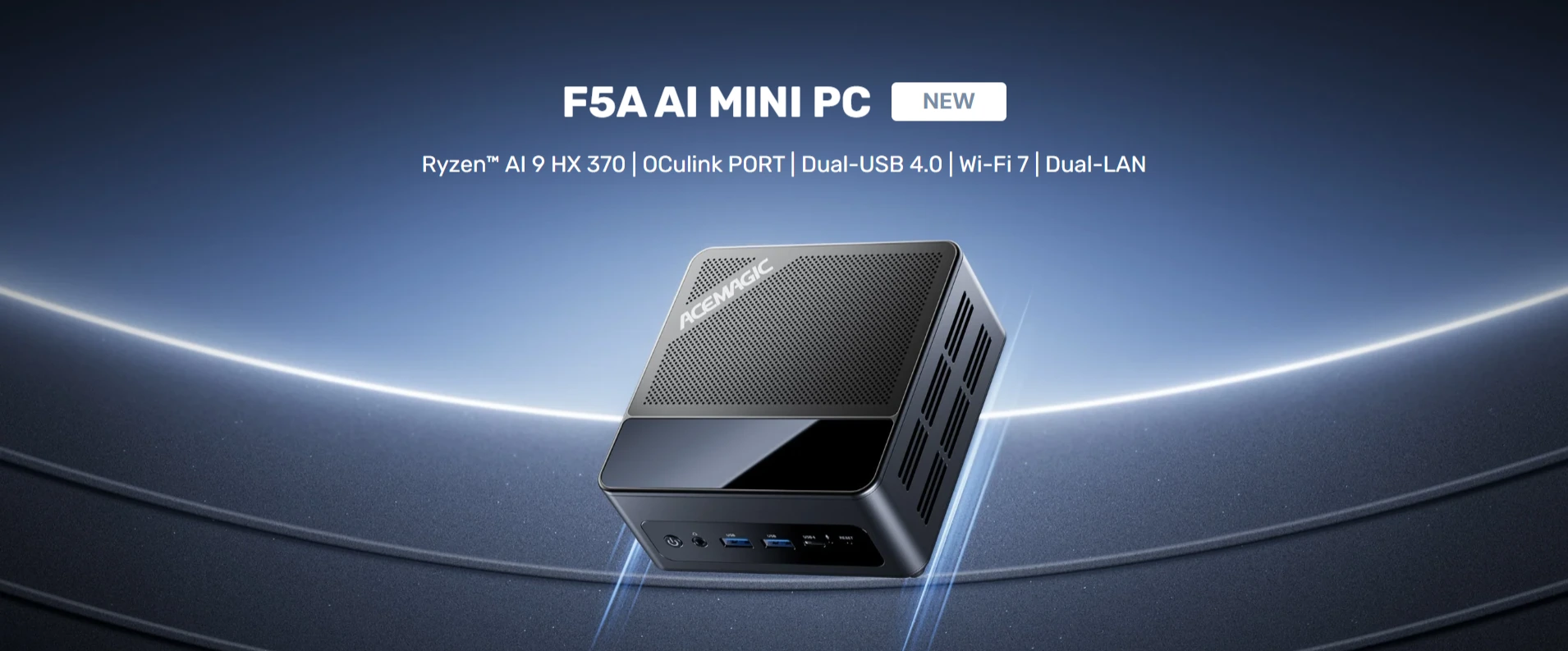
AMD Ryzen™ AI 9 HX 370 (Strix Point) AI Mini PC. 12 Zen 5 / Zen 5c cores / 24 threads up to 5.1 GHz. AMD Radeon™ 890M — 16 RDNA 3.5 CUs at 2.9 GHz. XDNA 2 NPU — 50 TOPS. 80 TOPS total AI. Copilot+ PC certified. Up to 96 GB DDR5 SO-DIMM UPGRADEABLE (2 slots). Dual M.2 2280 PCIe 4.0 — up to 4 TB. Quad display output. OCuLink PCIe 4.0 ×4 (no hot-plug). Dual USB4 100W PD. Dual 2.5 GbE. Wi-Fi 7 + BT 5.4. DP 2.1 + HDMI 2.1. RGB lighting. Dual fan + SSD heatsink cooling. TPM 2.0. 132 × 130 × 61 mm. ~2-year warranty.

Description
ACEMAGIC F5A
AI Mini PC — AMD Ryzen™ AI 9 HX 370 (Strix Point)
The ACEMAGIC F5A is the company’s most ambitious mini PC to date — a direct evolution of the well-received F3A that adds OCuLink eGPU support, Wi-Fi 7, dual USB4 with 100W Power Delivery, and DisplayPort 2.1 to the already formidable Ryzen AI 9 HX 370 platform. Launched in September 2025 and reviewed positively by outlets including WCCFTech, Liliputing, and NotebookCheck, the F5A combines a gamer-aesthetic chassis with customisable RGB lighting and a dual-fan cooling solution into a package measuring just 132 × 130 × 61 mm. For users who want expandability, the two DDR5 SO-DIMM slots support up to 96 GB of user-replaceable memory, and the OCuLink port opens the door to connecting a full-size discrete GPU enclosure — giving the F5A a performance ceiling that far exceeds any fixed iGPU configuration. One important operational note: the OCuLink port on the F5A does not support hot-plugging, meaning the system must be powered down fully before connecting or disconnecting any external GPU dock or peripheral through this port.
AMD Ryzen™ AI 9 HX 370 — 12 Zen 5 Cores, 5.1 GHz, 80 TOPS
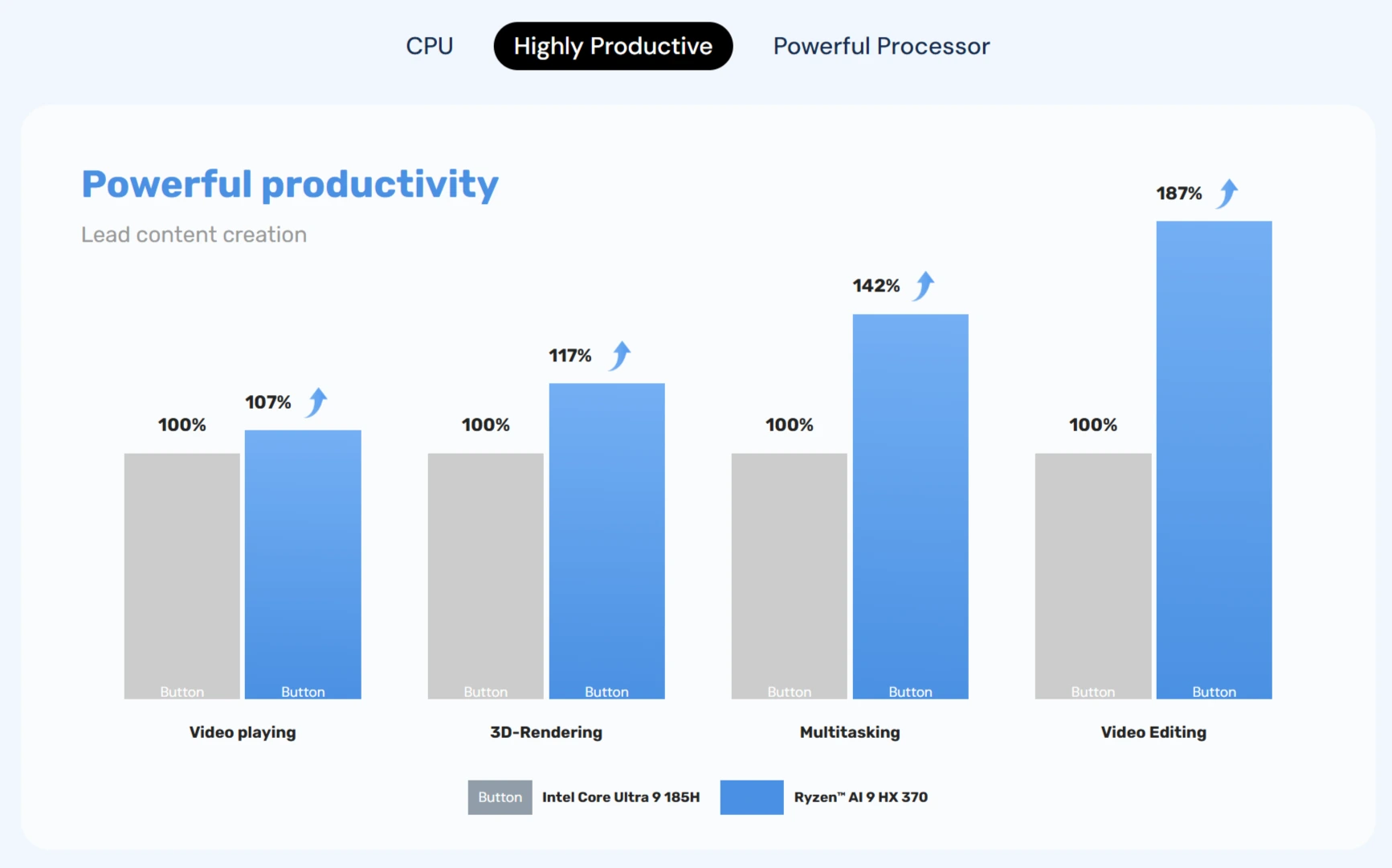
The Ryzen AI 9 HX 370 (Strix Point) is AMD’s flagship mainstream APU of the Ryzen AI 300 series, built on TSMC’s 4 nm process node. Its 12-core, 24-thread configuration combines four full-size Zen 5 performance cores with eight compact Zen 5c efficiency cores — a hybrid layout that delivers strong single-threaded responsiveness from the P-cores while the E-cores handle background tasks and parallel workloads without stealing clock budget from demanding applications. The chip boosts to 5.1 GHz and operates within a configurable TDP range of 28W to 54W, giving system builders the flexibility to tune for silence or maximum throughput depending on the use case. In independent benchmark results for the F3A — the F5A’s direct predecessor using the same silicon — the HX 370 delivers multi-core Cinebench R23 scores around 13,000 to 14,000 and single-core scores of approximately 1,900, placing it firmly among the fastest chips ever integrated into a mini PC chassis.
- 12 cores / 24 threads (4× Zen 5 P-cores + 8× Zen 5c E-cores)
- Base 2.0 GHz — Boost up to 5.1 GHz
- L2 Cache: 12 MB | L3 Cache: 24 MB
- 4 nm TSMC process node (Strix Point — Ryzen AI 300 series)
- TDP: 28W base / up to 54W configurable
- Released: Q3 2024 — F5A launched September 2025

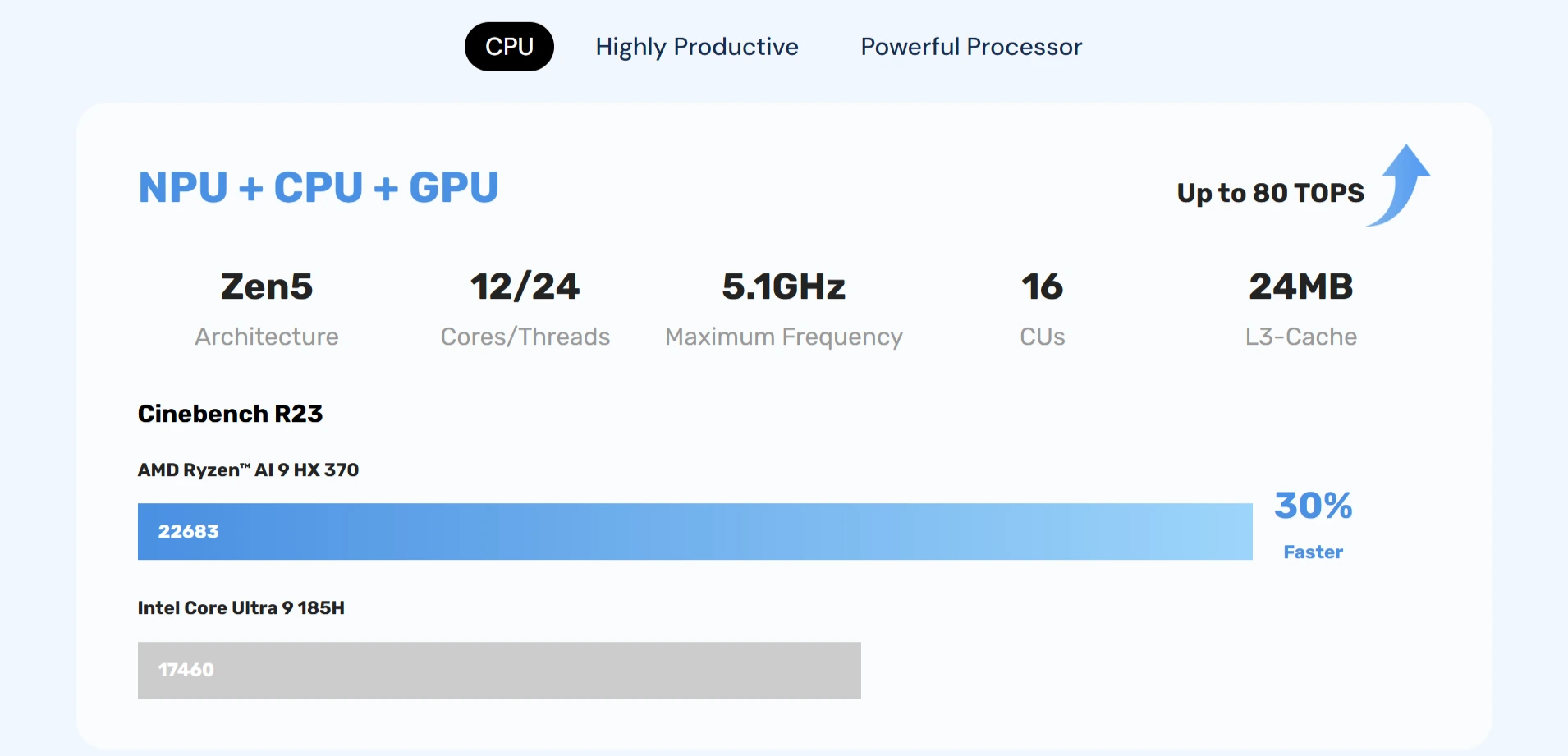
AMD Radeon™ 890M — 16 RDNA 3.5 CUs at 2.9 GHz
The Radeon 890M integrated GPU brings 16 RDNA 3.5 compute units running at a maximum of 2.9 GHz, making it the most powerful integrated graphics solution available in any standard-TDP APU at the time of the F5A’s launch. In gaming at 1080p, it handles mainstream titles at medium to high settings with playable frame rates — Forza Horizon 5 and CS2 run smoothly, while more demanding titles like Cyberpunk 2077 and Starfield require lowering to medium or performance presets. For AI-assisted creative work, the 890M accelerates video encode/decode through AMD’s media engine and supports Vulkan, OpenCL, and DirectX 12 Ultimate across all current professional and creative software stacks. Through the BIOS, users can configure the amount of system DDR5 allocated to GPU use, allowing the 890M to access a substantially larger memory pool than fixed-VRAM discrete cards in lower price brackets — a meaningful advantage when running large AI image generation models locally. For users who push beyond the 890M’s ceiling, the OCuLink port provides a direct PCIe 4.0 ×4 pathway to a discrete external GPU, recovering up to 90% of the card’s native performance without the overhead that afflicts Thunderbolt-based eGPU solutions.
XDNA 2 NPU — 50 TOPS, Copilot+ PC Certified
The XDNA 2 neural processing unit embedded in the HX 370 delivers 50 peak TOPS of dedicated AI inference, operating on its own power domain completely independently of the CPU and GPU. Combined with contributions from the CPU and GPU instruction sets, total system AI throughput reaches 80 TOPS — twice the 40 TOPS threshold required for Microsoft Copilot+ PC certification. All Windows 11 Copilot+ features — including Recall, live caption and translation, generative image tools, and AI-enhanced studio audio — run locally on the NPU without requiring internet connectivity or cloud processing. For local language model inference through platforms such as LM Studio or Ollama, the XDNA 2 NPU offloads the tokenisation and embedding layers, allowing the CPU and GPU to focus on inference throughput — a workflow that makes running Phi-3, Mistral 7B, and similar models on the F5A both practical and responsive.

Up to 96 GB DDR5 SO-DIMM — User-Upgradeable, Not Soldered
The ACEMAGIC F5A uses two standard DDR5 SO-DIMM slots running at DDR5-5600 MT/s, each supporting modules up to 48 GB for a maximum system capacity of 96 GB. The standard configuration ships with 32 GB in a dual-channel 2×16 GB arrangement, delivering the full bandwidth the Radeon 890M needs for iGPU workloads. Unlike the LPDDR5X-soldered configurations found in the GMKtec EVO-X2 and Beelink SER9 Pro, the F5A’s SO-DIMM slots are fully user-accessible — upgrading from 32 GB to 64 GB or 96 GB requires only purchasing compatible DDR5 SO-DIMM modules and slotting them in after removing the bottom panel. The 96 GB ceiling is lower than the 128 GB supported by the GEEKOM A9 Max and Minisforum AI X1 Pro-470, but for the vast majority of AI, creative, and gaming workloads it represents ample headroom. The dual-channel configuration ensures the Radeon 890M operates at full memory bandwidth for graphics-intensive tasks.
- 2× DDR5 SO-DIMM slots — fully user-accessible, not soldered
- Standard config: 32 GB DDR5-5600 (2×16 GB dual-channel)
- Maximum supported: 96 GB (2×48 GB DDR5 SO-DIMM)
- Barebones option available: no RAM, no storage, no OS
Dual M.2 2280 PCIe 4.0 — Up to 4 TB NVMe Storage
Storage is handled through two M.2 2280 slots, both running at PCIe 4.0 ×4 with sequential read speeds exceeding 6,000 MB/s. The standard pre-configured model ships with a 1 TB or 2 TB WD Black NVMe SSD in the primary slot, leaving the secondary slot available for expansion without swapping drives. Each slot supports modules up to 2 TB for a maximum combined capacity of 4 TB. A dedicated aluminium SSD heatsink is integrated into the cooling assembly directly over the primary slot, maintaining drive temperatures under heavy transfer workloads and reducing thermal throttling on high-performance NVMe modules. Both slots are accessible from the bottom panel after removing four screws — a straightforward process that requires no specialist tools.

OCuLink PCIe 4.0 ×4 — eGPU Support with Up to 90% Native Performance
The F5A’s OCuLink port delivers PCIe 4.0 ×4 bandwidth at up to 64 Gbps, providing a direct electrical connection to compatible external GPU docks without the protocol overhead and latency of Thunderbolt or USB4-based eGPU solutions. ACEMAGIC rates OCuLink eGPU performance at up to 90% of the discrete card’s native throughput — a figure that brings even high-end cards like the RTX 4070 and RX 7900 XT close to their full potential in this compact chassis. Compatible enclosures accept full-length, full-height double-slot cards, transforming the F5A from a capable compact workstation into a full gaming or rendering station without replacing any internal components.
⚠️ Important: The OCuLink port on the F5A does not support hot-plugging. The system must be fully powered down before connecting or disconnecting any device through the OCuLink port. Connecting or disconnecting with the system running risks data corruption and hardware damage.

Dual USB4 with 100W Power Delivery — Front and Rear
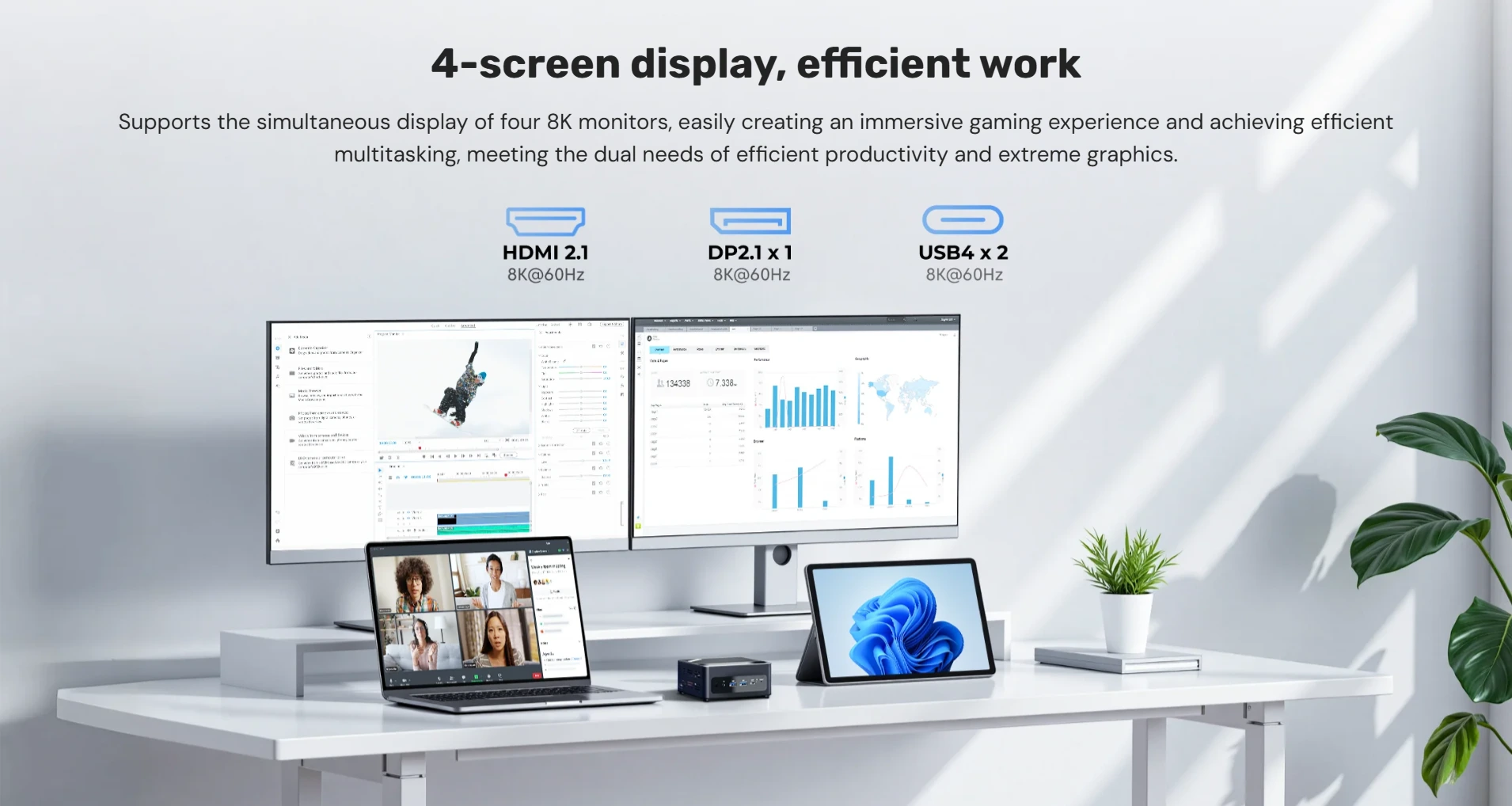
Two USB4 ports (40 Gbps each) are located front and rear, both supporting simultaneous data transfer, DisplayPort 2.1 Alt Mode video output, and 100W Power Delivery charging input. This means the F5A can be powered entirely through a single USB-C cable from a 100W USB PD source — eliminating the external power brick in scenarios where a PD-capable hub or monitor is available. Each USB4 port can also drive an 8K display independently, contributing to the quad-display output capability alongside the HDMI 2.1 and DisplayPort 2.1 outputs.

DisplayPort 2.1 + HDMI 2.1 — Quad Display up to 8K@60Hz
The F5A’s display output configuration is among the most capable of any HX 370 mini PC available. DisplayPort 2.1 (UHBR10, 40 Gbps) supports 8K@60Hz natively or 4K@240Hz — a significant step up from the DP 1.4 found in many competing systems — while HDMI 2.1 FRL provides an additional 8K@60Hz or 4K@120Hz output. Combined with the two USB4 ports in DisplayPort Alt Mode, the F5A supports four independent displays simultaneously at up to 4K resolution each, or two 8K displays and two 4K displays when mixed. This output set is particularly valuable for video editing, multi-screen development environments, and high-refresh-rate gaming monitors.

RGB Lighting — Customisable Ambient Strip
A defining aesthetic feature of the F5A — and one that sets it apart visually from more utilitarian competitors like the GEEKOM A9 Max and Minisforum AI X1 Pro-470 — is its customisable RGB lighting strip integrated into the underside of the top lid. The illuminated strip wraps around the perimeter of the upper chassis and can be configured through the ACEMAGIC RGB control software, allowing users to select from static colours, breathing patterns, and dynamic cycling effects. For users who prefer a clean, professional desk appearance, the RGB can be disabled entirely. The lighting adds to the F5A’s gamer-adjacent aesthetic without compromising the overall build quality or thermal design.
Dual Fan + SSD Heatsink Cooling — Quiet Under Load
Cooling the HX 370’s 54W TDP in a 132 × 130 × 61 mm chassis is handled by a dual copper heat pipe system driving two large blower fans, supplemented by a dedicated aluminium heatsink clamped directly over the primary SSD slot. Air intake is drawn through the bottom panel perforations, exhausted through the side vents, keeping the top surface cool and reducing hot air circulation on the desk surface. In sustained load scenarios, the system remains quiet enough for open-plan office environments, with fan noise rising to audible but non-intrusive levels only under extended full-CPU-and-GPU stress. Idle operation is near-silent. A BIOS-accessible fan speed profile allows adjustment between prioritising silence and prioritising thermal headroom for sustained high-performance workloads.

Dual 2.5 GbE + Wi-Fi 7 + Bluetooth 5.4 — Full Networking Stack
Two independent 2.5 Gigabit Ethernet ports provide simultaneous wired connections to separate networks — useful for home server configurations, NAS direct-attach setups, and professional network isolation scenarios. Wi-Fi 7 (802.11be) with Bluetooth 5.4 covers wireless connectivity, delivering theoretical speeds far exceeding Wi-Fi 6E with support for multi-link operation across 2.4 GHz, 5 GHz, and 6 GHz bands. The combination of dual 2.5 GbE and Wi-Fi 7 puts the F5A’s networking specification on a par with the GEEKOM A9 Max and Minisforum AI X1 Pro-470, and substantially ahead of the Beelink SER9 Pro’s single 2.5 GbE and Wi-Fi 6 setup.
TPM 2.0 + Windows 11 Pro — Security and OS Ready
A hardware TPM 2.0 security module provides platform-level encryption for stored data and credentials — a feature more commonly associated with enterprise hardware that adds meaningful protection in shared or public deployment scenarios. The F5A ships with Windows 11 Pro pre-installed and activated on pre-configured models, with full Copilot+ AI features enabled from first boot. A barebones version is available without RAM, storage, or operating system for users who wish to configure their own hardware and software stack. Linux and other x86 operating systems including Manjaro and Ubuntu are fully supported.

Complete Port Layout
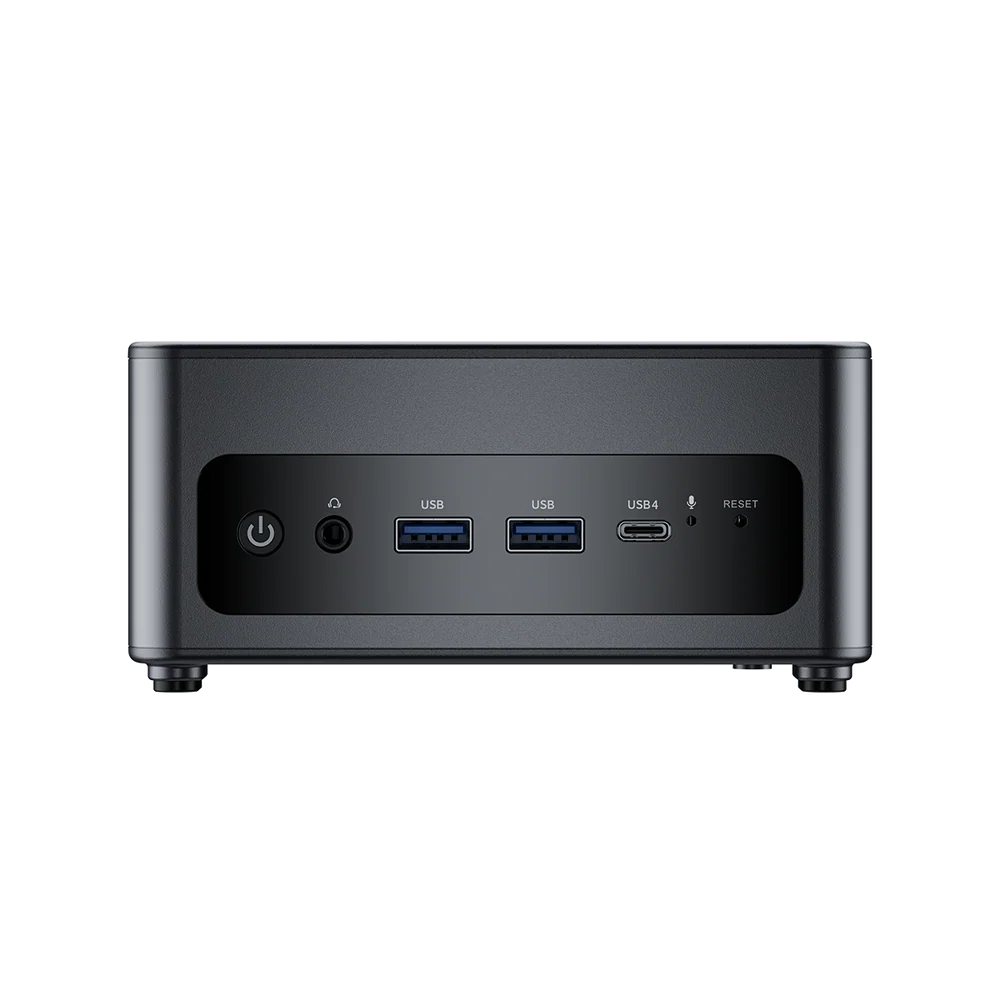
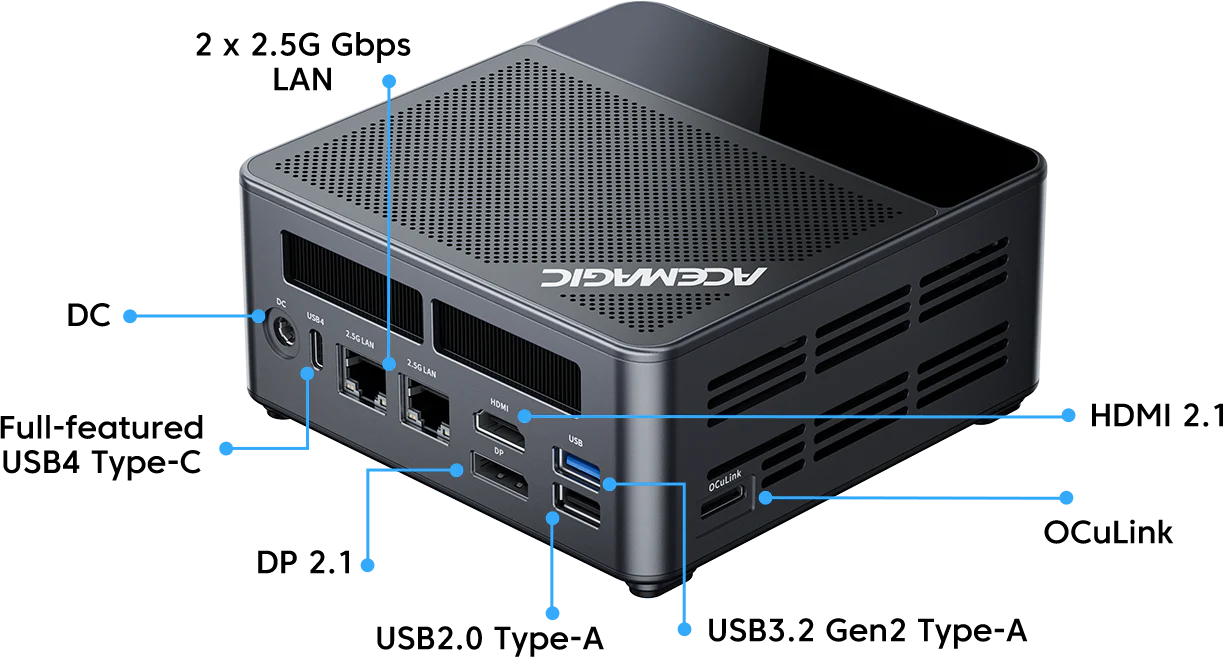
Front: 2× USB-A 3.2 Gen2 (10 Gbps) · 1× USB4 (40 Gbps, 100W PD / DP Alt Mode / Data) · 1× 3.5mm audio jack · Power button · RGB button
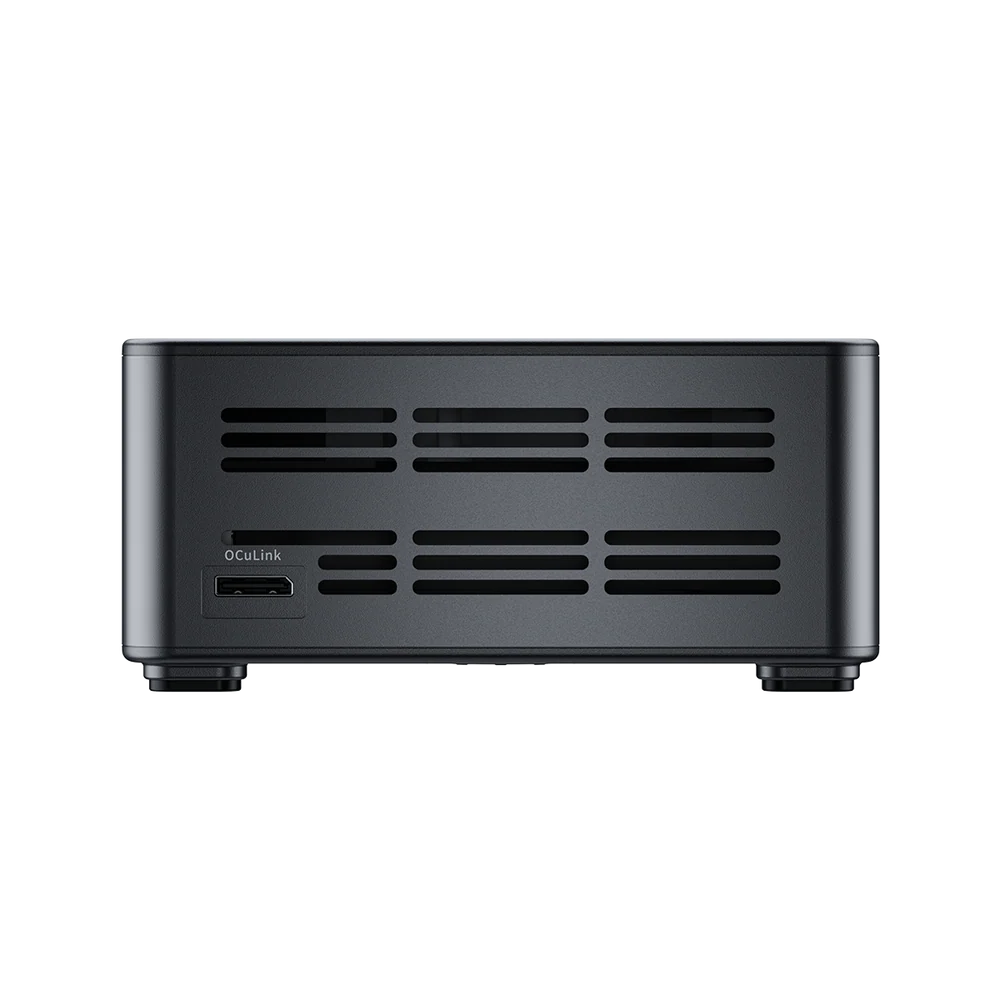
Rear: 1× HDMI 2.1 FRL (8K@60Hz) · 1× DisplayPort 2.1 (8K@60Hz / 4K@240Hz) · 1× USB4 (40 Gbps, 100W PD / DP Alt Mode / Data) · 2× USB-A 3.2 Gen2 (10 Gbps) · 2× RJ45 2.5 Gigabit Ethernet · 1× OCuLink PCIe 4.0 ×4 (64 Gbps — no hot-plug) · 1× 3.5mm audio jack · 1× CLR CMOS button · 1× DC power input





Additional information
Specification: ACEMAGIC F5A AMD Ryzen™ AI 9 HX 370
| Configuration Options | ||||||||||||||||||||||||||
|---|---|---|---|---|---|---|---|---|---|---|---|---|---|---|---|---|---|---|---|---|---|---|---|---|---|---|
|
||||||||||||||||||||||||||
| AI Capabilities | ||||||||||||||||||||||||||
|
||||||||||||||||||||||||||
| Processor | ||||||||||||||||||||||||||
|
||||||||||||||||||||||||||
| Ports | ||||||||||||||||||||||||||
|
||||||||||||||||||||||||||
| Network | ||||||||||||||||||||||||||
|
||||||||||||||||||||||||||
| GPU | ||||||||||||||||||||||||||
|
||||||||||||||||||||||||||
| Internal Ports | ||||||||||||||||||||||||||
|
||||||||||||||||||||||||||
| Storage & RAM | ||||||||||||||||||||||||||
|
||||||||||||||||||||||||||
| Power | ||||||||||||||||||||||||||
|
||||||||||||||||||||||||||
| Others Specifications | ||||||||||||||||||||||||||
|
||||||||||||||||||||||||||
| Specification | ||||||||||||||||||||||||||
|
||||||||||||||||||||||||||


![MINIX NEO J50C-8SE, 8GB/240GB Intel Pentium Silver Mini PC with Windows 10 Pro (64-bit) [Dual-Band Wi-Fi/Gigabit Ethernet/4K @ 60Hz/Triple Display/USB-C/Auto Power On/Vesa Mount]](https://minis-pc.com/wp-content/uploads/thumbs_dir/minix-neo-j50c-8se-8gb240gb-intel-pentium-silver-mini-pc-with-windows-10-pch6lqfmof7sigvrdl8qe2n622kluc7qrnf77wrz8g.jpg)


