
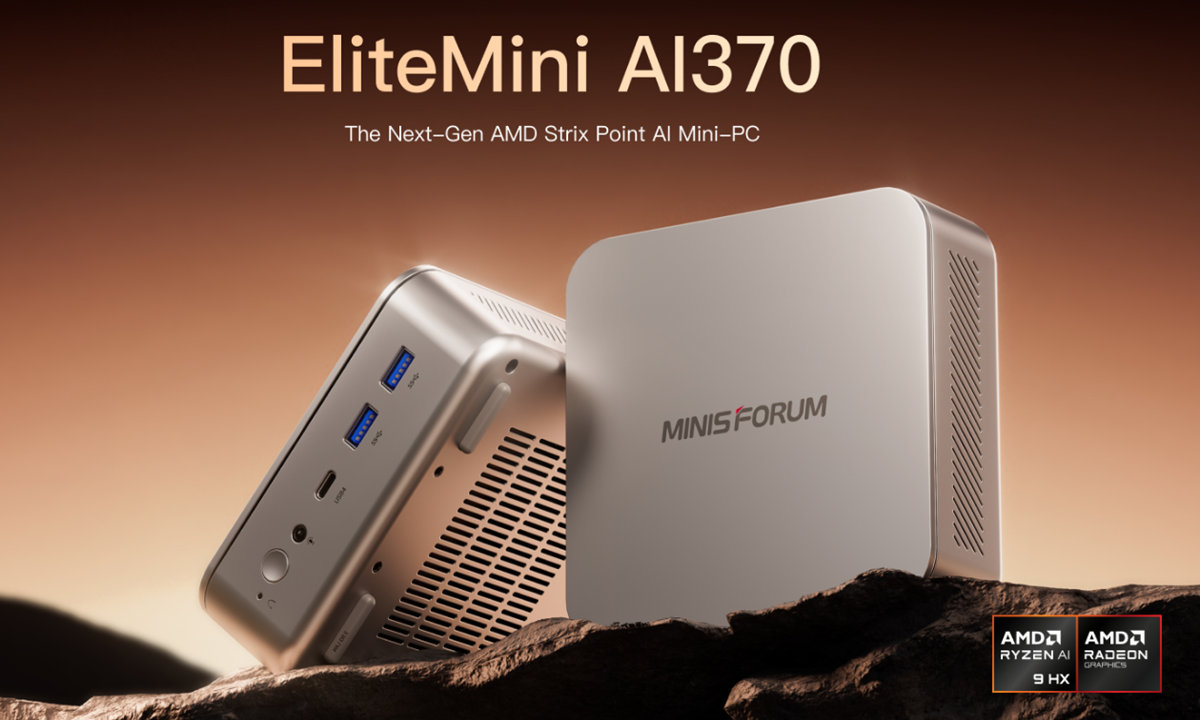
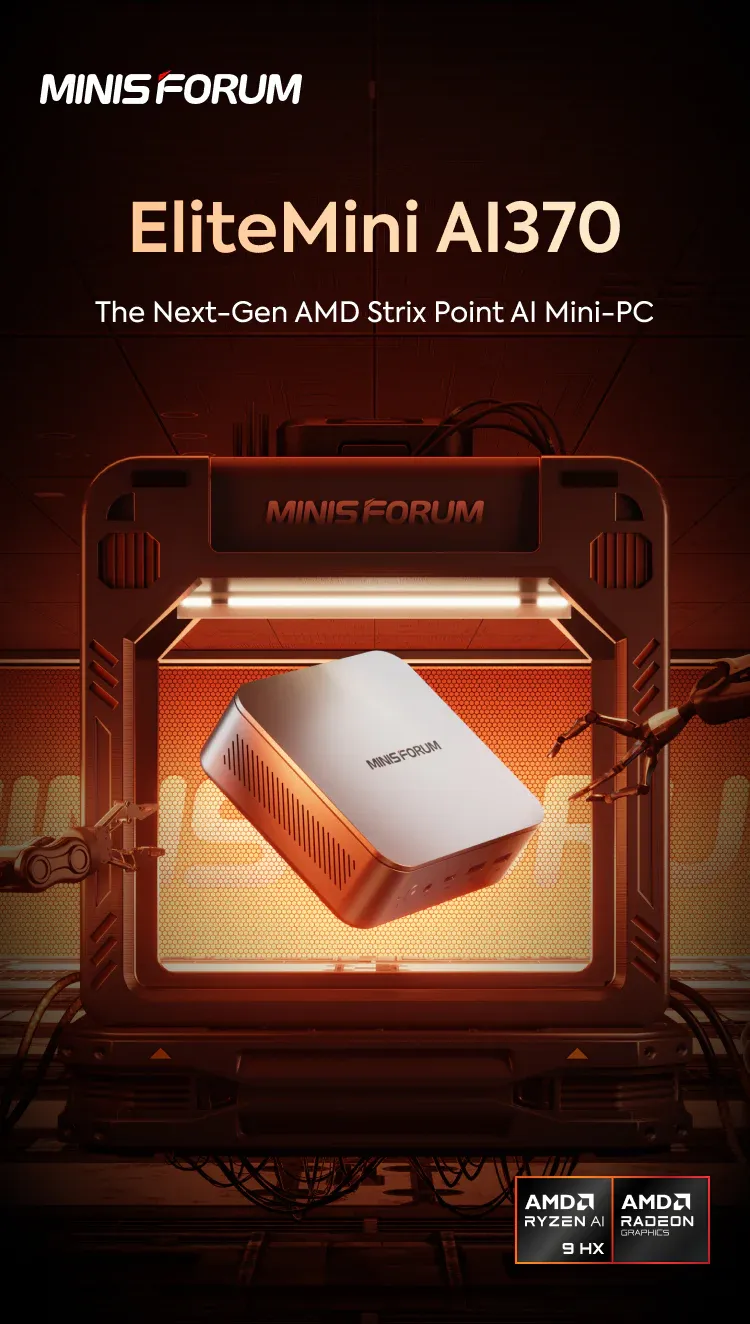
When AMD launched the Ryzen AI 9 HX 370 in mid-2024, the mini PC market moved faster than anyone expected. Within weeks, Minisforum had the EliteMini AI 370 in reviewers’ hands — one of the first compact desktops built around the Strix Point platform. Eighteen months later, it remains a benchmark for the category. This is a detailed assessment of everything the AI 370 does, how it does it, and where it stands in a market that has since produced more than a dozen competing HX 370 systems.
Context: Why the EliteMini AI 370 Matters
The Minisforum EliteMini AI 370 occupies a historically significant position in the mini PC market. It was among the very first systems to bring AMD’s Strix Point architecture — with its combination of Zen 5 CPU cores, RDNA 3.5 integrated graphics, and XDNA 2 NPU — to the compact desktop form factor. The reviews it generated in late 2024 established the performance baseline for this chip in mini PC contexts, and the specifications it shipped with informed the design decisions of every competing system that followed.
Understanding the AI 370 in 2026 means understanding it in two contexts simultaneously: as the machine it was when it launched, and as the machine it is today relative to the expanded field of HX 370 alternatives from GEEKOM, ACEMAGIC, Beelink, and others. In both contexts, there are meaningful things to say — some of them flattering, some of them not, all of them worth understanding before a purchase decision.
Processor: AMD Ryzen AI 9 HX 370 — A Genuine Generational Leap
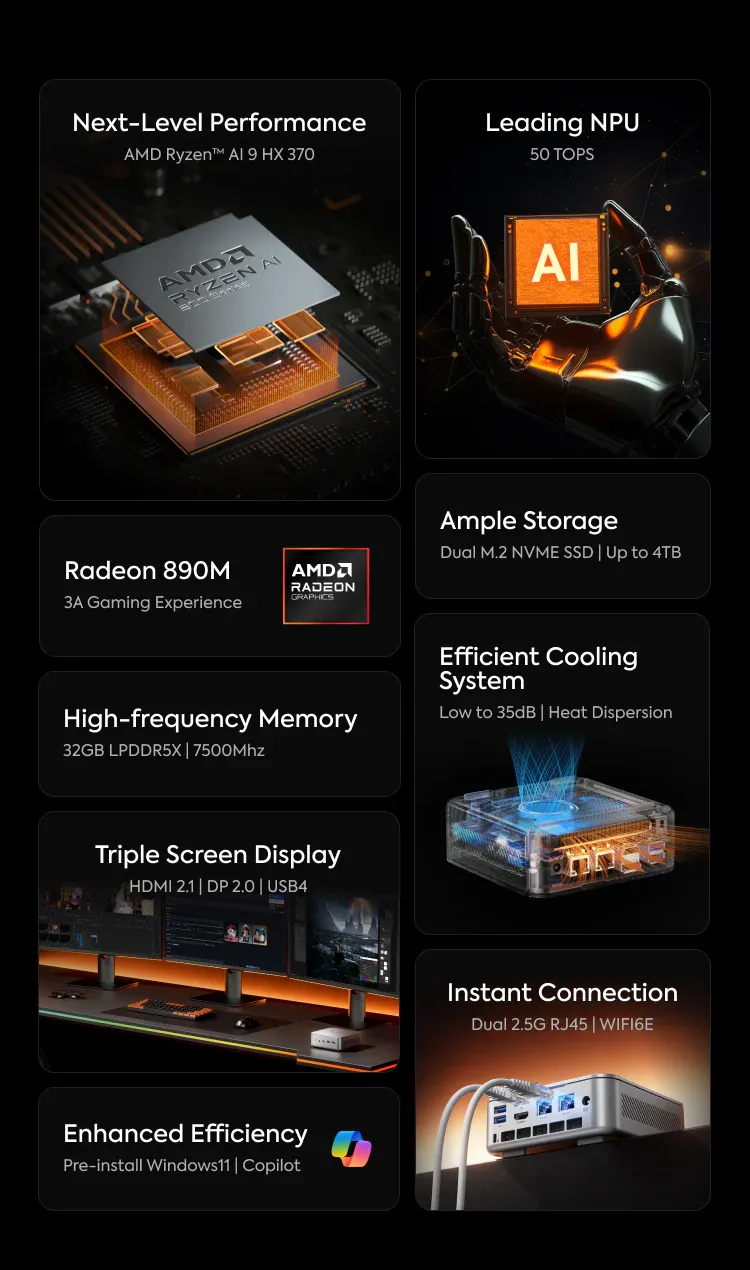
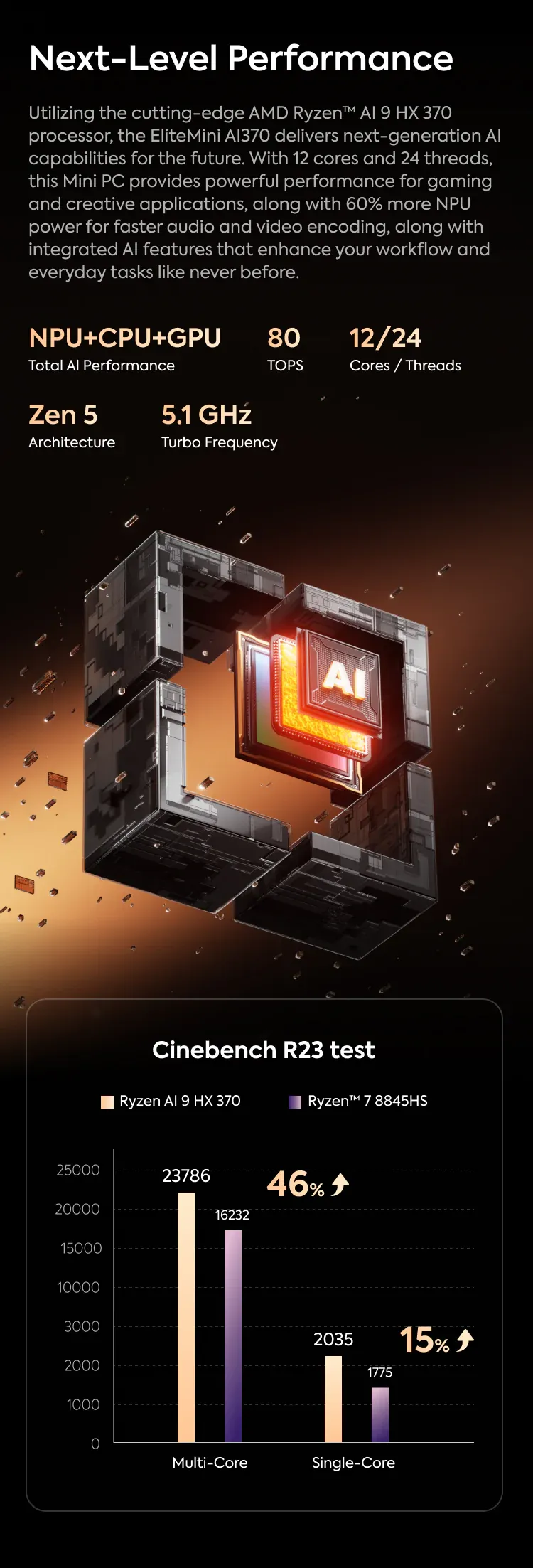
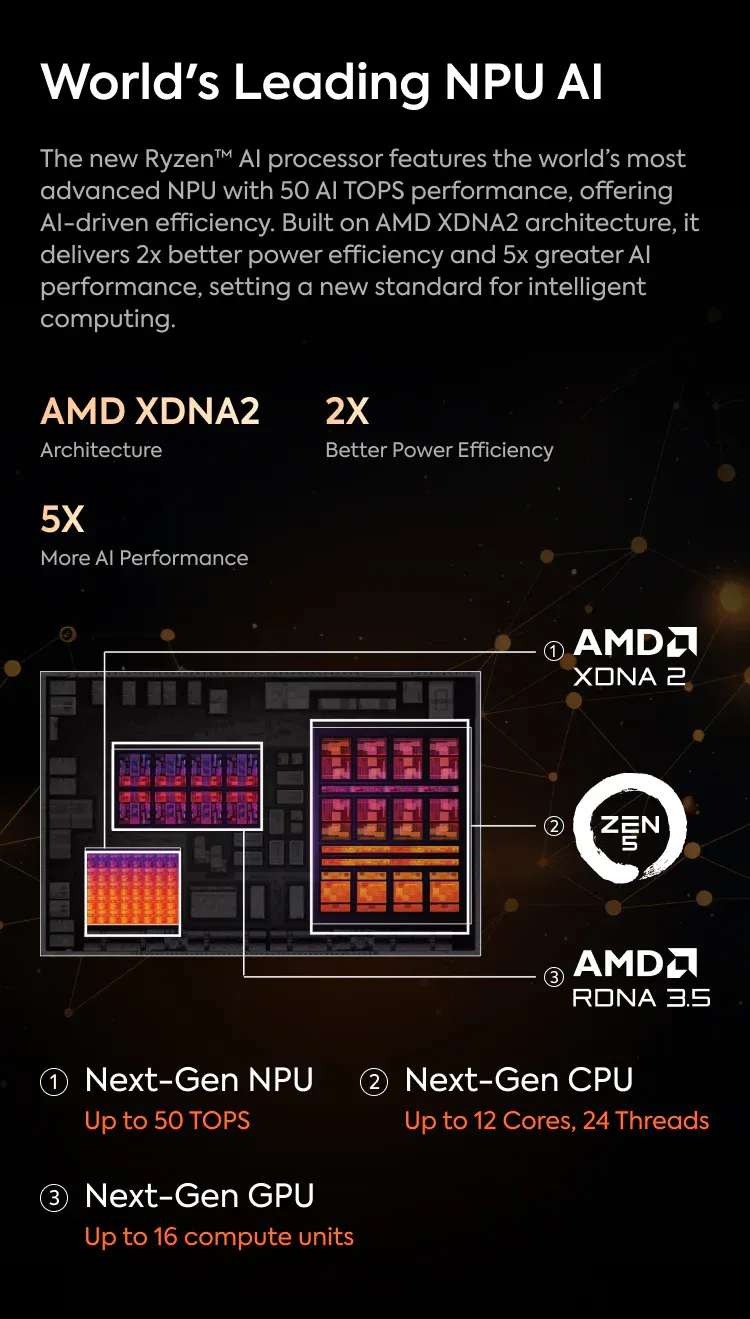
The Ryzen AI 9 HX 370 is AMD’s flagship Strix Point APU, and it represents one of the most significant architecture improvements in AMD’s laptop and compact desktop processor history. The Zen 5 microarchitecture delivers meaningful IPC improvements over Zen 4 — independent analysis consistently places Zen 5 P-core IPC approximately 16% higher than Zen 4 at equivalent clock speeds — while the hybrid layout adding eight Zen 5c efficiency cores alongside four full Zen 5 performance cores creates a twelve-core, twenty-four-thread chip that handles both demanding single-threaded applications and heavily parallel workloads with equal confidence.
The performance numbers from the EliteMini AI 370’s real-world testing are genuinely impressive. In multi-core benchmark testing, the HX 370 in this chassis delivers results that consistently outperform Intel’s Core i9-12900H — an 8+16 core chip that powered premium performance laptops at $2,500+ price points two years ago — despite operating at substantially lower power limits. NotebookCheck concluded their processor assessment by noting the AI 370 “delivers excellent performance for its size” and described it as “one of the most efficient devices we have tested to date.” That is not marketing language. That is a specific technical claim about performance-per-watt, and it reflects accurately the advantage of TSMC’s 4 nm process applied to AMD’s most current architecture.
The three BIOS-configurable power profiles deserve detailed attention because they fundamentally change the character of the machine depending on which one is selected. The Silent profile, operating at approximately 28W sustained, produces a system that is acoustically near-invisible in any normal room — the fan is audible if you place your ear near the chassis, and inaudible at desk distance. Performance is reduced compared to the Balanced profile but remains more than adequate for office productivity, web browsing, and everyday media use. For always-on deployments, home server roles, or quiet office environments, the Silent profile transforms the AI 370 into a machine that disappears entirely from sensory awareness while remaining fully functional.
The Balanced profile — 45W sustained PL1, 54W short burst PL2 — is the default and the configuration under which almost all published reviews were conducted. At this power level, the HX 370 operates near its rated capability for sustained workloads, and the cooling system manages thermal output without triggering throttling under realistic use cases. Fan noise under sustained load is audible but not intrusive — present in a quiet room, masked by any audio from connected speakers or headphones.
The Performance profile, unlocking up to 65W sustained, extracts the chip’s maximum capability for applications that can use all twelve cores continuously. Video rendering, 3D modelling compilation, and extended AI inference workloads benefit from the additional headroom. Fan noise increases correspondingly and becomes the loudest acoustic element of the room in quiet environments.
GPU: Radeon 890M — The Best Integrated GPU in a Standard APU
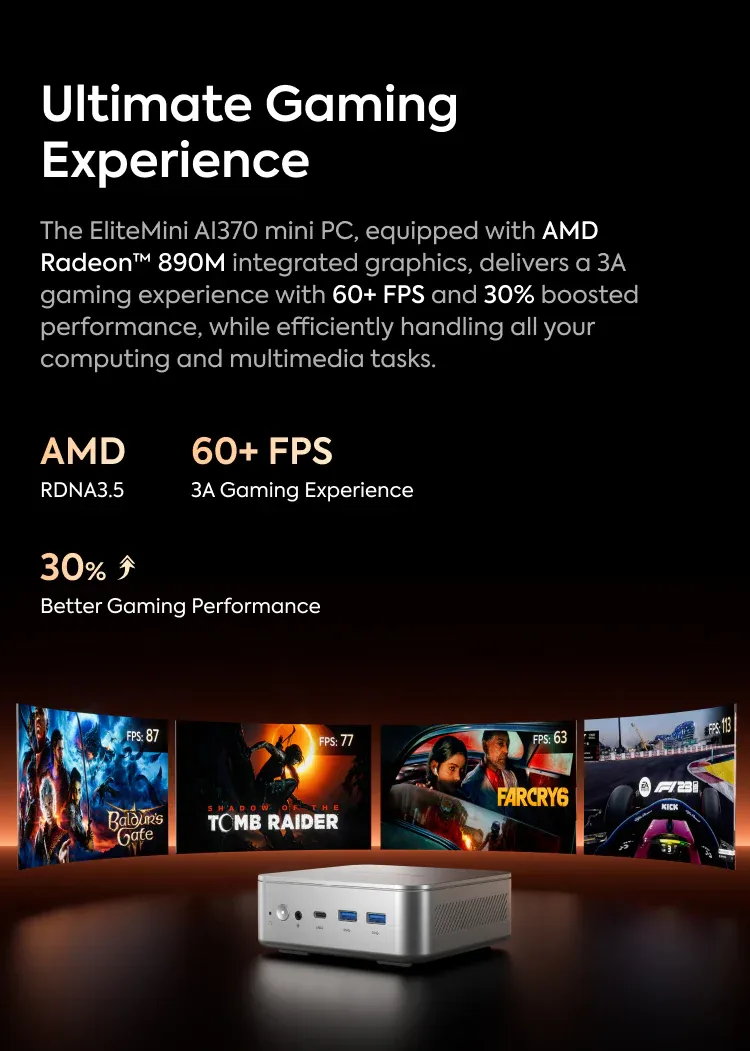
The Radeon 890M is the integrated graphics engine embedded in the HX 370 die, and in 2024 it was the most capable integrated GPU ever placed in a standard-TDP mobile processor. In 2026, it shares that distinction with the same engine in newer Strix Point and Gorgon Point variants — all of which use the same 16 RDNA 3.5 compute unit configuration at 2.9 GHz. The architectural advantages of RDNA 3.5 over its predecessor include improved ray tracing units, higher throughput per compute unit, and better compatibility with the current suite of graphics APIs including DirectX 12 Ultimate and Vulkan 1.3.
In practical gaming terms, the 890M in the EliteMini AI 370 delivers what no integrated GPU of the previous generation could claim: genuinely playable frame rates in mainstream gaming titles at 1080p without heroic settings compromises. Forza Horizon 5, CS2, Baldur’s Gate 3 at medium-to-high settings, Far Cry 6, F1 23 — all produce frame rates above 45 FPS at 1080p in Minisforum’s own testing, with some titles exceeding 60 FPS with AMD FSR enabled. This does not make the EliteMini AI 370 a gaming PC in the sense that a dedicated GPU system is a gaming PC. It makes it a system that can play games as a secondary activity without requiring a separate gaming device — a meaningfully different and genuinely useful capability.
For creative applications, the 890M’s AV1 hardware encode and decode engine is a workflow accelerator that becomes immediately apparent for anyone who regularly exports video. DaVinci Resolve and Adobe Premiere Pro both expose the AV1 hardware encoder, and export times for H.265 and AV1 content are substantially shorter than CPU-only rendering on any system without GPU-accelerated encoding.
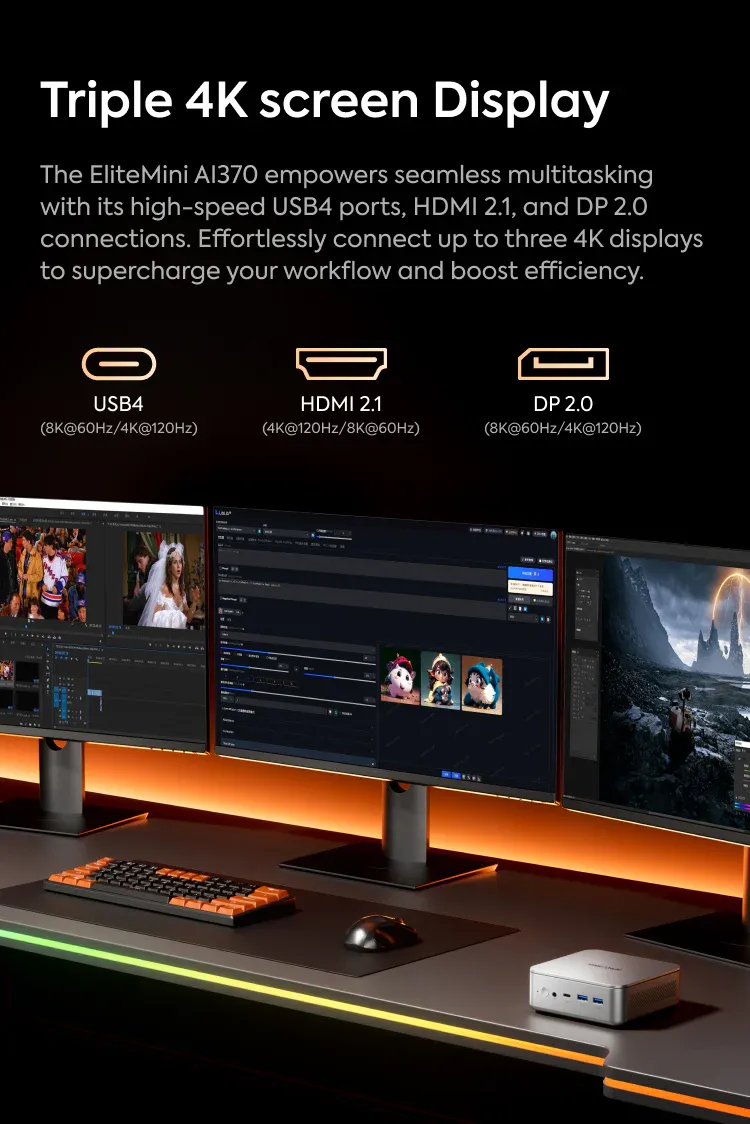
The display output configuration is exceptional for a machine of this size and price. HDMI 2.1 driving 8K at 60 Hz or 4K at 120 Hz, two dedicated DisplayPort 1.4 outputs each supporting 4K at 144 Hz, and USB4 in DisplayPort Alt Mode for a fourth 8K display — this is a quad-display configuration that matches or exceeds competing systems costing significantly more, and it is driven entirely by the 890M’s internal display engine without requiring any external hardware.
One limitation that requires honest acknowledgment: the 890M’s shared memory pool is constrained by the 32 GB soldered LPDDR5X configuration. Systems with SO-DIMM slots supporting 64 or 128 GB — the GEEKOM A9 Max, ACEMAGIC F5A, Minisforum AI X1 Pro-470 — provide the 890M with access to a much larger VRAM allocation for AI inference tasks involving large model weights. For a user running LLaMA 3 70B at 4-bit quantisation through LM Studio, the 32 GB ceiling is the binding constraint on which models can be loaded fully into memory without layer offloading.

AI Engine: XDNA 2 NPU — 50 TOPS and What They Actually Mean
The XDNA 2 NPU is the third compute engine in the HX 370 alongside the CPU and GPU, and it is the component that most clearly distinguishes Strix Point from every preceding AMD APU generation. Fifty TOPS of dedicated neural processing sounds impressive as a marketing number, and the practical implications are worth unpacking carefully.
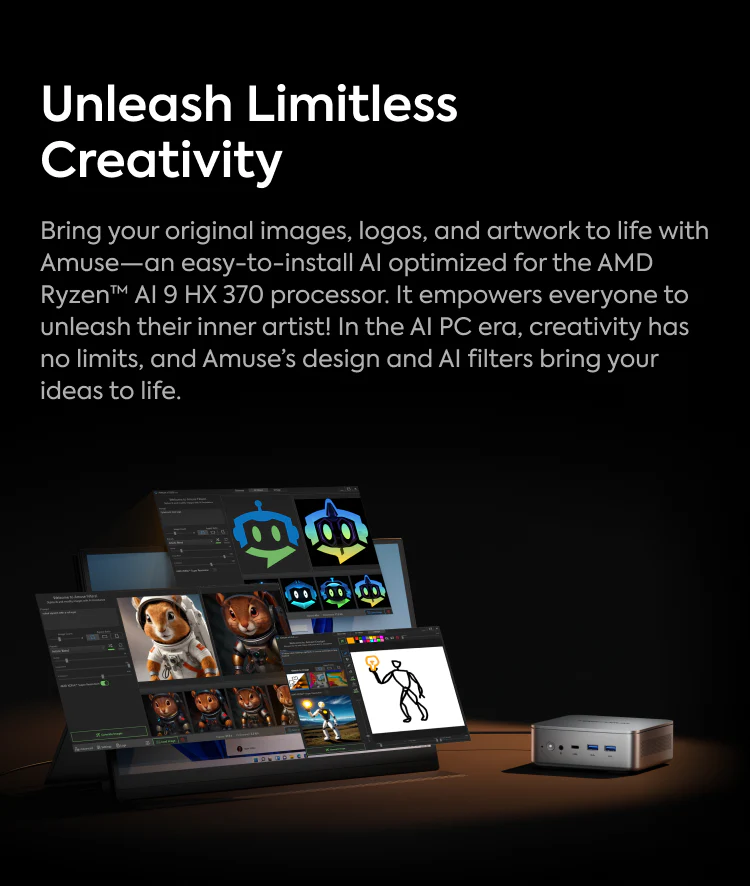
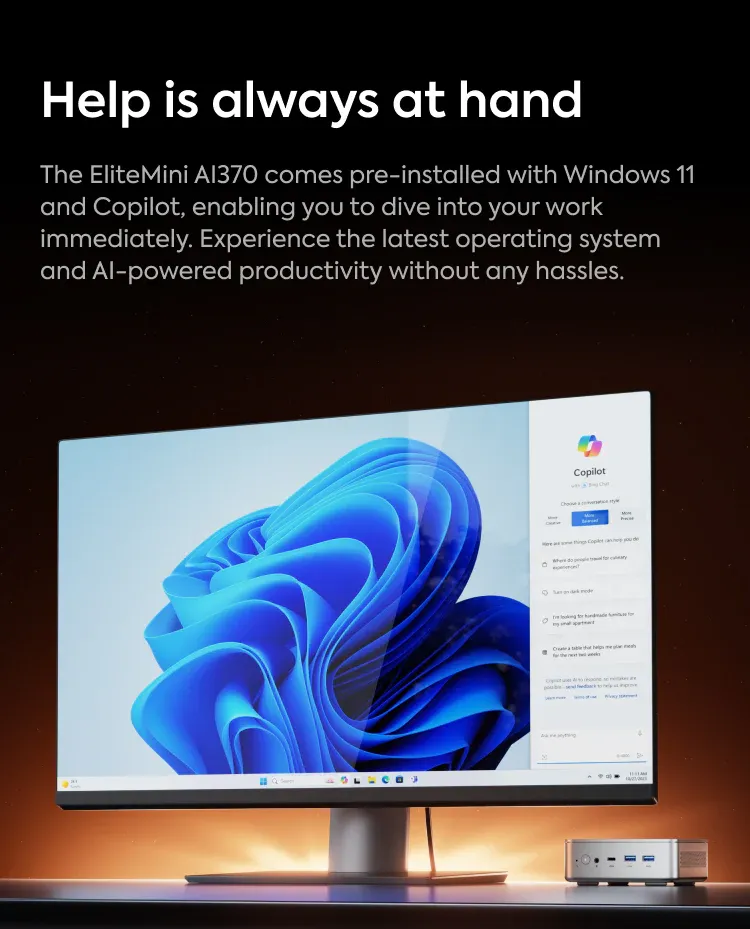
In the Windows 11 Copilot+ feature set, the NPU’s role is clear and consistent: it handles the inference workloads for Recall, live caption translation, AI image generation in Paint and Photos, and the AI audio effects in the microphone settings. These features run locally, without internet connectivity, without cloud latency, and without subscription fees. On systems that lack an NPU — including the Bosgame M4, GEEKOM A8 Max, and every N-series mini PC — these features simply do not function. On the EliteMini AI 370, they work as designed and do not consume CPU or GPU resources in the process, because the XDNA 2 NPU handles them on its own power domain.
For more demanding local AI inference — running Phi-3, Mistral 7B, or similar language models through LM Studio or Ollama — the XDNA 2 NPU contributes to the processing pipeline alongside the GPU, which handles the heavier matrix multiplication operations. Total system AI throughput of 80 TOPS positions the AI 370 well above the 40 TOPS Copilot+ threshold and at a meaningful practical capability level for compact AI inference. The binding constraint in this scenario is not TOPS but memory: 32 GB limits the maximum unquantised model size, and 4-bit quantised models up to approximately 13B parameters are the practical ceiling for full in-memory loading.
Memory: The Elephant in the Room
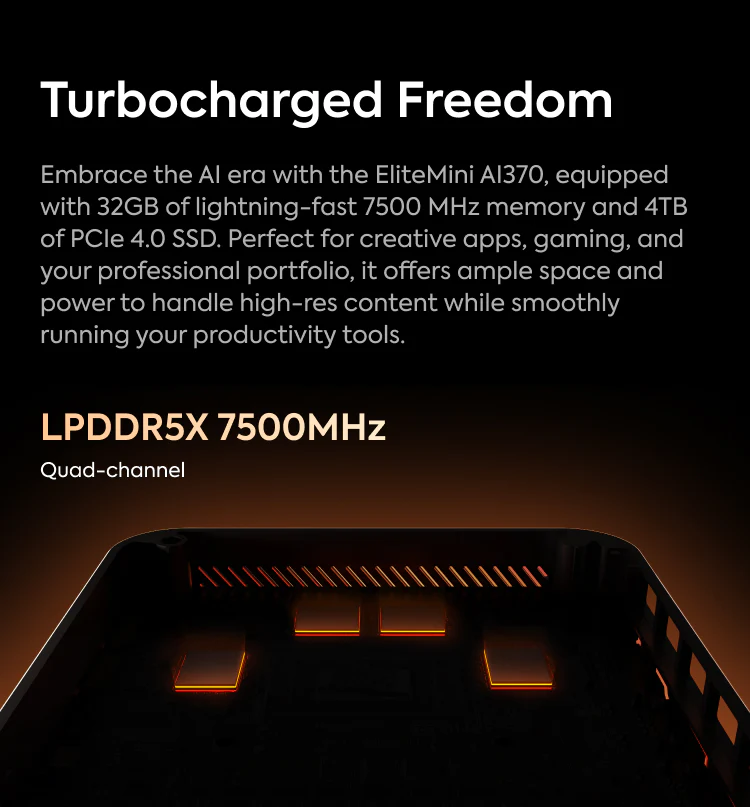
Every substantive review of the EliteMini AI 370 raises the same point, and this assessment will not avoid it: 32 GB of permanently soldered LPDDR5X memory is the machine’s defining limitation, and it was already a limitation at launch in October 2024 when competing systems with SO-DIMM slots were beginning to emerge.
The technical argument for LPDDR5X soldering is real — the 7,500 MT/s speed provides higher bandwidth per GB than the 5,600 MT/s DDR5 SO-DIMM modules in competing systems, which benefits the Radeon 890M GPU’s memory access patterns and the XDNA 2 NPU’s data throughput. But bandwidth is not the constraint for most workloads; capacity is. A buyer who purchases the EliteMini AI 370 today cannot add a second SO-DIMM to expand to 64 GB when their needs grow. They cannot run larger AI models without quantisation compromises. They cannot simultaneously maintain a large virtual machine alongside a memory-intensive creative application without paging.
Tom’s Guide’s reviewer specifically flagged this as the reason the AI 370 narrowly missed a full recommendation. NotebookCheck noted that Minisforum does not offer a 64 GB version, closing the door on capacity expansion through configuration choice as well as hardware upgrade.
This matters more in 2026 than it did in late 2024, because the intervening eighteen months have produced HX 370 competitors with SO-DIMM slots supporting 64 to 128 GB: the GEEKOM A9 Max (128 GB), ACEMAGIC F5A (96 GB), and Minisforum AI X1 Pro-470 (128 GB) all provide the upgrade path the EliteMini AI 370 lacks. For buyers whose current workloads fit within 32 GB, this distinction is irrelevant. For buyers who anticipate memory-intensive AI workflows over the next two to three years of ownership, it is worth weighing seriously.

Connectivity: USB4 Nuances Worth Understanding
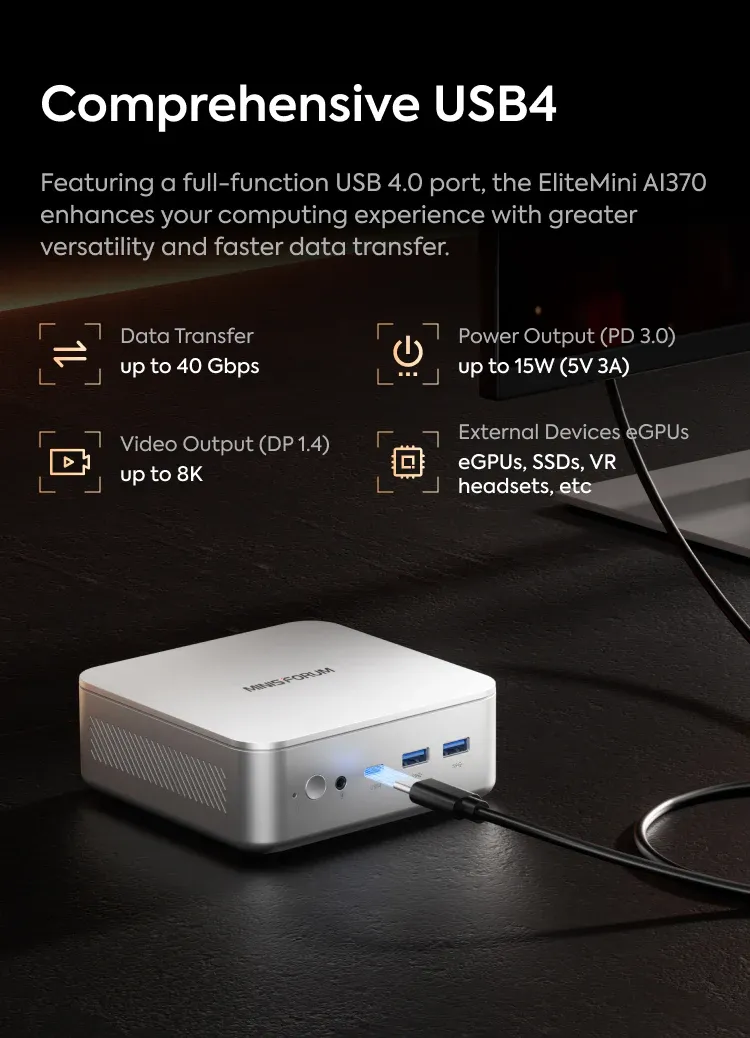
The EliteMini AI 370’s connectivity specification is strong overall, but contains one detail that is not always clearly communicated in marketing materials: the two USB4 ports operate at different speeds. The front-panel USB4 port runs at Gen3×2 — 40 Gbps — with DisplayPort Alt Mode and compatibility with Thunderbolt 4 peripherals and eGPU enclosures at full bandwidth. The rear-panel USB4 port runs at Gen2×1 — 20 Gbps — also with DisplayPort Alt Mode but at half the data bandwidth.
For most use cases, this distinction is irrelevant: driving a 4K or 8K display through either port works identically, and most peripherals do not saturate 20 Gbps. For users planning to connect an external GPU dock or high-speed NVMe enclosure requiring the full 40 Gbps connection, only the front USB4 port provides the required bandwidth. This is a real-world planning consideration for specific buyers, and it is worth noting explicitly.
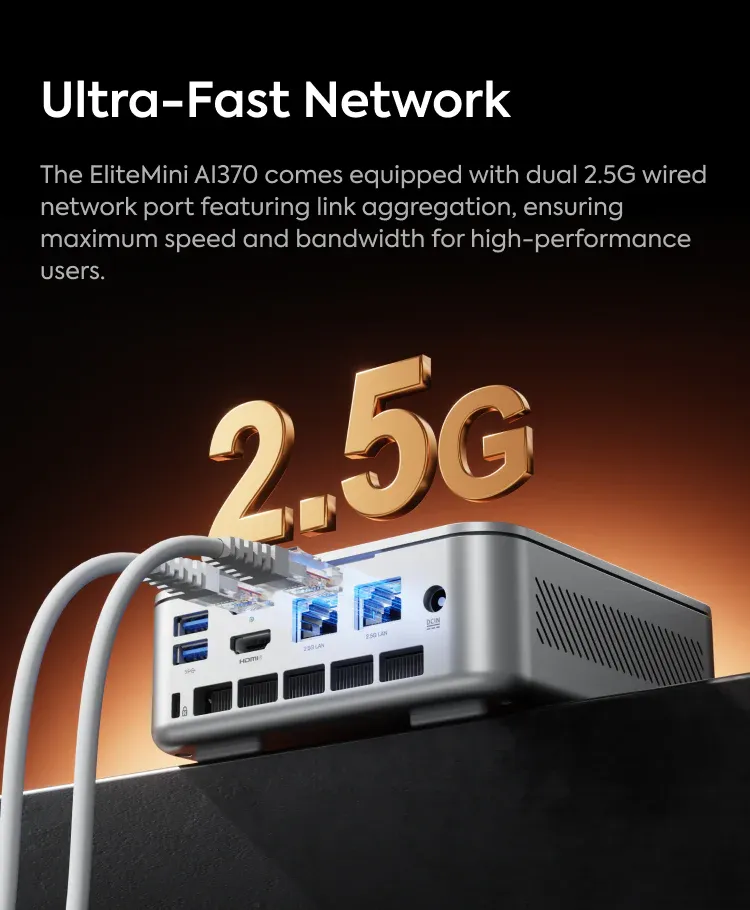
The dual 2.5 GbE Ethernet configuration is genuinely valuable and differentiates the AI 370 from single-port competitors like the Beelink SER9 Pro. Intel Killer Wi-Fi 6E with the AX1675x module provides tri-band wireless including 6 GHz band support — the same module that earned consistent praise in the Minisforum UM780 XTX. Four USB 3.2 Gen2 Type-A ports across front and rear panels provide sufficient peripheral connectivity for most desktop setups without requiring a hub. The Kensington lock slot is a practical addition for shared environments that many competing mini PCs omit.
Thermal Design: What the IceCool Pro System Actually Delivers
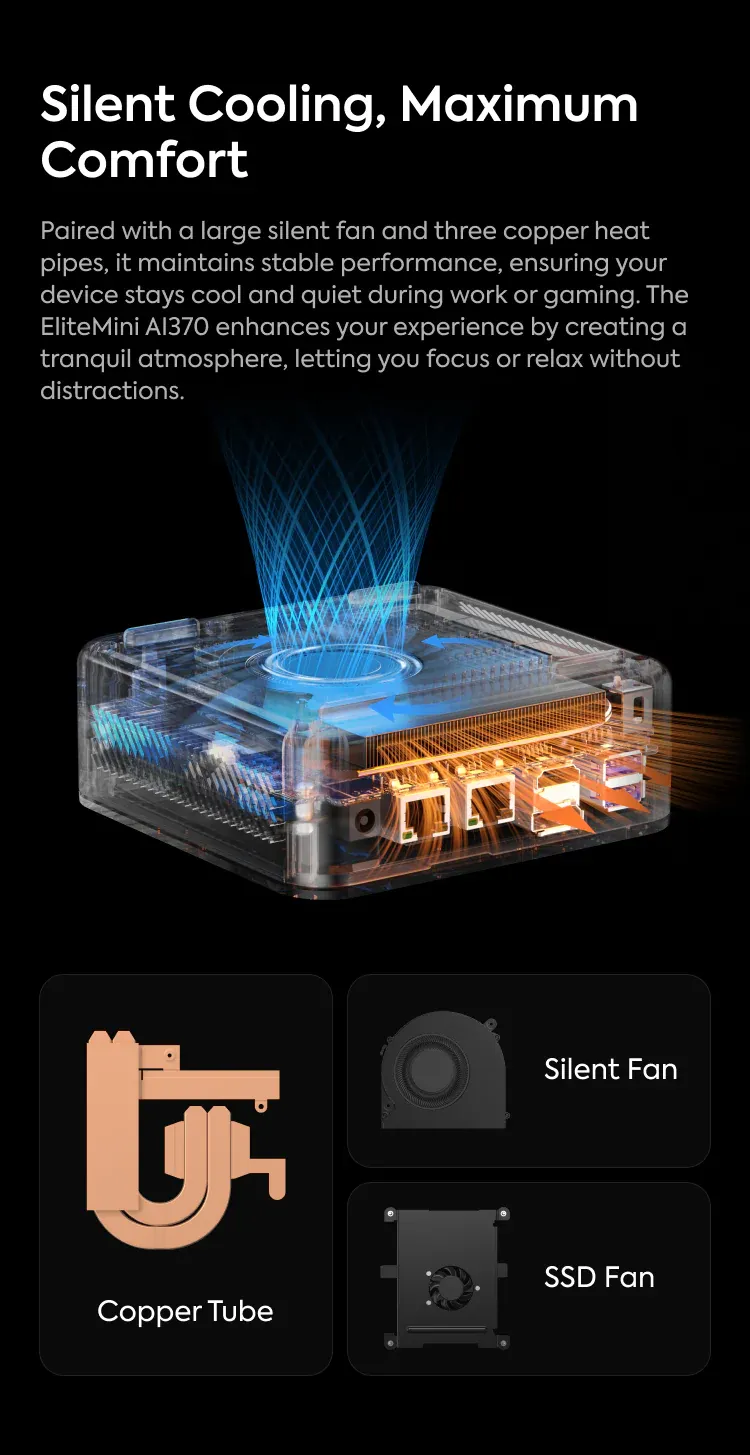
The IceCool Pro thermal system uses a copper base plate in direct contact with the HX 370 die, dual copper heat pipes conducting heat to a copper fin stack, and a high-speed blower fan exhausting through side ventilation slots. Air enters through perforations in the bottom panel and exits through the sides — a layout that keeps the top surface cool and directs hot exhaust air sideways rather than up toward a monitor or down toward a desk surface.
Under the default Balanced profile, independent testing confirms that the system manages the HX 370’s 45W PL1 sustained power limit without thermal throttling during realistic workloads. CPU junction temperatures peak in the 85–90°C range under extended full-core stress — within AMD’s operating specification but with reduced margin compared to larger systems with more generous heatsink volume. In ambient temperatures above 28°C, users in hot climates may find that the system approaches its thermal ceiling more frequently under sustained load than in cooler environments. Switching to the Balanced profile from Performance in such conditions reduces thermal stress while maintaining adequate throughput for most workloads.
Fan noise in real-world operation is a nuanced story. At idle and light load — web browsing, email, document editing — the fan is effectively inaudible at desk distance. Under moderate load — video streaming, light gaming, office multitasking — the fan produces a low hum that is perceptible in a quiet room but masked by any audio from connected speakers. Under sustained multi-core stress in the Performance profile — long renders, extended AI inference, benchmark runs — fan noise becomes clearly audible and is the dominant acoustic element in the room. This progression is broadly consistent with competing HX 370 systems of similar thermal density, and is not unique to Minisforum’s implementation.
Design: Silver Plastic, Small Footprint, VESA Included
The EliteMini AI 370 measures 130 × 127 × 47 mm and weighs 680 g — genuinely compact, lighter than a lunchbox, and small enough to mount behind a monitor without the mount adapter being visible from the front. The silver plastic chassis with its rounded corners and clean surface finish reads as professional office hardware rather than gaming equipment, which will suit most buyers for whom the machine is primarily a work tool.
The plastic construction has been consistently noted by reviewers as inconsistent with the premium price point. The GEEKOM A9 Max’s aerospace-grade aluminium chassis, the Beelink SER9 Pro’s composite construction, and the ACEMAGIC F5A’s CNC metal lower half all provide a more premium tactile impression for similar or slightly higher prices. The EliteMini AI 370’s plastic does not flex or creak, and the build quality is adequate, but it does not convey the material confidence of its competitors.
The VESA 75×75 mount adapter included in the box enables rear-of-monitor installation — a practical feature for users who want to eliminate the machine from their desk footprint entirely. The four-screw bottom panel provides access to the storage slots and cooling assembly for maintenance and upgrades.

Where the EliteMini AI 370 Stands in 2026
The EliteMini AI 370 launched as the first major HX 370 mini PC and established the performance benchmark for the category. Eighteen months later, the category it pioneered has expanded substantially, and several competing systems have addressed the constraints that reviewers identified in the AI 370.
The GEEKOM A9 Max provides the same HX 370 platform with SO-DIMM slots supporting 128 GB, dual HDMI 2.1 outputs, IceBlast 2.0 cooling, and an aluminium chassis — addressing the memory, build quality, and video output limitations simultaneously. The ACEMAGIC F5A adds OCuLink eGPU support, dual USB4 with 100W PD, and DisplayPort 2.1. The Minisforum AI X1 Pro-470 offers the updated HX 470 silicon with 55 TOPS NPU, triple M.2 slots, OCuLink, dual USB4, integrated PSU, fingerprint reader, and DMIC microphones.
What the EliteMini AI 370 retains that some of these alternatives lack is its combination of compact footprint, Kensington lock, dual 2.5 GbE with Intel Killer Wi-Fi 6E, and — for buyers whose workloads fit within 32 GB — a thoroughly reviewed and proven platform that has been in production long enough for Minisforum to address early firmware issues through updates. It is no longer the definitive HX 370 mini PC, but it remains a competent, well-understood, and reasonably priced entry into the Strix Point mini PC category.
For buyers whose needs include expandable RAM, OCuLink eGPU support, or a premium build, the newer alternatives are worth the additional cost. For buyers whose priorities are compact footprint, proven reliability, dual 2.5 GbE networking, Kensington lock security, and the HX 370’s excellent CPU and AI performance within a 32 GB memory envelope, the EliteMini AI 370 remains a rational and well-supported purchase.
Verdict: A Pioneer That Deserves Honest Assessment
The Minisforum EliteMini AI 370 earned its reputation as one of the defining mini PCs of 2024. Its processor performance, integrated graphics capability, NPU-driven AI features, and connectivity specification set the standard that every subsequent HX 370 mini PC was measured against. NotebookCheck’s “one of the most efficient devices we have tested” is a genuine compliment from a publication that applies consistent methodology across hundreds of systems annually.
The 32 GB non-upgradeable memory remains the product’s defining constraint — one that was noted at launch and remains unresolved, because hardware cannot be changed through software updates. In a product category that is increasingly defined by local AI model inference, where memory capacity directly determines which models can be used and at what quality level, this constraint grows more relevant with each passing month.
Buy the EliteMini AI 370 if you want a proven, compact, Kensington-secured HX 370 mini PC with dual 2.5 GbE and excellent display output for workloads that fit within 32 GB. Look at the GEEKOM A9 Max if you need expandable memory. Look at the AI X1 Pro-470 if you need OCuLink, more storage slots, or the updated HX 470 silicon. The right choice depends entirely on which constraints matter for your specific use case — and the EliteMini AI 370 is excellent at what it does, within those constraints.
More information: Minisforum EliteMini AI 370 on minis-pc.com
Discover our full Mini PC comparison: minis-pc.com
Article written for minis-pc.com — Mini PC Comparisons and Reviews