
In a market where every new mini PC announcement reads like a spec sheet looking for a chassis, the Ayaneo AM02 did something genuinely unusual: it made people feel something. Specifically, it made people feel like they were eleven years old, sitting on a carpet in front of a CRT television, about to blow on a cartridge.
The Problem with Most Mini PCs
There is a peculiar anonymity epidemic in the mini PC market. Open any comparison table — including the ones on this website — and you will see the same pattern repeating: a black or silver box, some ventilation grilles, a cluster of ports, a spec sheet. Differentiation exists, but it happens inside the chassis, in processor generations and memory speeds and storage slot counts. The outside of the box is almost never the point.
This is rational. Most mini PCs are purchased for rational reasons: they are space-efficient, power-efficient, quiet, and capable. Nobody needs their office computer to tell a story. Nobody requires their home server to generate an emotional response. The anonymous black box serves its purpose without demanding anything from the user in return.
Ayaneo looked at this situation and decided, apparently, that it was a problem worth solving.
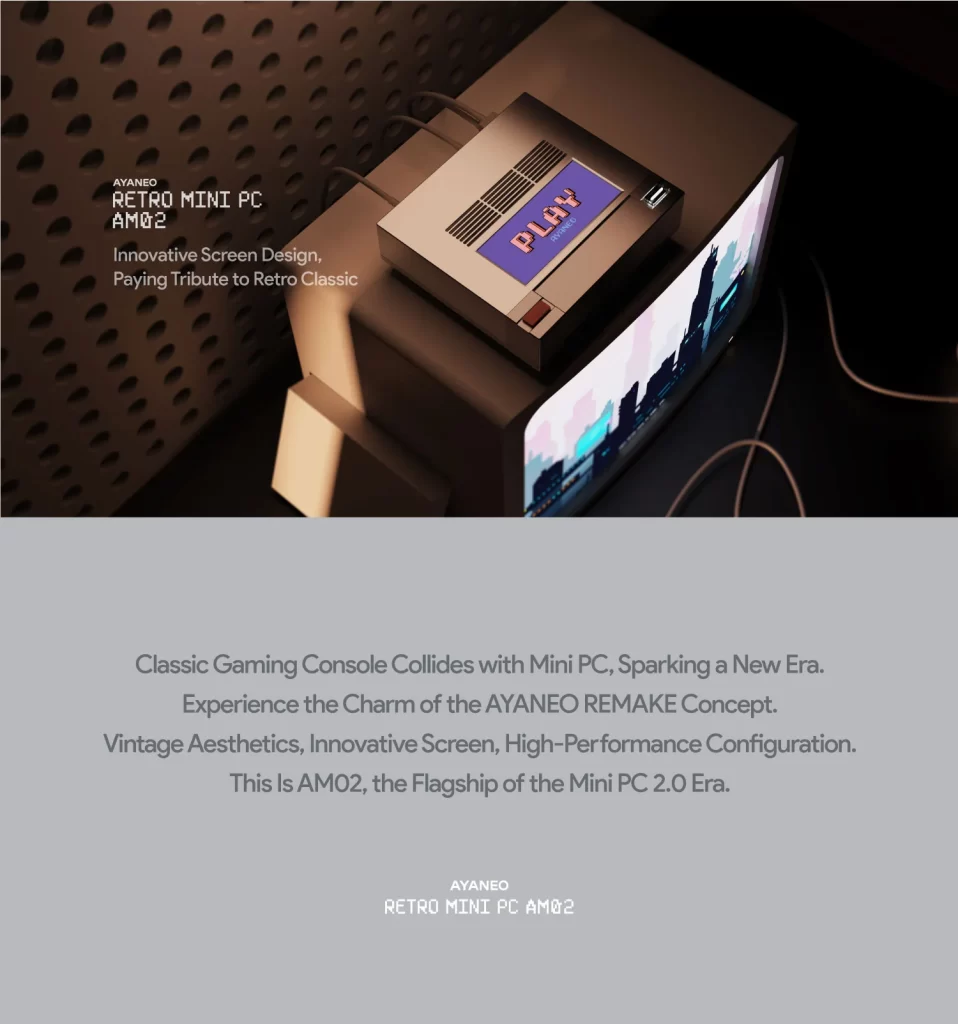
The AM02 is not the first mini PC to attempt a design-forward approach. Intel’s NUC line had moments of visual ambition. Various boutique builders have experimented with custom enclosures. But the AM02 is something different: a machine that has committed to a specific cultural reference with the kind of confidence that risks looking foolish if executed poorly, and succeeds in looking wonderful because it is executed extraordinarily well.
First Contact: The Cartridge Slot That Isn’t
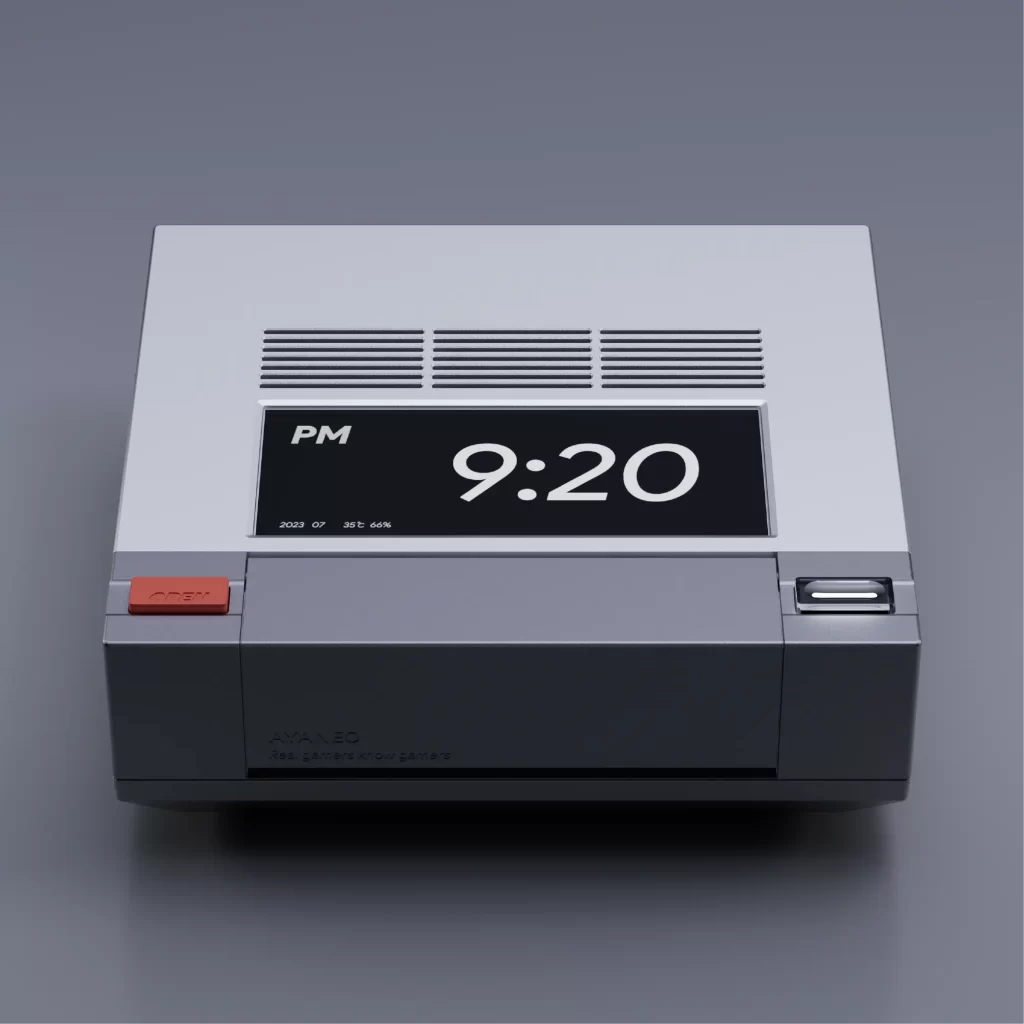
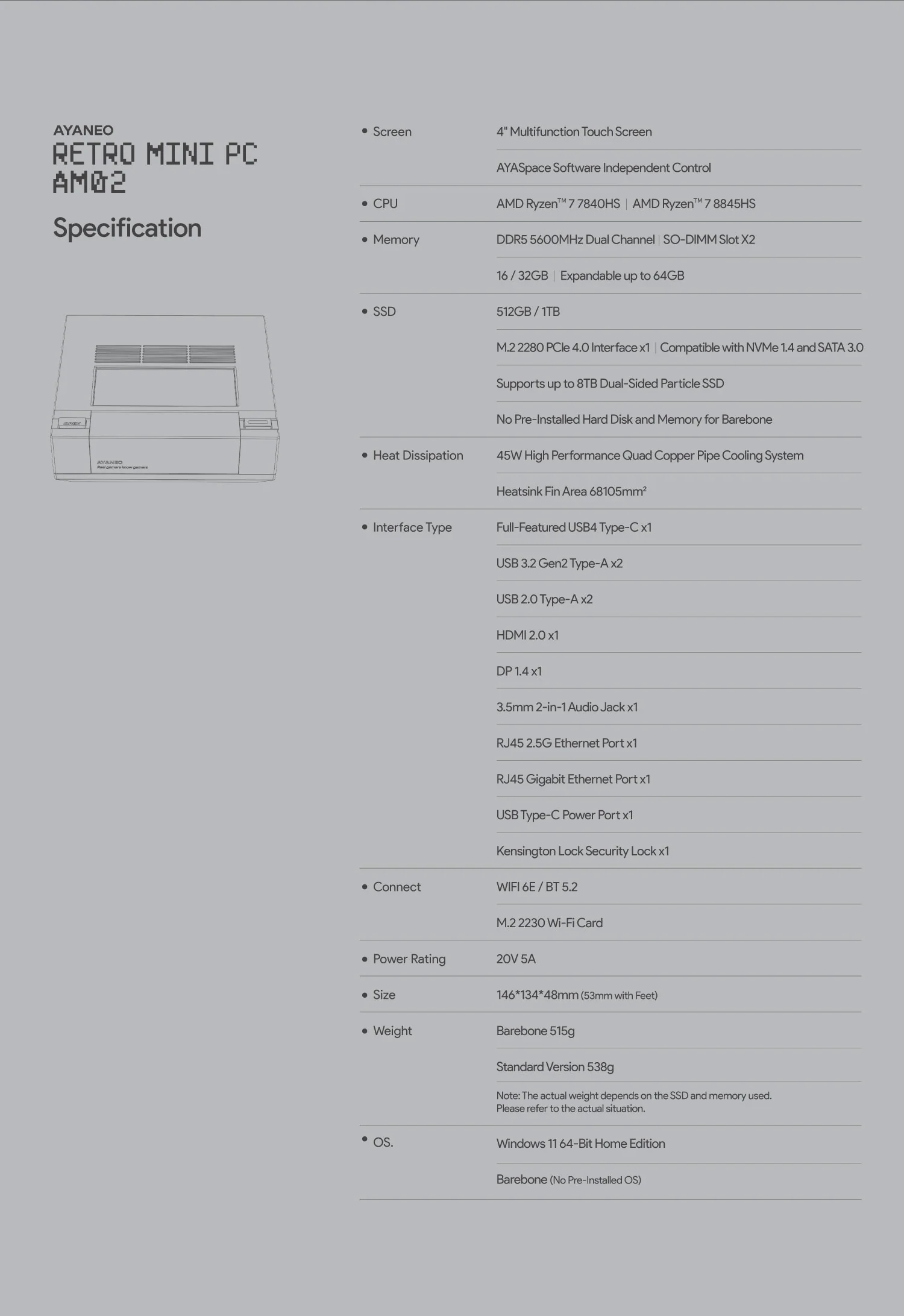
The AM02 measures 146 × 134 × 53 mm and weighs approximately 538 g. You can fit it in the side pocket of a backpack. At least one reviewer confirmed they had done exactly this, carrying it to a family gathering to connect to the living room television for a gaming session — an experience that would be practical with approximately zero other desktop computers.
The chassis is plastic rather than metal, which becomes immediately apparent in hand. This is the AM02’s most visible compromise compared to competing systems like the aluminium-clad GEEKOM A9 Max or the CNC-machined ACEMAGIC Retro X5. The plastic is adequately solid — there is no perceptible flex in the panels, and the vent grilles do not creak — but it does not convey the same premium tactile impression as brushed aluminium. AYANEO has offset this with careful attention to surface finish and colour matching: the dual-tone grey is consistent and precise, and the dark accent stripe running horizontally across the front is crisp enough to suggest injection moulding tooling of above-average quality.
Then you see the front cover, and the material question becomes secondary.
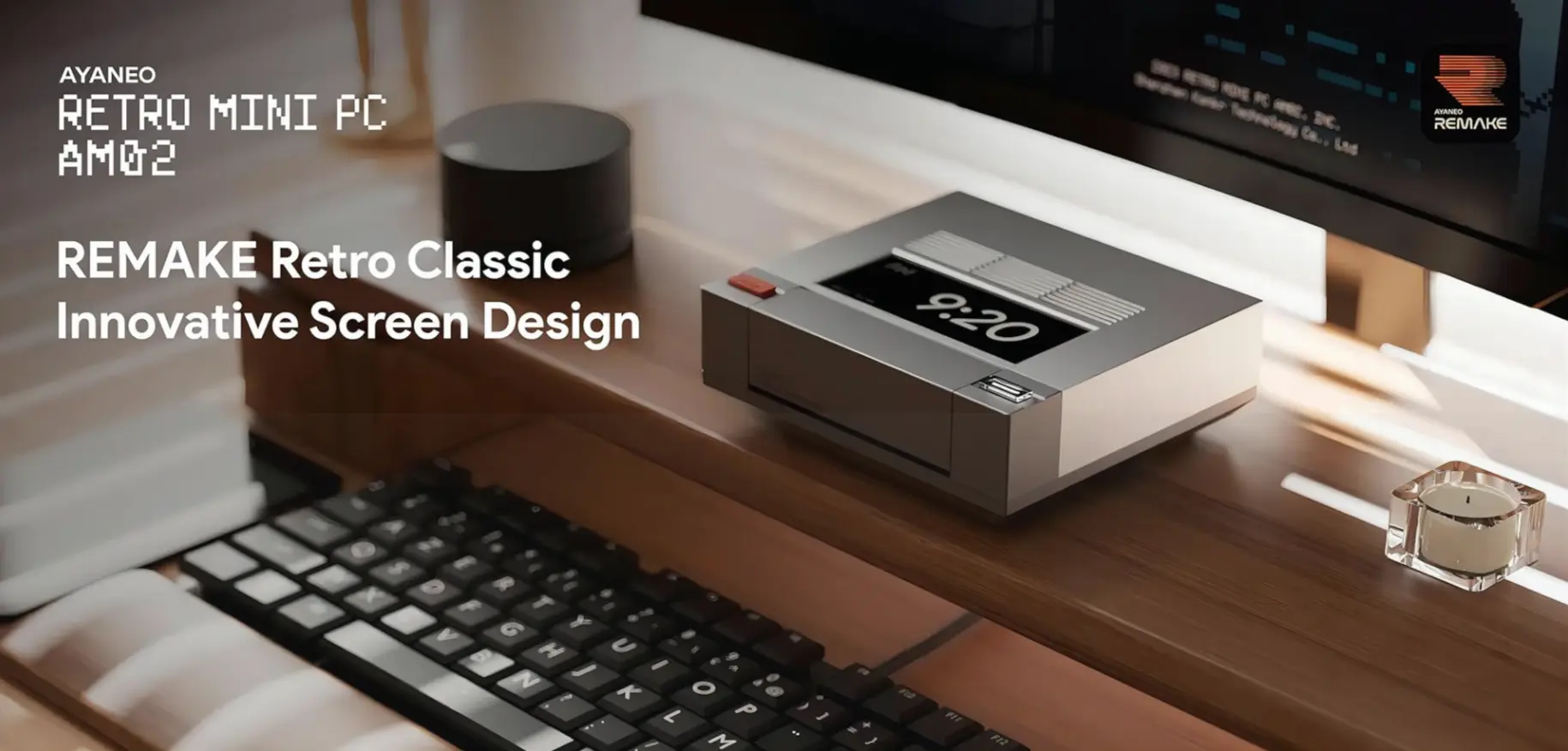
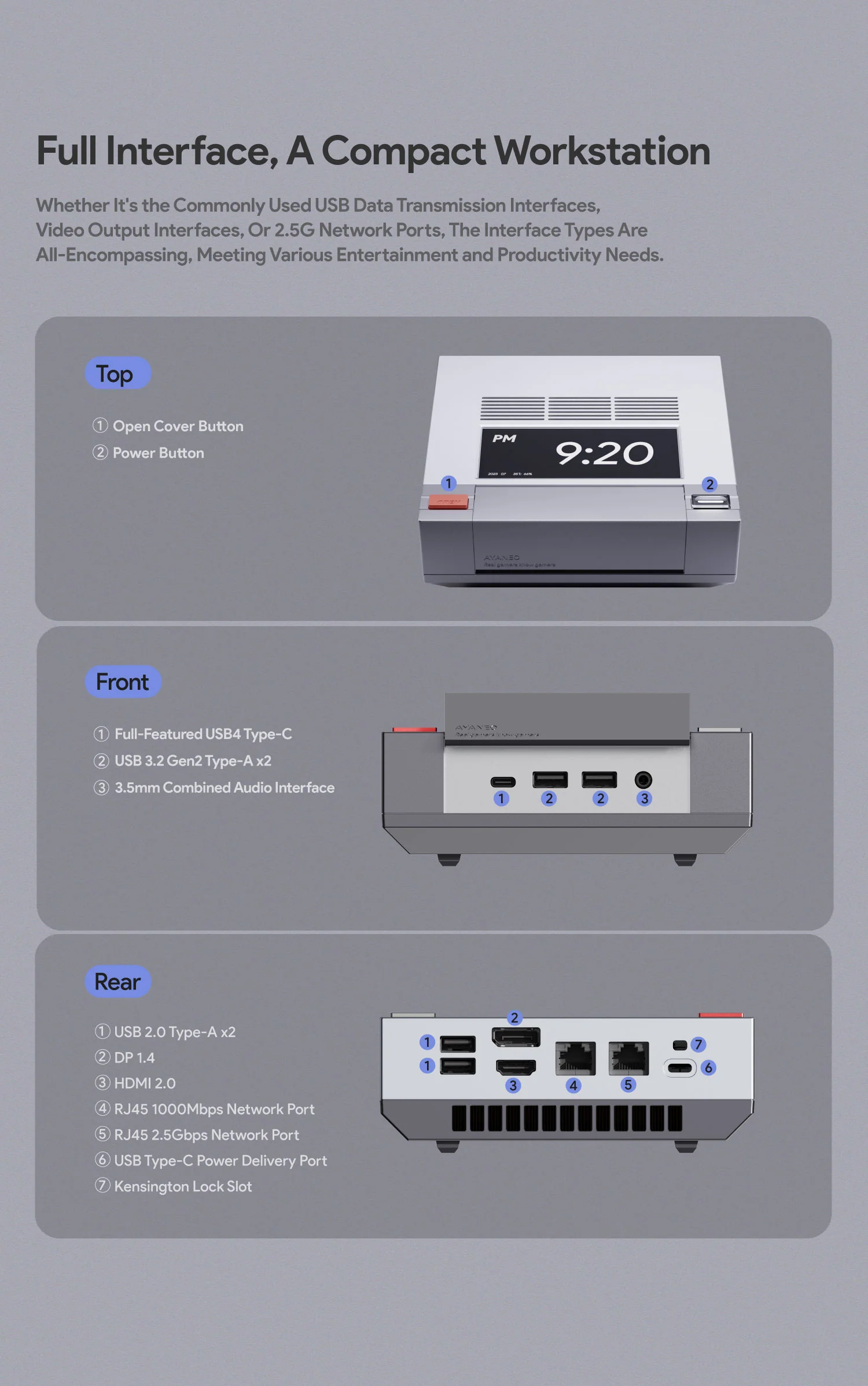
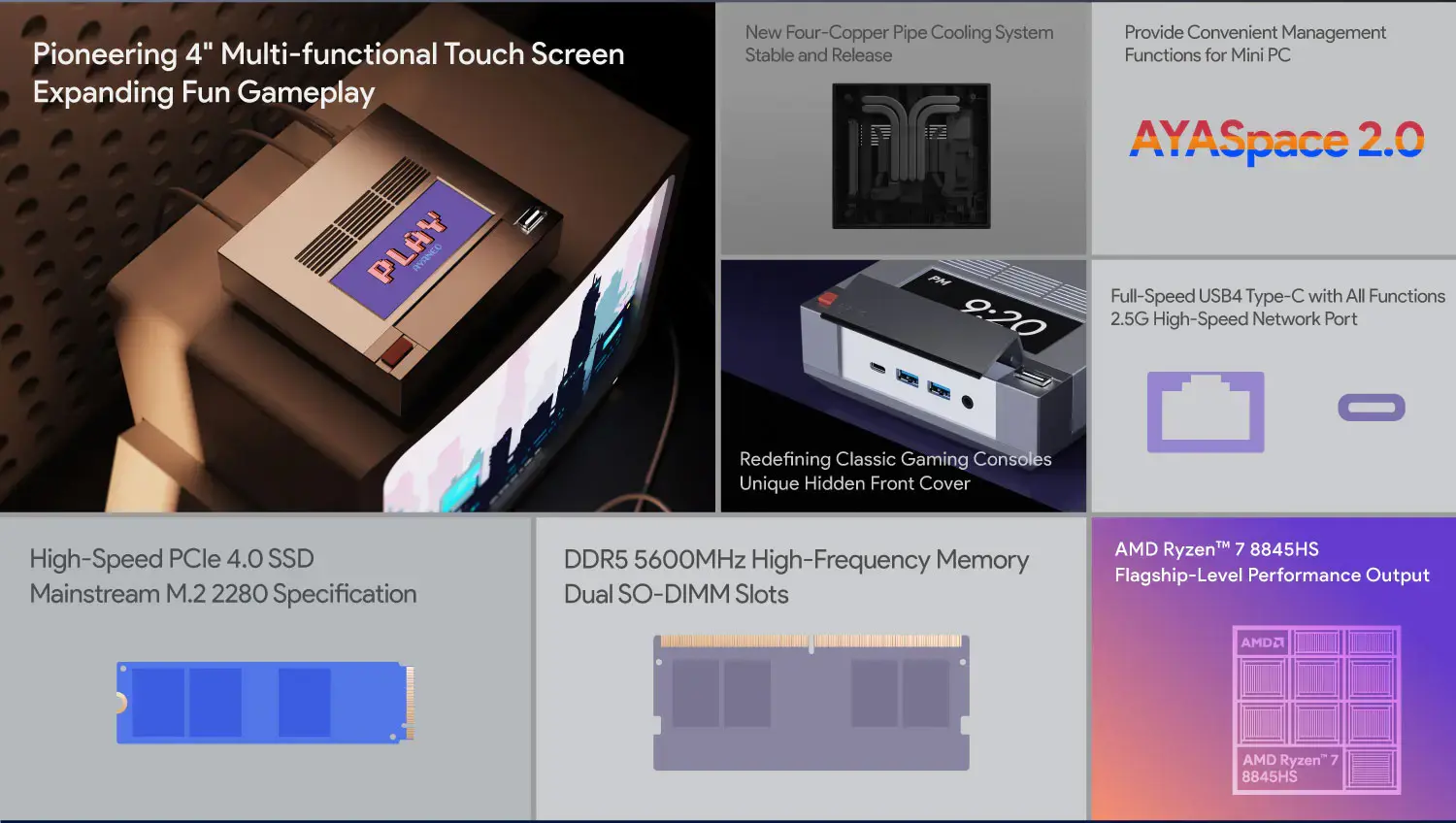
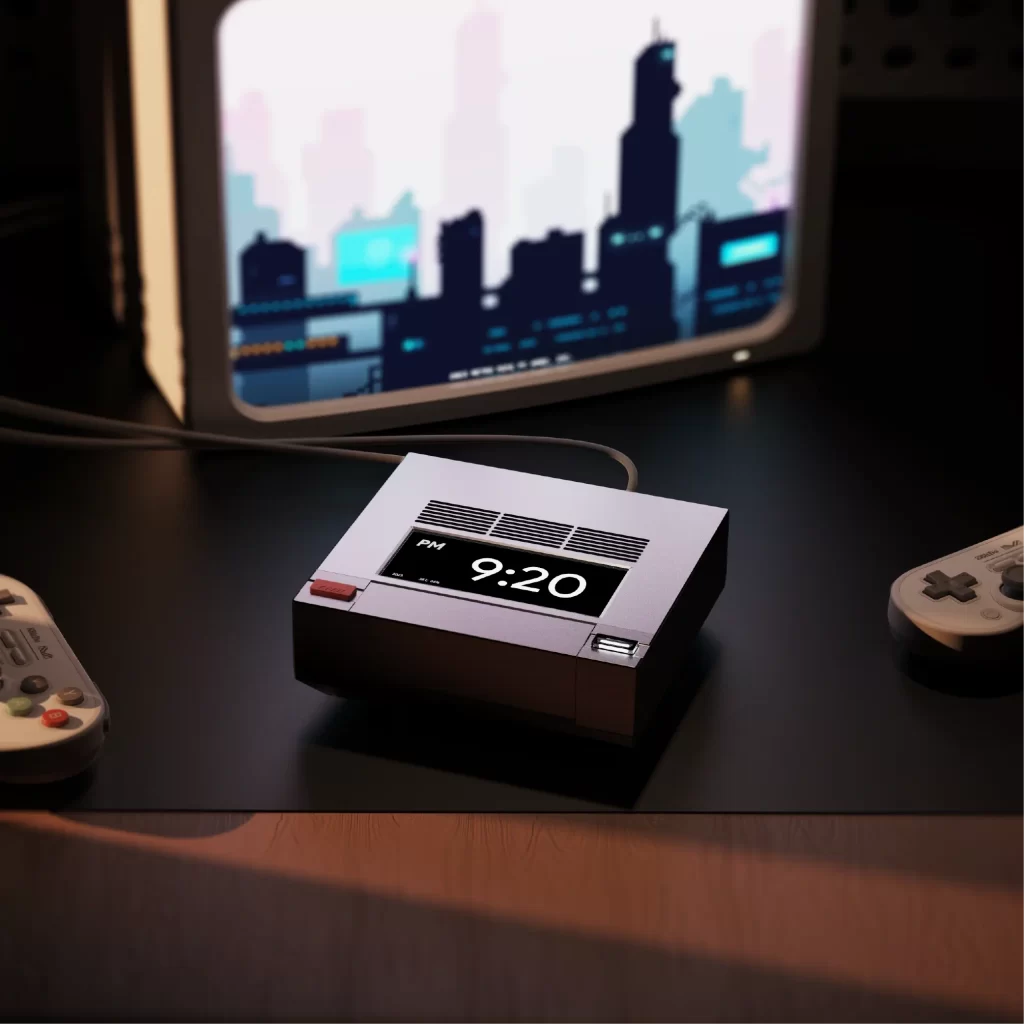
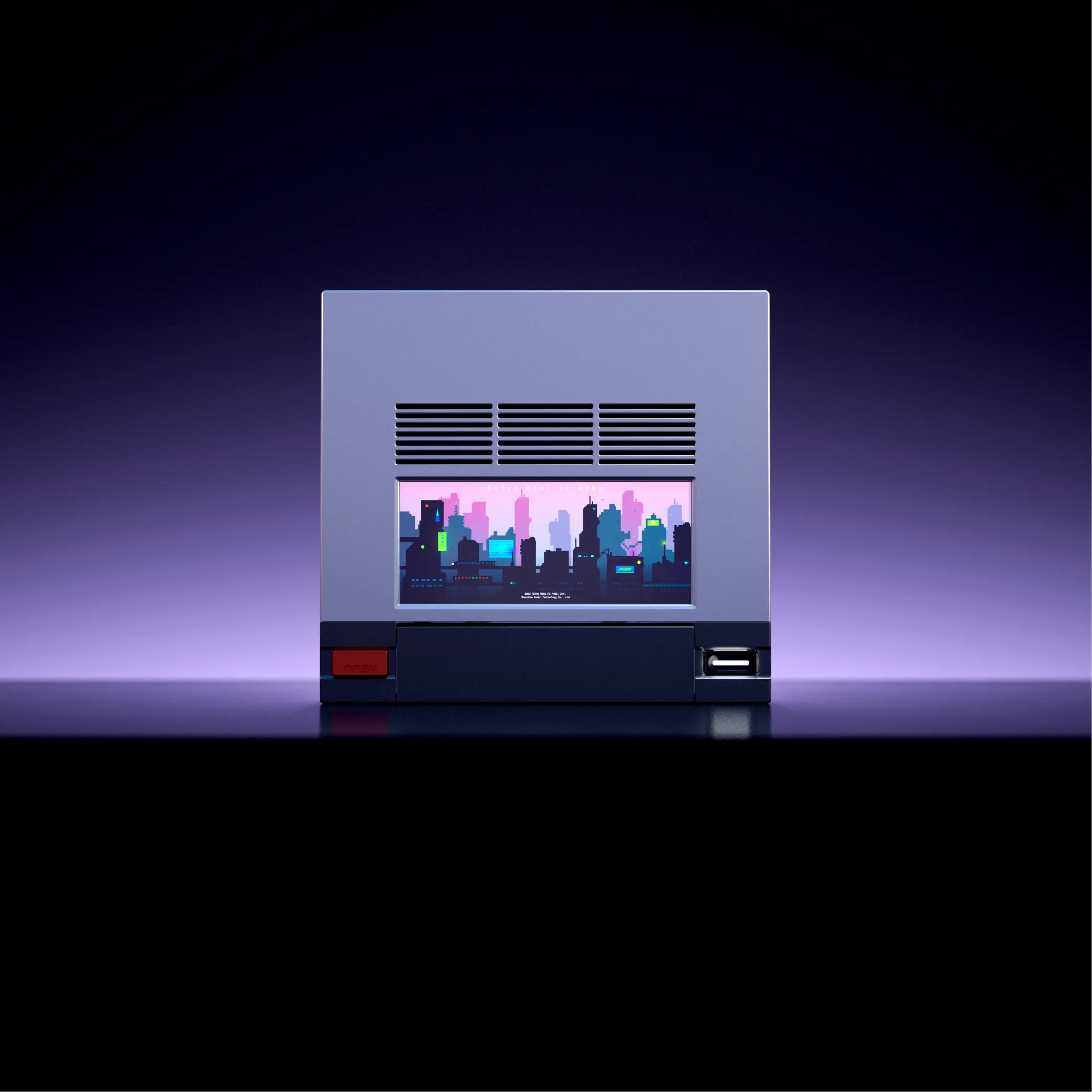
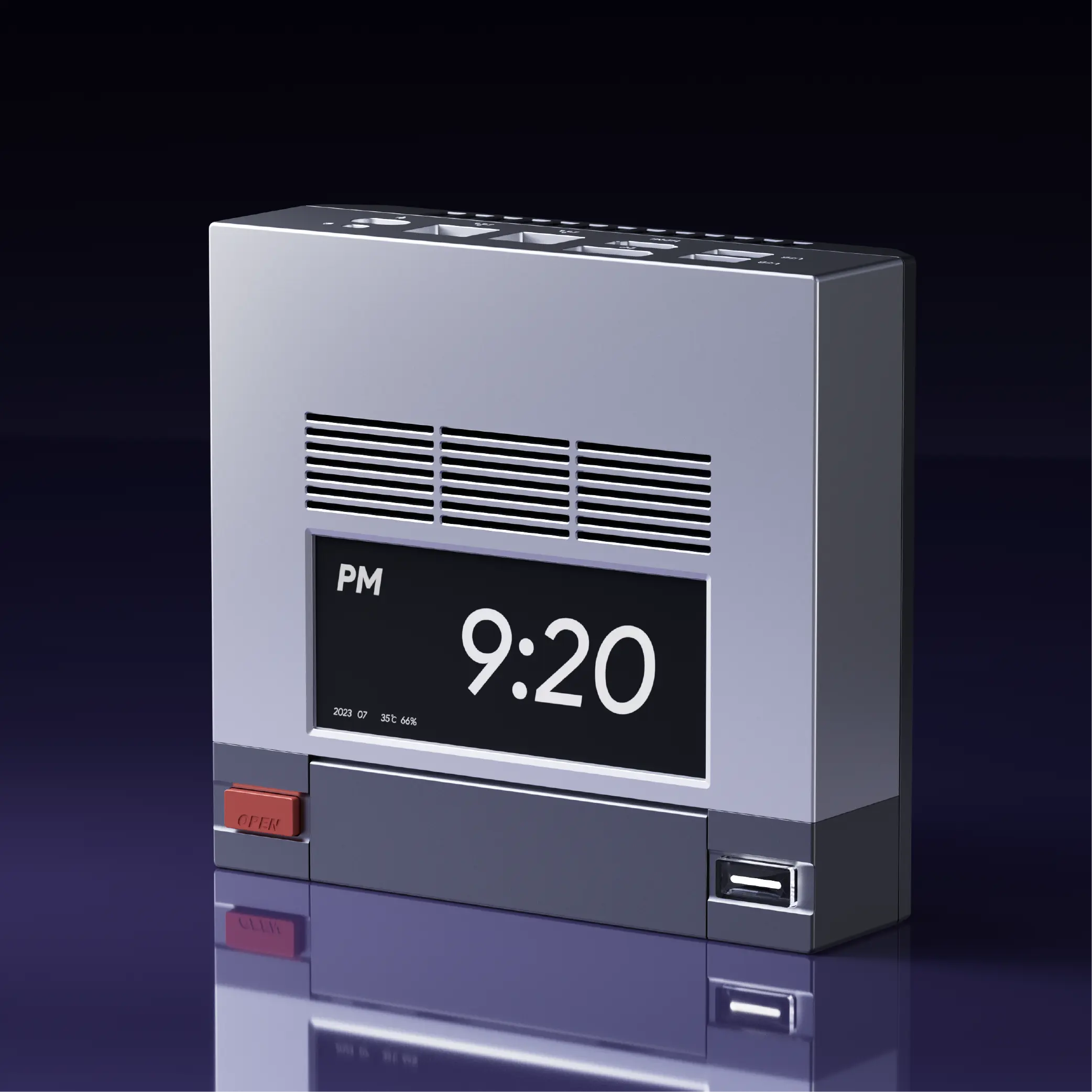
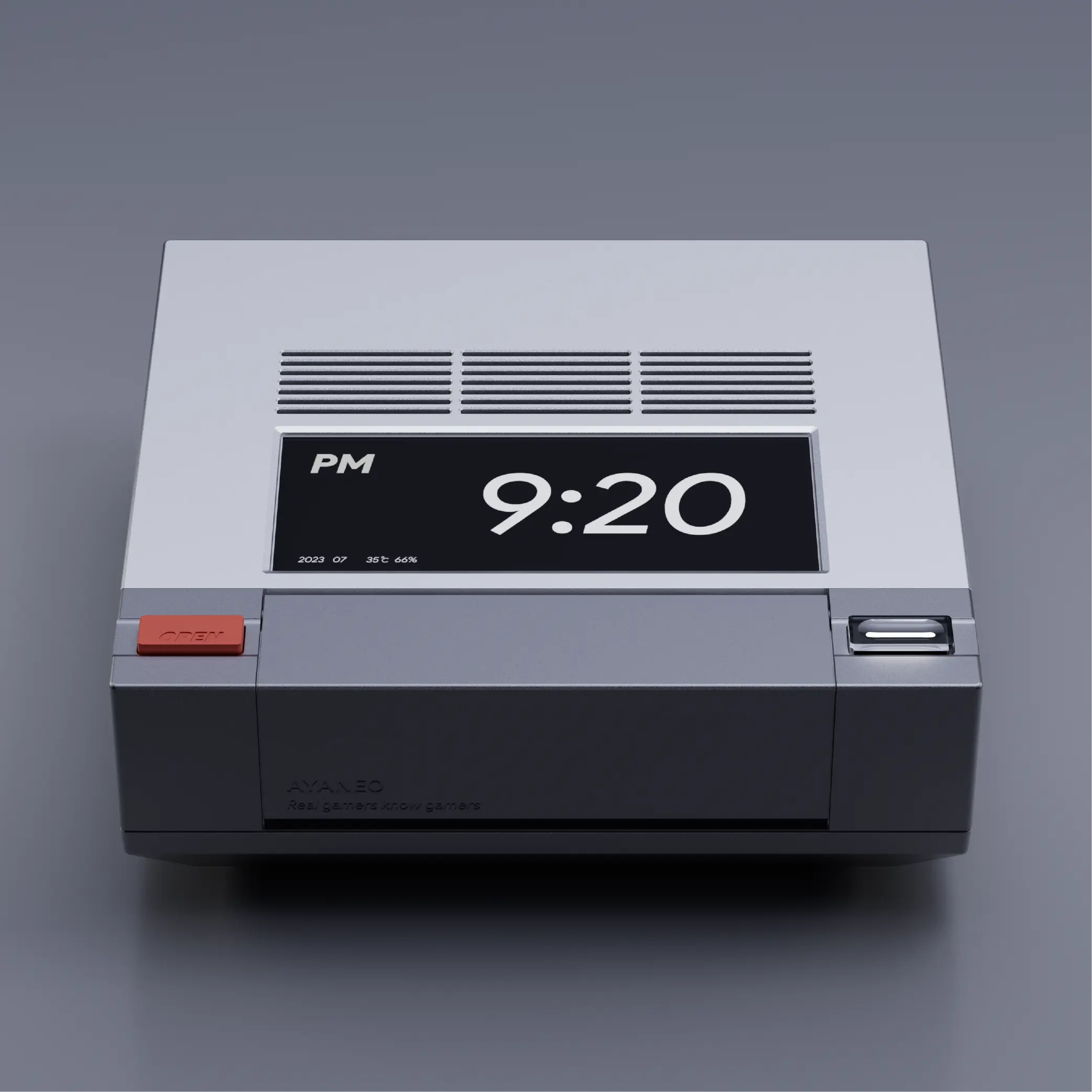
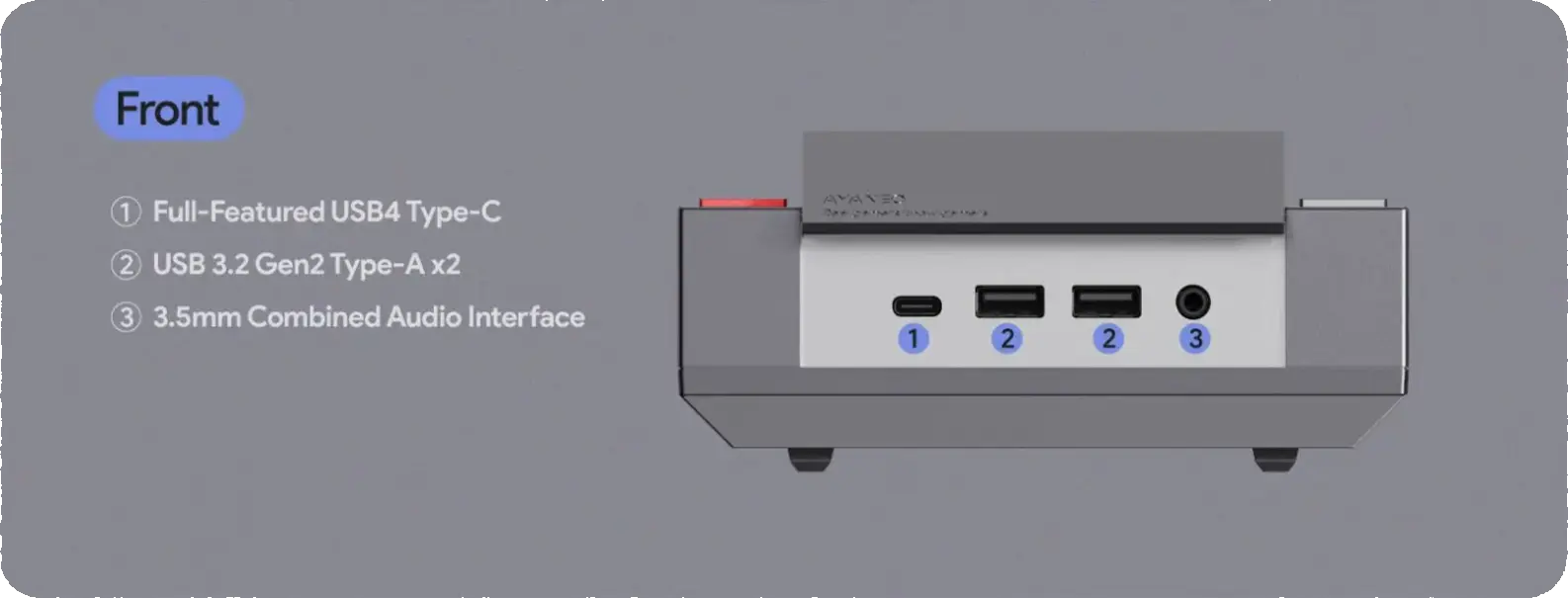
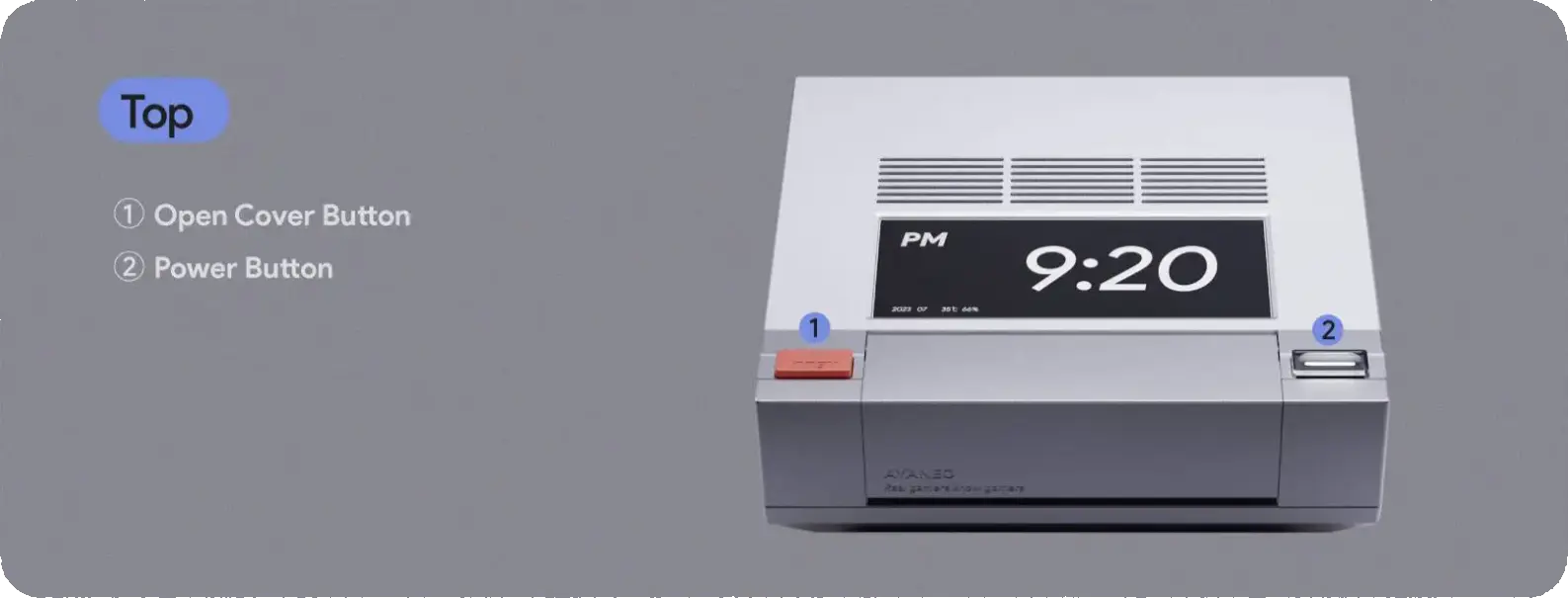
The flip-down front panel — activated by the large red button on the left side of the top surface — drops to reveal the front IO ports in a recess proportioned exactly like the cartridge loading area of a North American NES. Not approximately. Not as a loose reference. With a fidelity that suggests the product designer spent meaningful time with an actual NES measuring things. Press the button and the cover drops: a movement that combines the mechanical satisfaction of a physical console interaction with the functional result of revealing a USB4 port, two USB 3.2 Gen2 ports, and a 3.5mm audio jack. GamesRadar noted that the lip of the cover replicates the feel of the NES cartridge slot, while the button position evokes the SNES — a layered retro reference that rewards the observant. It is elegant, tactile, and easy on the eye.
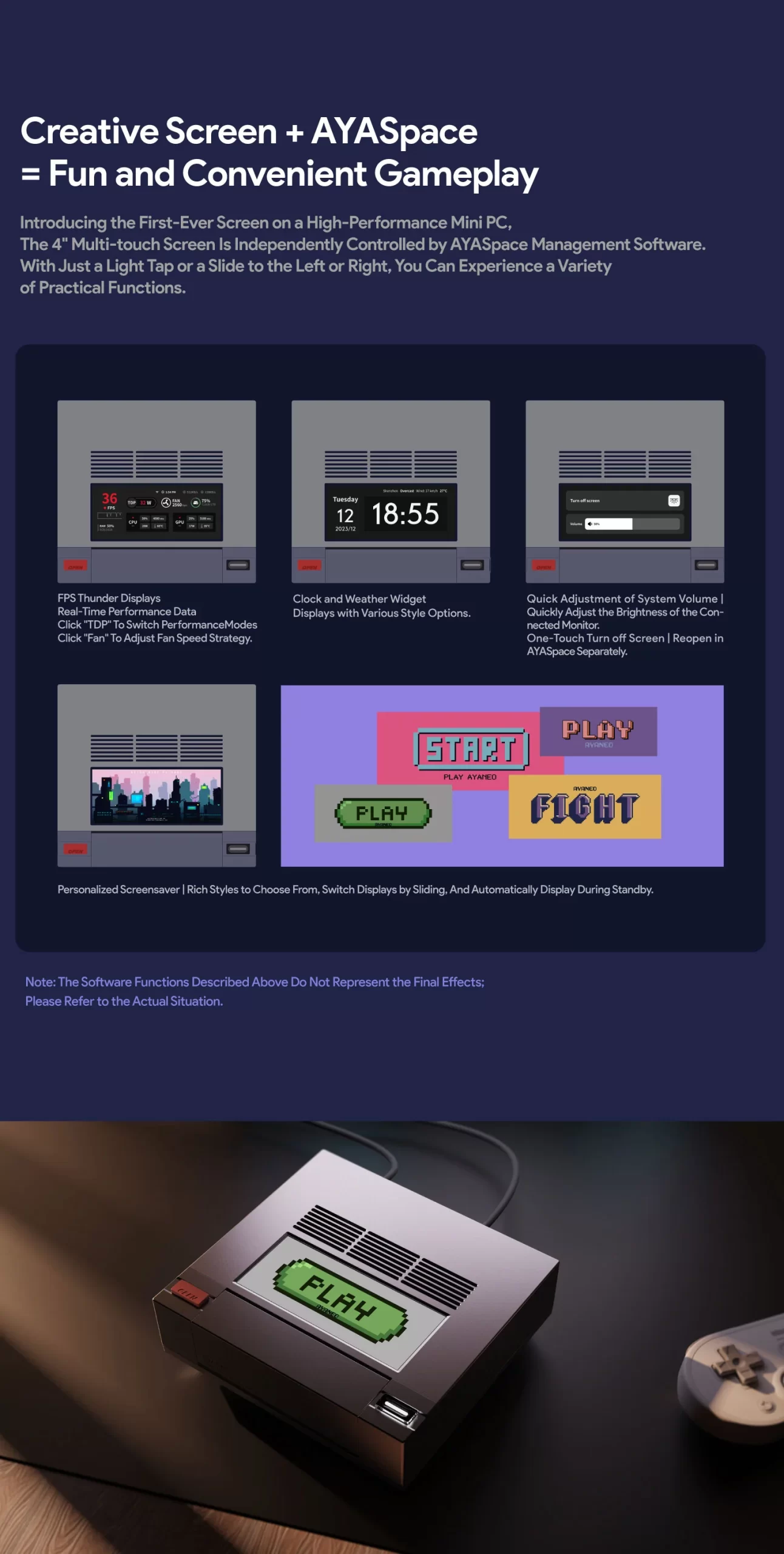
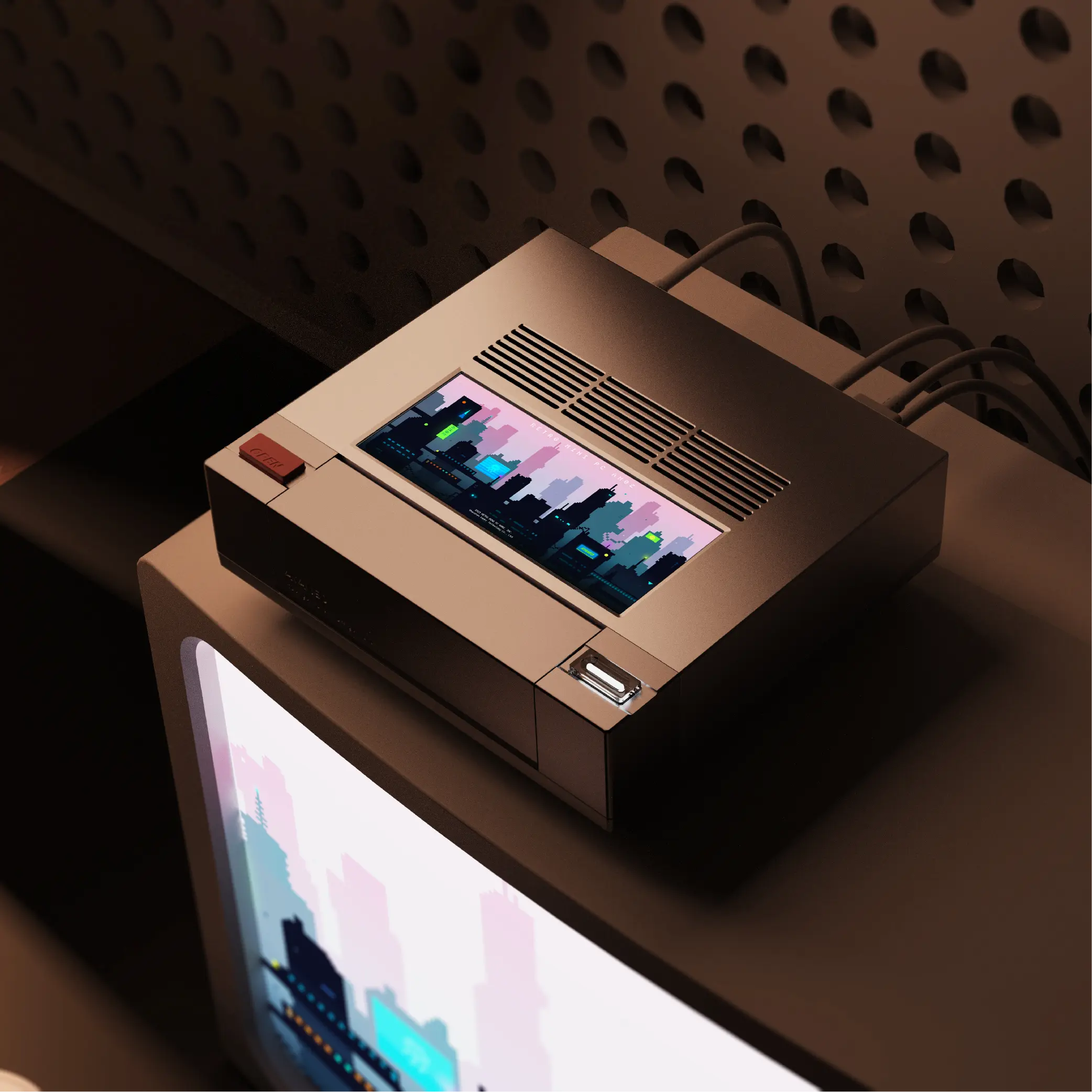
Above it, on the top surface, sits the four-inch LCD touchscreen. This is where the retro-futurist aesthetic takes over from the pure period homage — a screen of this kind would have been science fiction on the original hardware. Its presence reads as exactly what it is: a component from AYANEO’s handheld gaming PC lineage, adapted for the mini PC context and styled to fit a machine that is otherwise channelling 1985. It works. PC Gamer described the overall effect as something “you’d expect to see in the background of a sci-fi anime.”
Inside: AMD Ryzen 7 7840HS and the Physics of Nostalgia
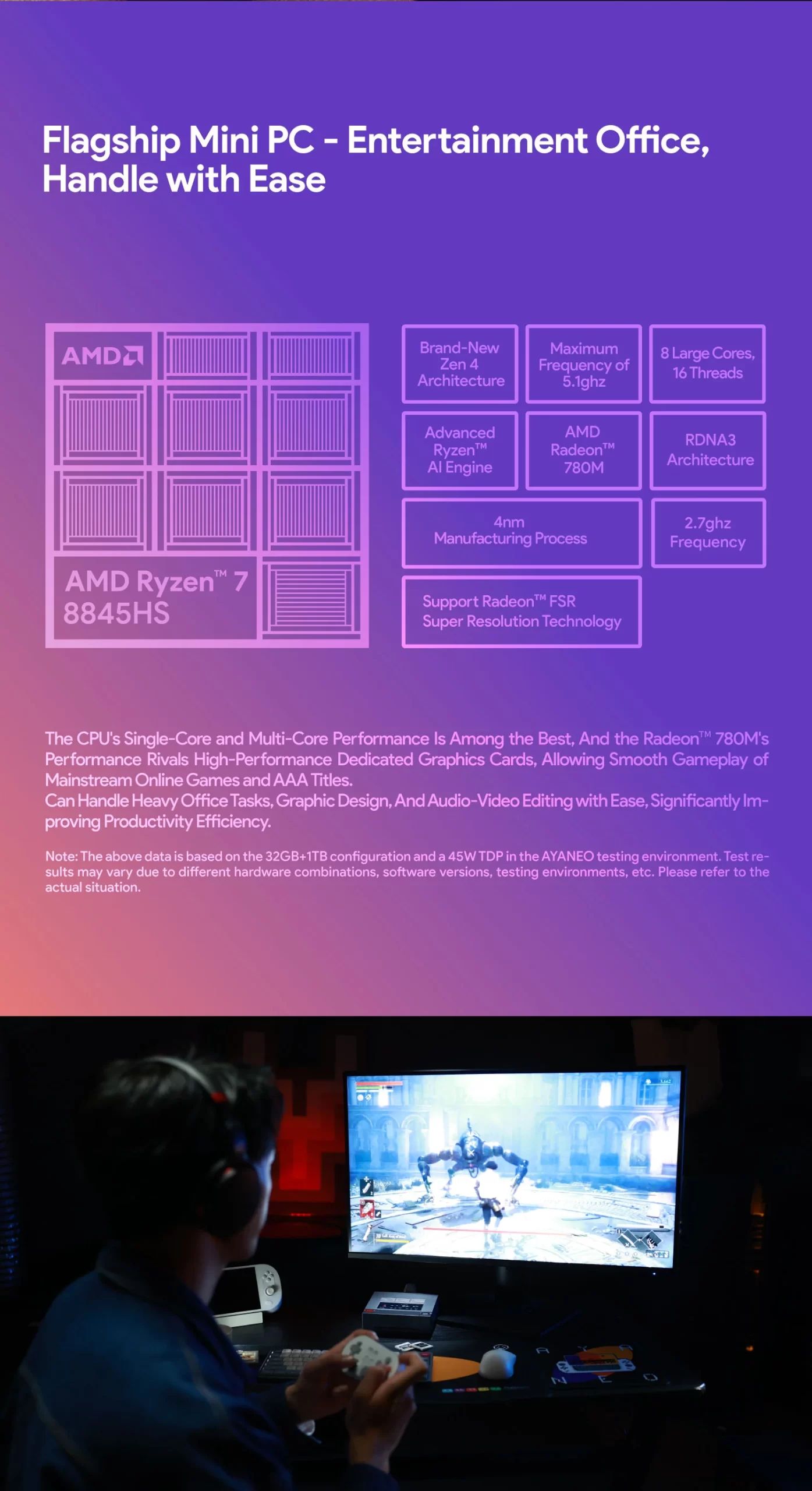
The Ryzen 7 7840HS is eight Zen 4 cores, sixteen threads, 5.1 GHz boost, four nanometres. It is the processor that powered the best gaming handhelds of 2023 and 2024 — the ASUS ROG Ally, the Lenovo Legion Go, the GPD Win 4 — and it translates directly into the mini PC context with the advantage of a more generous power envelope. Where handhelds typically limit the 7840U (the efficiency-tuned sibling) to 15–25W for battery life reasons, the AM02 runs the 7840HS at 45W sustained, which gives it substantially more thermal headroom and therefore more sustained performance.
Liliputing’s benchmarking found the AM02 achieving a Cinebench R23 Multi Core score of approximately 15,991 and Single Core score of 1,773 — matching AYANEO’s own published figures, which is rarer in this market than it should be. More strikingly, the AM02 actually outperformed the GEEKOM A7 — a system built around the higher-tier Ryzen 9 7940HS — in several benchmarks. The reason, as Liliputing’s reviewer concluded, was the effectiveness of the AM02’s four copper heat pipe cooling system in sustaining boost frequencies under load, where many competing mini PCs thermally throttle before the 7840HS can demonstrate its full capability.
DROIX recorded idle power consumption of 25.6W and peak consumption of 89.4W under Cinebench stress — figures that place the AM02 among the more efficient systems in its performance class, and that mean the machine runs on the kind of power adapter that fits in a bag without complaint.
What the 7840HS does not include is a neural processing unit. The AM02 is not a Copilot+ PC. It will not run Windows 11’s Recall feature, live AI caption translation, or AI image generation. In 2024, when the AM02 launched, this was entirely unremarkable — NPU-equipped consumer mini PCs barely existed. In 2026, with Strix Point systems offering 50–55 TOPS of NPU acceleration sitting alongside the AM02 in the market, the gap is visible. Buyers who need local AI inference capability should look at newer systems. Buyers who need a retro gaming machine and a capable productivity desktop should keep reading.
The Radeon 780M and the Art of Being Enough
The integrated Radeon 780M GPU — 12 RDNA 3 compute units at 2.7 GHz — is not the most powerful integrated graphics available in 2026. The Strix Point 890M has more compute units, a more advanced architecture, and substantially better AI acceleration. The 780M is the GPU that powers the AM02, and for the AM02’s actual use cases, it is more than enough.
For retro gaming and emulation — the AM02’s declared purpose — “more than enough” is not faint praise. It is the correct description of a system that can run every major emulation target from the NES through to the PlayStation 3, Nintendo Switch, and original Xbox without meaningful performance constraints. RPCS3 — the PS3 emulator, widely considered one of the most CPU and GPU demanding emulation targets available — runs at native resolution on the AM02 with “only some hiccups” in demanding titles, according to overkill.wtf. For less demanding platforms, the AM02 is, as the same reviewer put it, “absolute overkill.”
For modern PC gaming, the 780M handles eSports titles and lighter releases with ease, and pushes demanding AAA games to playable frame rates at 1080p with reduced settings. overkill.wtf’s reviewer noted that Cyberpunk 2077 — a title that would have been unplayable on the AM01 — runs “straight-up enjoyable” on the AM02. DROIX found Forza Horizon 5 running at approximately 70 FPS at 1080p with mixed medium-high settings.
For users who eventually find the 780M’s ceiling, the USB4 port under the front cover provides eGPU connectivity — a point that overkill.wtf’s reviewer specifically anticipated, looking forward to “figuring out what this can do hooked up to an eGPU.” OCuLink delivers higher bandwidth in dedicated eGPU configurations, but USB4 at 40 Gbps provides a meaningful fraction of a discrete card’s native performance through compatible enclosures.
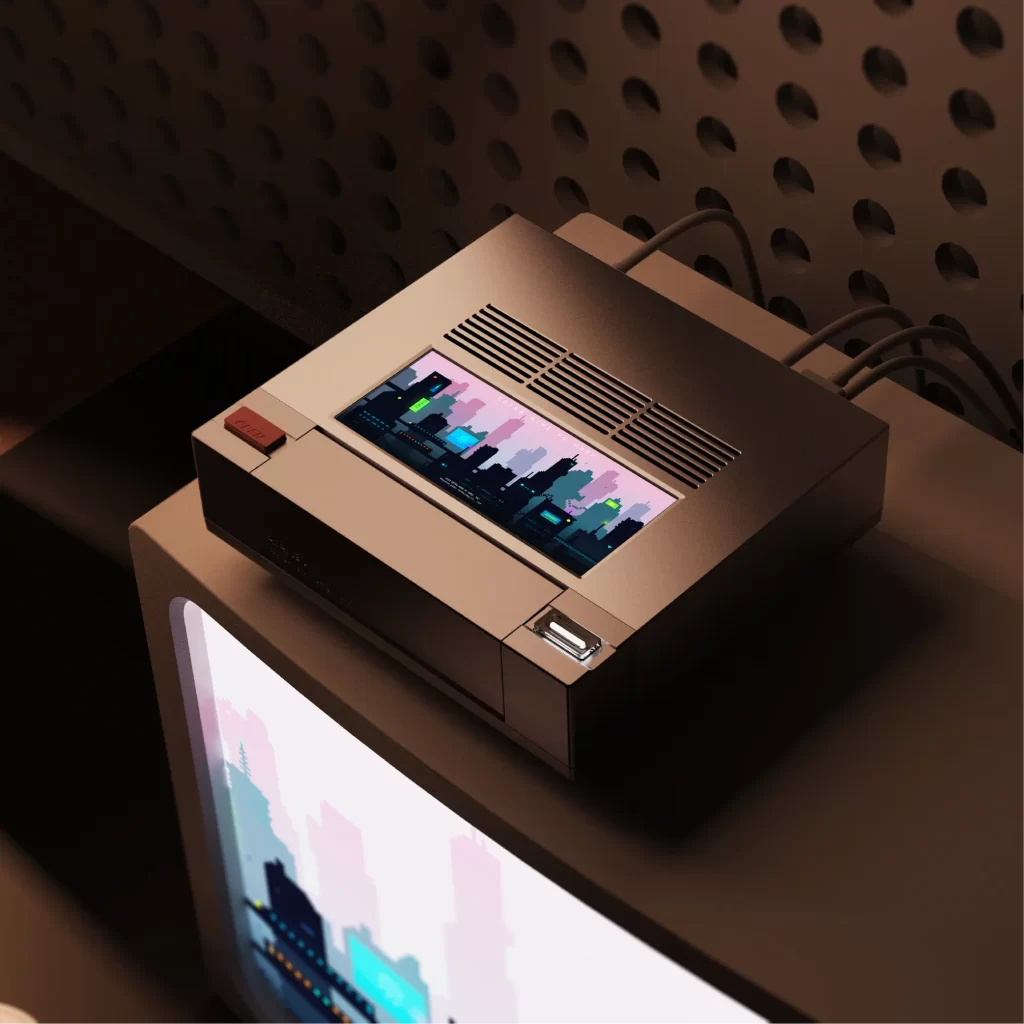
The Four-Inch Screen: Gimmick, Utility, or Both?
The multifunction touchscreen on the AM02’s top panel is the most debated element of the machine across its critical reception. One reviewer called it “mostly a gimmick.” GamesRadar called it “a bit of flair to your gaming desk.” Handheld HQ called it genuinely useful. The truth is that it is all three of these things simultaneously, and which one it is depends on how you use it.
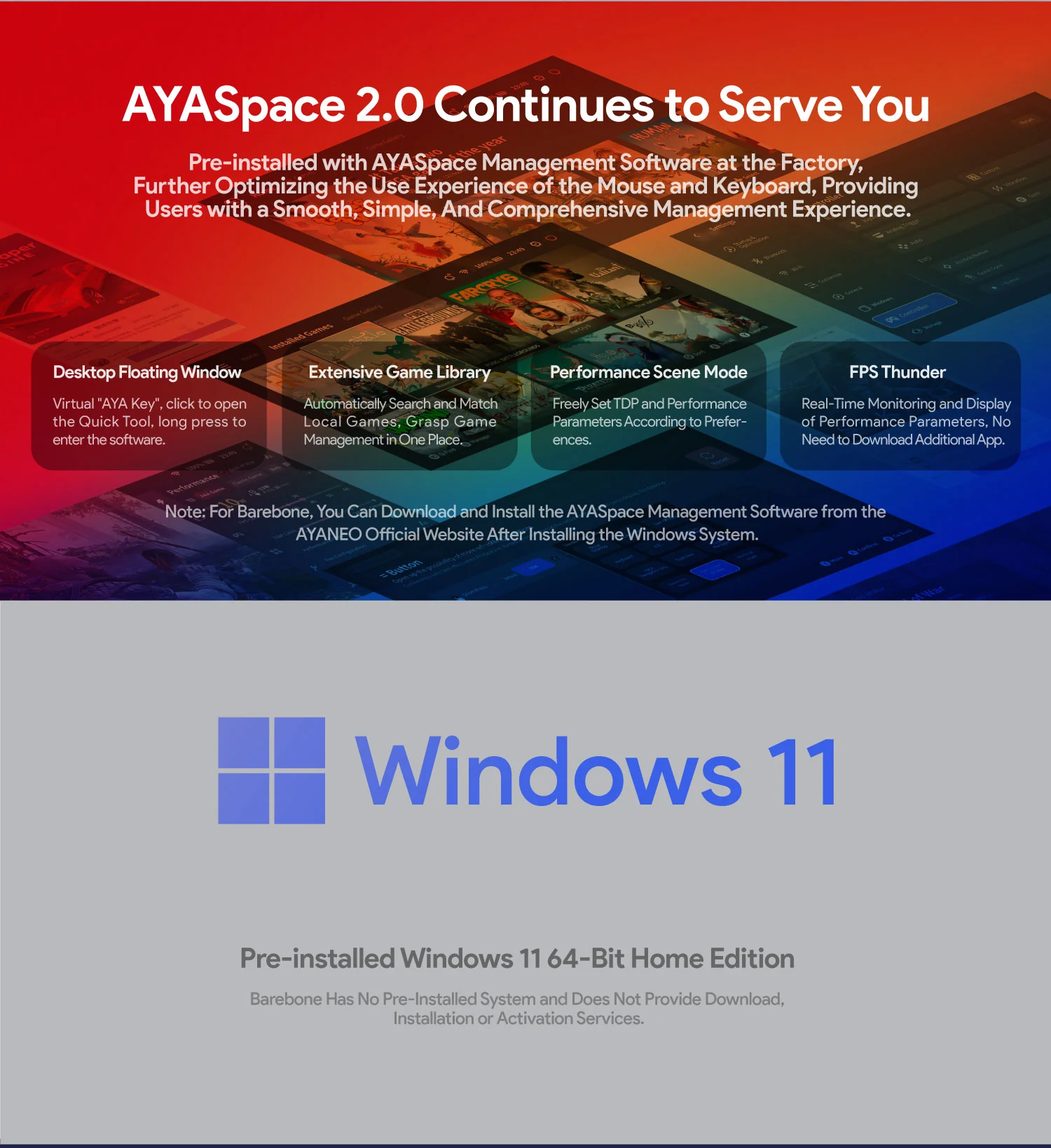
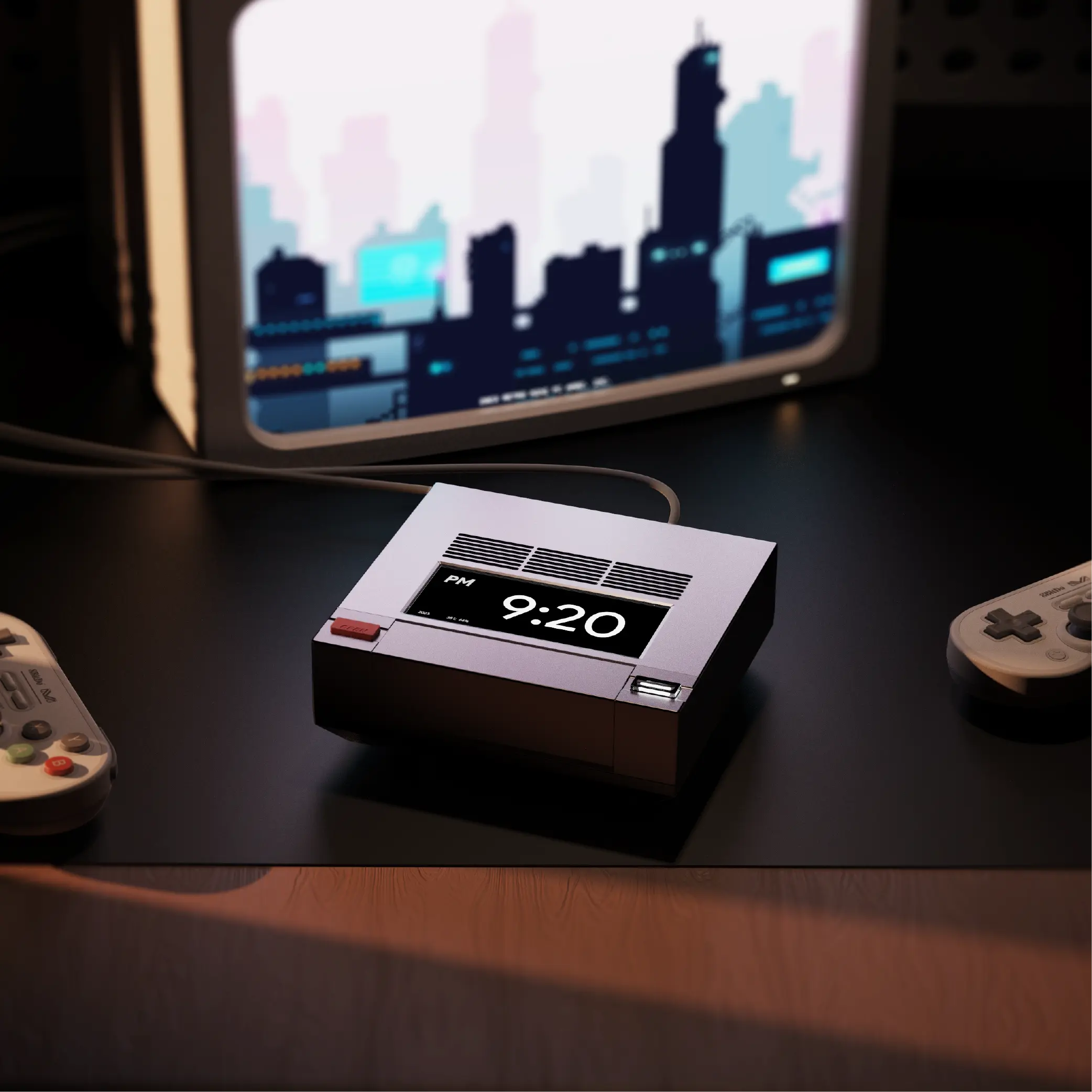
The screen runs AYASpace — AYANEO’s system management software — and displays swipeable panels: live performance metrics (CPU and GPU temperature, clock speeds, power draw, fan speed), a 24-hour clock with several aesthetic face options, and a live performance graph. The practical value of the performance data is clear: monitoring thermals and frame rates without an on-screen overlay is genuinely useful during gaming sessions, freeing the primary display from HUD clutter. The ability to tap to adjust power profiles without opening any software on the main screen is similarly practical — switching the AM02 between efficiency mode and performance mode takes one tap on the top panel rather than navigating a software menu.
The clock face and aesthetic screensaver options are, by honest admission, decorative. They make the AM02 look interesting sitting on a desk, which is a legitimate value proposition for a machine whose design is explicitly its differentiating feature. Whether you find a four-inch screen showing a stylised clock face useful, appealing, or both depends on how much you value desk aesthetics — but it is, at minimum, more interesting than the equivalent space on every other mini PC in the market, which is typically an unmarked flat surface.
Two genuine caveats: early firmware versions had occasional desyncing issues where the screen would stop displaying live data and require an AYASpace restart, and the screen runs warm to the touch under sustained operation. Both have been addressed in subsequent software updates, but buyers running older firmware should be aware.
Connectivity: More Than the Chassis Suggests
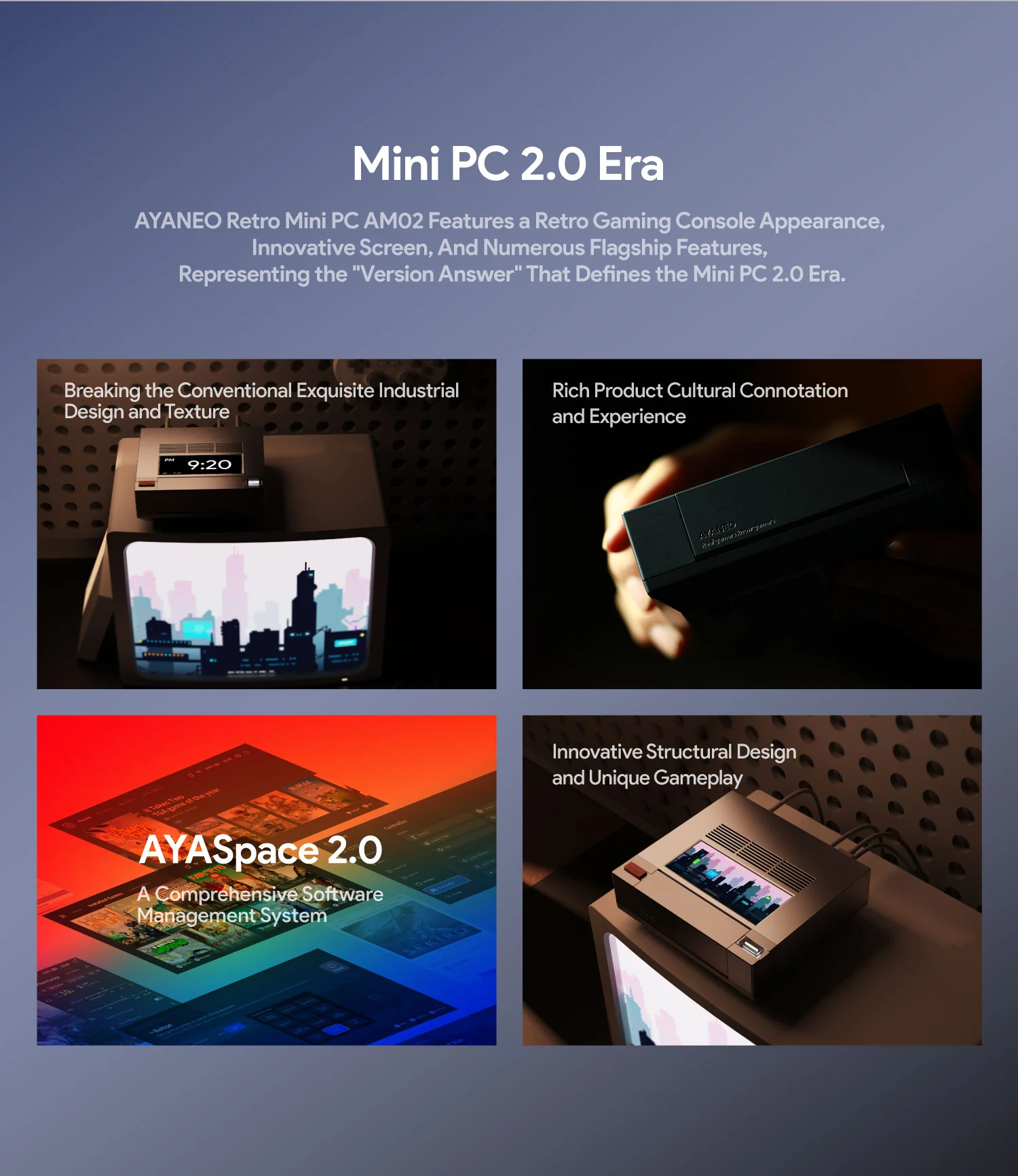
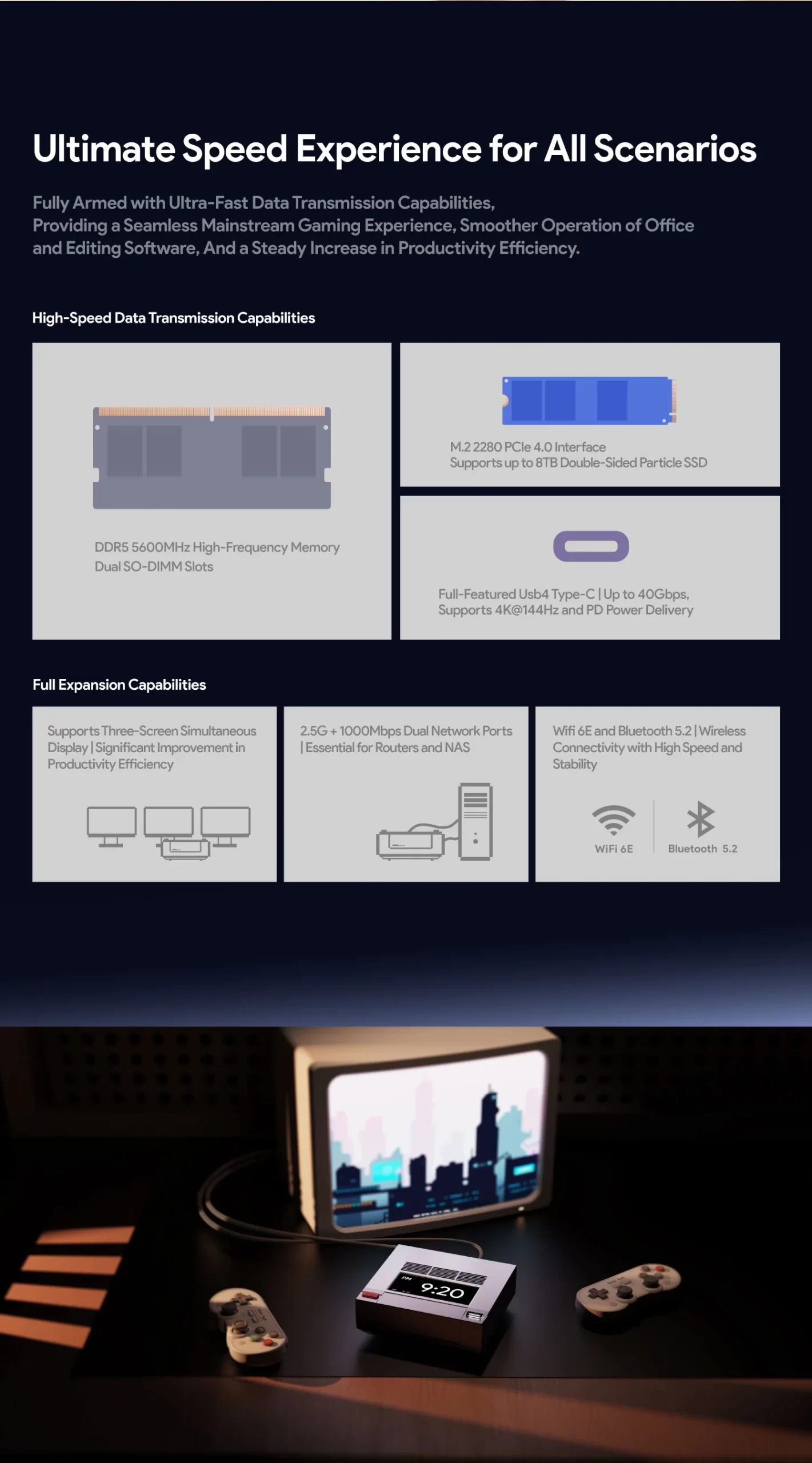
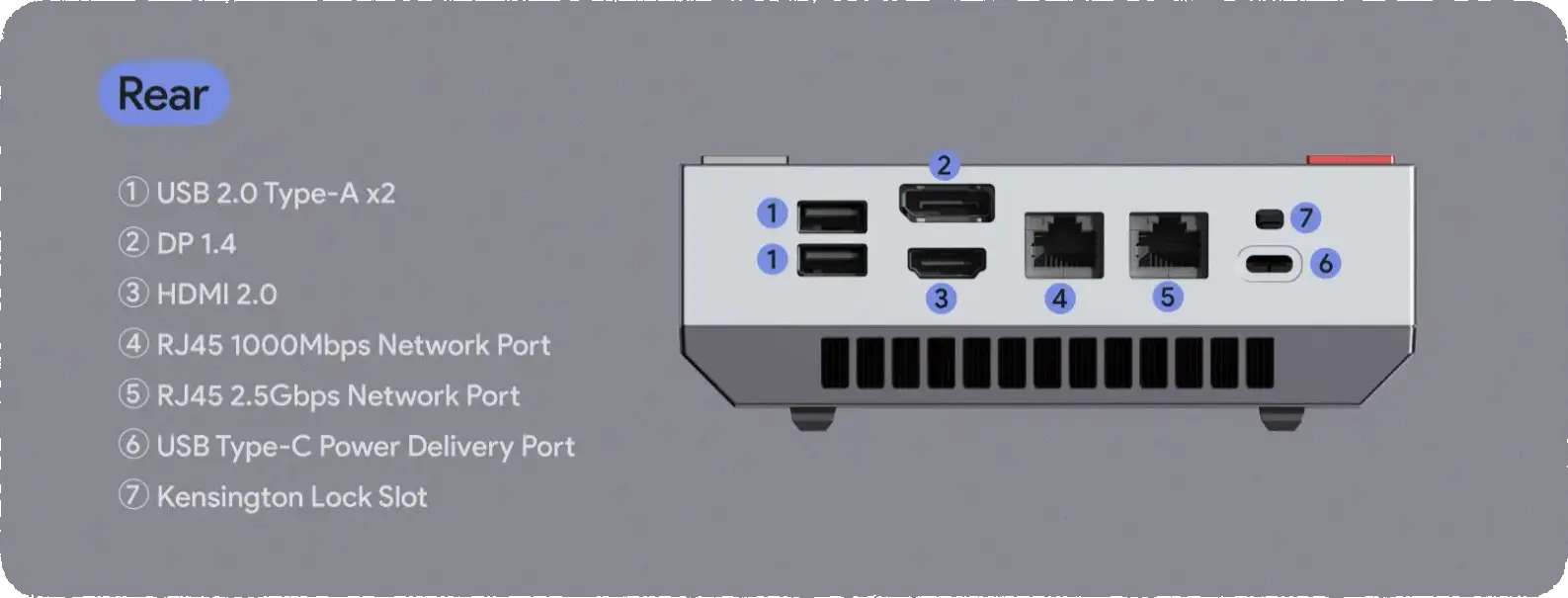
The AM02’s port selection is surprisingly comprehensive given its size and the space claimed by the flip-down front cover mechanism. The front compartment holds a USB4 (40 Gbps), two USB 3.2 Gen2 Type-A (10 Gbps), and a 3.5mm audio jack. The rear provides HDMI 2.0 (4K@60Hz), DisplayPort 1.4 (4K@144Hz), two USB 3.2 Gen1 Type-A (5 Gbps), and — notably — dual 2.5 Gigabit Ethernet.
The dual 2.5 GbE is worth pausing on. At the AM02’s price point, a single Gigabit Ethernet port is the norm; 2.5 GbE is an upgrade; dual 2.5 GbE represents a genuinely unusual networking specification for a machine in this category. It allows simultaneous connection to two separate wired networks — practical for NAS direct-attach setups, home lab network isolation, or link aggregation on compatible switches. For a machine positioned as a retro gaming platform that also does double duty as a home server or productivity desktop, dual 2.5 GbE is a meaningful practical feature that most buyers will appreciate.
Wi-Fi 6E (802.11ax) with Bluetooth 5.2 covers wireless connectivity, including the 6 GHz band for reduced congestion in dense wireless environments. The triple display output across USB4, HDMI, and DisplayPort covers multi-monitor productivity and living-room TV setups without requiring adapters.
Comparing the AM02 to the ACEMAGIC Retro X5: A Tale of Two Generations
The question inevitably arises: how does the AM02 compare to the ACEMAGIC Retro X5, the other NES-inspired mini PC that now exists in the same market?
The answer is that they are not, in any practical sense, competing for the same buyer. The AM02 launched in February 2024 at $529 for the 32 GB / 1 TB configuration. The Retro X5 launched in March 2026 at approximately $940 for the same memory and storage tier, with AMD’s Ryzen AI 9 HX 370 inside — a chip released eighteen months after the 7840HS, with 50% more CPU cores, a 50 TOPS NPU, more capable integrated graphics, and Copilot+ certification. The price gap is approximately $400, and the hardware gap between the 7840HS and the HX 370 is substantial in specific areas.
The AM02 is the better choice for buyers who: want the most characterful retro gaming mini PC available at an accessible price; do not need NPU-accelerated AI features; do not require the latest Copilot+ Windows 11 capabilities; and want a machine that they can carry in a bag to a friend’s house without thinking twice about the weight or footprint. It is also the only mini PC in existence with a four-inch touchscreen displaying a 24-hour clock on the top panel, which is either irrelevant or decisive depending on the buyer.
The Retro X5 is the better choice for buyers who want maximum hardware performance within the retro gaming aesthetic, who intend to run local AI models, and who want a machine that will remain current-generation hardware for longer. It does not have a touchscreen. It has a tool-free top cover instead. It costs significantly more.
Both are valid products. Neither makes the other redundant. The AM02 pioneered the category. The Retro X5 escalated it.
The Verdict: A Machine That Fulfils Its Destiny
PC Gamer wrote that when configured as a retro gaming console, the AM02 “fulfils its destiny.” This is the most accurate critical assessment the machine received, and it captures something important about the AM02’s relationship to its design brief: it is not a productivity machine that happens to look like a NES. It is a machine that was designed with retro gaming as its emotional and aesthetic core, and it delivers on that brief with hardware adequate for the task and a physical presence that no competing system matches.
The limitations are real: the plastic chassis is not premium, the 7840HS has no NPU, after-sales support requires patience for international buyers, and the screen has quirks. None of these undermines the central case for the AM02, which is that it is a genuinely original piece of product design in a market that has forgotten how to be original, running hardware capable of decades of gaming history on a single device.
GamesRadar said they had “never been this hyped for a low-spec rig.” That sentence contains everything the AM02 needs to say for itself. A machine that generates genuine enthusiasm — the kind that makes experienced reviewers reach for superlatives — is doing something right that specification sheets alone cannot explain.
The NES launched in North America in 1985. The AM02 launched in 2024. Thirty-nine years separate them. The AM02 contains eight processor cores, runs at 5.1 GHz, and can play PlayStation 3 games. The only thing it shares with the original hardware is the way it looks — and it turns out that is enough to make people care about a mini PC in a way they do not usually care about mini PCs. That is not a gimmick. That is design.
Video:

| Configuration Options | ||||||||||||||||||||||||
|---|---|---|---|---|---|---|---|---|---|---|---|---|---|---|---|---|---|---|---|---|---|---|---|---|
|
||||||||||||||||||||||||
| Processor | ||||||||||||||||||||||||
|
||||||||||||||||||||||||
| Ports | ||||||||||||||||||||||||
|
||||||||||||||||||||||||
| Network | ||||||||||||||||||||||||
|
||||||||||||||||||||||||
| GPU | ||||||||||||||||||||||||
|
||||||||||||||||||||||||
| Internal Ports | ||||||||||||||||||||||||
|
||||||||||||||||||||||||
| Storage & RAM | ||||||||||||||||||||||||
|
||||||||||||||||||||||||
| Power | ||||||||||||||||||||||||
|
||||||||||||||||||||||||
| Others Specifications | ||||||||||||||||||||||||
|
||||||||||||||||||||||||
| Specification | ||||||||||||||||||||||||
|
||||||||||||||||||||||||


More information: Ayaneo AM02 on minis-pc.com
Discover our full Mini PC comparison: minis-pc.com
Article written for minis-pc.com — Mini PC Comparisons and Reviews